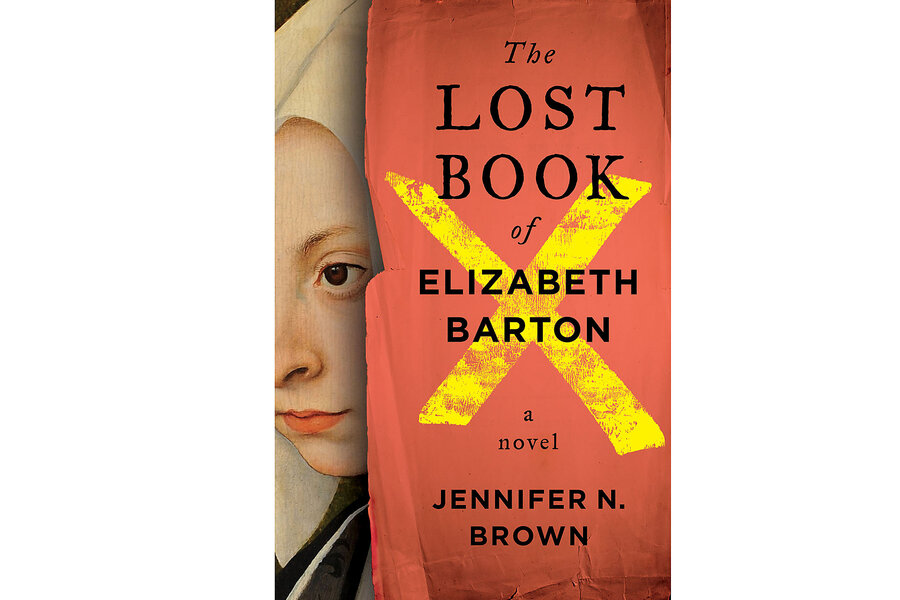
In what I affectionately refer to as my “mom book group” – started during the pandemic under heat lamps on a friend’s lawn – getting everyone to agree on a novel can be a challenge. If your book group, like mine, has competing tastes, “The Lost Book of Elizabeth Barton,” by Jennifer N. Brown, may be just the ticket. It is a plot-driven page-turner that weaves together historical fiction, academic satire, and detective fiction into a compulsively readable and intellectually rewarding book.
Like A.S. Byatt’s 1990 award-winning Possession, which intertwines the lives of Victorian poets with academics whose bread and butter is studying them, “The Lost Book of Elizabeth Barton” toggles between historical figures and the modern-day scholars hot on their trail. Here, the subject of scholarly scrutiny is the eponymous Elizabeth, a Roman Catholic mystic who spoke out against King Henry VIII and his plan to break from the pope and found a new church. Unlike Martin Luther’s principled stance – set forth in his 1517 treatise – Henry’s motive was personal and political, born of his desire to divorce his wife, Catherine, so as to marry Anne Boleyn. And, as head of the new church, he would wield absolute power. Religious dissent was a convenient crowbar to pry apart his marriage, a conflict that set in motion the mass persecution of Catholic loyalists.
Enter the prophesying Elizabeth Barton, appearing just as Henry was demanding that the pope grant his divorce. To be a female visionary was to have a voice in an era when few women did. It was also to risk manipulation by the male clergy, especially for the young, naïve, and unschooled. A female servant like Elizabeth occupied a rung of society from which there was little hope of ascent. Such servants slept on a bare floor, with little food or even the humblest creature comforts. Brown, a debut novelist and medieval scholar, renders Elizabeth’s rise from impoverished servant to popular prophetess in admirably human and complex terms. What began as Elizabeth’s visions or dreams were likely manipulated by the monk Edward Bocking, who “recorded” them.
Why We Wrote This
In Tudor England, women had little say over their lives. They could acquiesce to an arranged marriage, or become a nun. Still, some women found ways – then as now – to exert influence and power in religious, academic, and political circles that frequently excluded them.
Elizabeth’s popularity as one of the most prominent Catholic loyalists made her dangerous. She was tortured into a confession, executed by hanging, and had the dubious distinction of being the only woman whose head was placed on a spike alongside those of other traitors on London Bridge.
Her book of visions was ordered burned. That no copies exist makes for a tantalizing prospect for the aptly named (fictional) Dr. Alison Sage, wise in the way of books, if not always people.
Brown draws on her deep knowledge of the epoch for a compelling story full of fascinating period details, such as “priest holes” – human hideaways, key to the intrigue in both stories. Brown is especially attuned to women’s prospects; no matter if they were servants or middle class, their destinies were limited to arranged marriages or joining a convent. It’s gratifying, then, when Elizabeth’s point of view gives way to the savvy strategizing of Philippa, the prioress, and Lady Agatha Vale, who supports an underground network of priests while employing stratagems to ensure the financial security of her offspring – especially the girls. (One has to wonder how they would have felt about the recently appointed Archbishop of Canterbury – the first woman in the 1,400-year history of the Church of England to hold the position.)
The plot involving Alison’s residency at an elite scholarly retreat is a bit less compelling, perhaps because Alison can seem a bit credulous. That said, the satire is awfully fun, especially for readers with a taste for skewering professors (guilty!). I had some laugh-aloud moments when Alison is asked repeatedly by taxi drivers if her work involves a Renaissance Fair, and rolled my eyes along with her at a hypermasculine scholar fixated on falconry. Likewise, I felt pangs of recognition in the gender dynamics that leave Alison forever bearing the “mental load” of parenting.
Without giving away any spoilers, I’ll say that the end of Elizabeth’s story – the aftermath, really – is tremendously clever and satisfying (I literally wrote “chills!” in the margin of my copy). For those considering how resistance looks in the face of tyranny (purely for academic reasons, of course) a tale of women’s visions and stratagems may be just the thing.