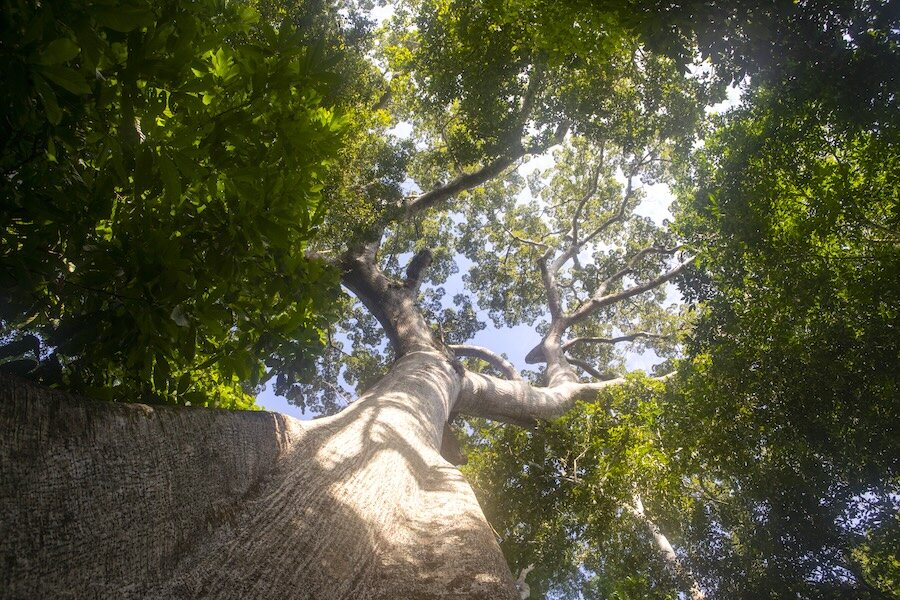
New data on global deforestation has the potential to infuse a breath of fresh air into conservation efforts and the world’s ongoing quest to balance environmental and economic priorities.
Findings released this week from the University of Maryland’s Global Land Analysis and Discovery laboratory show that tree loss worldwide registered a 14% decline from 2024 to 2025. More significantly, deforestation in tropical rainforests – which help regulate weather by absorbing carbon and releasing water vapor and oxygen – plummeted by 36%.
“Improved governance, recognition of Indigenous land rights and corporate commitments” helped spur these achievements in countries such as Brazil, Indonesia, Malaysia, and Colombia, noted the World Resources Institute. While the advocacy group and other environmental experts caution against reading too much into what may be a one-year “lull,” signs of progress are present.
Recent years have seen more countries engaging in measured policymaking and enforcement efforts; pursuing private- and public-sector cooperation; broadening civic engagement and participation of Indigenous peoples; and using technology such as satellite imagery to monitor performance. In addition, sophisticated financial instruments are also being used to incentivize forest protection. (This includes the Tropical Forests Forever Facility launched last November to target investment capital to countries maintaining low levels of deforestation.)
These trends of thought and practice indicate a shift away from what climate change critics have called alarmist or exaggerated tactics to more considered conversations that acknowledge both the ecological and economic value of forest resources.
When it comes to the Amazon – which makes up one-fifth of the world’s forests – “Its services are immensely valuable,” The Economist pointed out last October. “Treating its carbon storage, water regulation and biodiversity as services rendered, rather than free gifts – would make its preservation economically rational.” Conserving this resource, it said, requires “creativity, diplomacy and clear-sightedness.”
Such clarity can also be supported by a greater degree of humility and readiness to go beyond “expert” opinions and learn from local communities – and from nature itself. For instance, studies show that collaborative, community-based forest management can reduce tree cover loss by 55% to 66%, compared with areas overseen by government staff alone. And in early April, scientists expressed surprise and delight at what they discovered about nature’s rapid resilience. In the course of a four-year study of deforested areas in Ecuador, they found that complex ecosystems can recover in a few years or decades – rather than the century or more they had previously believed necessary.
“It’s been a huge surprise for all of us,” one of the study’s authors told The New York Times. “None of us expected it to be so impressive and so quick.”
The challenges of continued rainforest loss remain serious and extensive. Population and economic pressures are often compounded by corruption, poverty, and inefficiency in many countries. But, as the quality of governance, scientific inquiry, and democratic participation improve, so, too, can principled stewardship of the world’s natural treasures.