The complete ineptitude of their rivals has kept them at the top of Scottish politics
Last Wednesday was my sixtieth birthday and, the night before, Scotland’s election finally flamed into life during a leaders’ debate on Channel 4.
Weary of yet again being denounced as a racist, Reform’s Malcolm Offord wheeled on Scottish Labour chieftain Anas Sarwar: why, after a shared Question Time gig last December, had Sarwar approached him to say they should be “working together” against the SNP?
“Oh! Oh!” went John Swinney, like a shocked deputy head. Sarwar, naturally, flew into what — in Scotland — is technically termed a tartan fit: hot, puce-faced and in complete denial. The spin-doctors hit the mosh-pit the moment the credits rolled — though, by Friday, most thought the hustings would move on from spits of liar-liar-pants-on-fire.
Would that it had. “What began as a dispute over campaign tactics has descended into a personal and political slugfest,” Hannah Brown has rightly observed, “a level of toxicity that is hard to row back from.”
That crisp and calamitous Channel 4 exchange counted because it punched on the bruise central to this Scottish Parliament election.
As Paul Hutcheon — the estimable political correspondent of the Daily Record — put it months ago, the outcome hinges on two arguments put to the public, and on which prevails.
If Anas Sarwar can convince Scots that only Labour can get rid of the SNP, he would win. If, by contrast, John Swinney can persuade a critical mass that only the Nationalists can stop Reform, that would secure an unprecedented fifth term in Edinburgh office for the SNP.
Even before last Wednesday’s OK Corral, it was already an argument that the SNP was winning. Polls for months have shown themselves way out in front, with about a third to 40 per cent of the vote. John Swinney’s personal approval-ratings have swelled. All the other parties are stuck in the teens.
Indeed, in the poll of polls, the Scottish Tories and Liberal Democrats fall shy of 11 per cent apiece. One huge MRP study, featured last week in the Daily Telegraph, suggested not only that the Conservatives would lose all their constituency seats but that Reform could actually — on top of their gains on the regional-list ballot — make off with three.
Something is very far wrong when the three historic parties of British governance cannot, between them, muster 40 per cent of the Scots vote. Their ongoing vituperations, tas a priest once joked to me of hearing nuns’ confessions, are like being pelted to death with popcorn.
Meanwhile, retail politics unfolds all around us. Where local authorities still permit it, party colours now blaze on lamp-posts. As long ago as January, I had serious difficulty easing a tiny Liberal Democrat activist off my lot — till I was reduced to pointing out that the Liberals last won the Western Isles in 1931.
Several days back, I stole away in my car to elude the crofterly harms of Donald MacKinnon. Tiny and be-jeaned — he puts you in mind of a 14-year-old who has had slightly too many doughnuts — the Scottish Labour candidate for the Western Isles seemed even last autumn as sure a thing as a horse going over the last fence; now you can scent the momentum with the defending Nationalist, Alasdair Allan.
This was only reinforced by a remarkable public meeting, open to all comers, on a Stornoway evening just after Easter. John Swinney and Alasdair Allan sat affably without pomp or circumstance before some sixty local electors, took a host of questions, and thought aloud on weighty themes from social media abuse to whom they most fondly recalled as their personal political mentors.
Alex Salmond, for some strange reason, was not among them.
It was intimate, engaging and cosy, considering the cost of living crisis, Scotland’s potholed roads, inordinate delays at A&E, the worst drugs deaths stats in Europe, or that every year yet more of Scotland’s younglings pour out of our schools unable to read, write or count.
Or, indeed, that not a week earlier half the major vessels of the Caledonian MacBrayne ferry-fleet had either broken down or were uselessly in drydock having their bottoms scraped. Why was not half the Hebridean populace massed at the doors, gesticulating with scythes?
But no. Bumping into the perky Alasdair Allan several days later, there was not the least sense of defeat oozing from every pore.
Not for the first time, as the Holyrood campaign unfolds, the Nationalists are incrementally gaining support, no one can seem to agree which opposition outfit can be entrusted with the honour of carrying them off slaughtered, chopped, and bagged for the freezer, and the stumblings at Holyrood seem nothing in contrast to the unfolding dumpster-fire in Whitehall.
If you had, late in 2024, predicted, in the wake of scandal and humiliation and some helping of the police in their inquiries, that the SNP would be healthily topping the polls, Scottish Labour would be death-rattling at 18 per cent, and that Reform would be a settled and competitive force in Scotland’s politics, you would have been howled to scorn.
As recently as May 2013, trying to visit a bar on Edinburgh’s Royal Mile, Nigel Farage was literally run out of town. Last week he packed out an Aberdeen arena. Young people in Shetland sought selfies with him. Hitting a Glasgow pub, he was hailed with cheers and applause, men vying to shake his hand.
Over it all serenely sails the SNP. It’s rather like those tales you used to hear of some Friday night “domestic.” No sooner would hapless police officers have their mitts on a man who had just been throwing his missus off the walls when she’d start laying into said cops with her handbag.
In truth, and whatever our mid-term grousing, the SNP has long enjoyed embedded advantages. If you support independence — which almost half of the folk living in Scotland do, with a clear majority among home-grown Scots and folk of working age — then Scotland’s National Party will usually be your default vote.
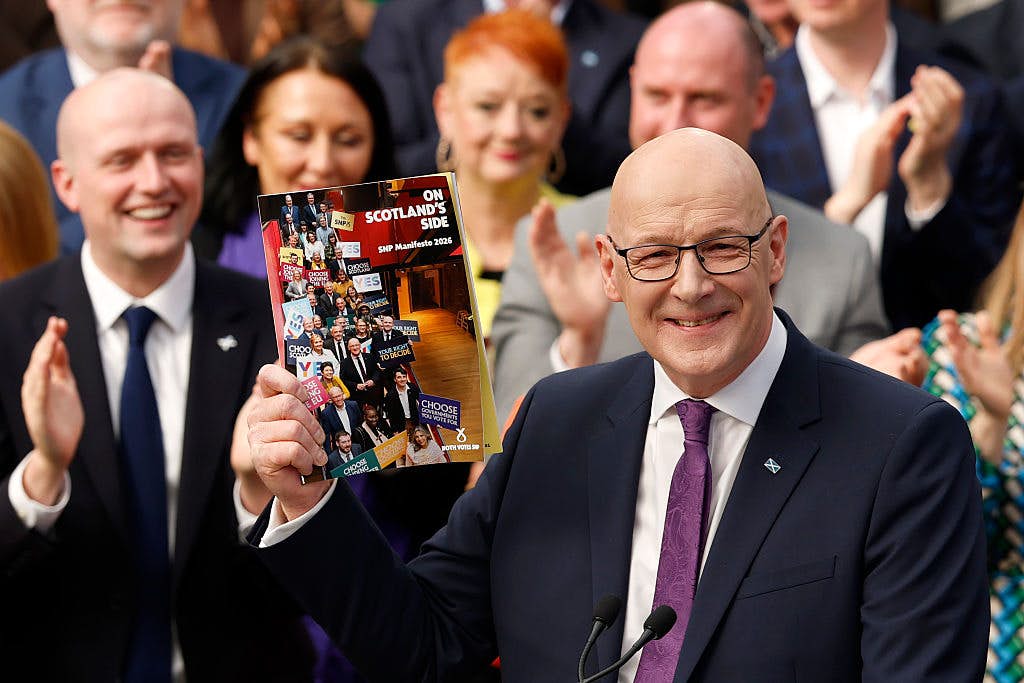
It is shape-shifting, protean and classless. Think Tory, and you immediately picture some tweedy chap out with his twelve-bore conserving wildlife. Think Labour, and what springs at once to mind is a fat man in a vest. Think the SNP, and there is our Swinney. Smiling, eager to help: the perfect son-in-law.
The more frustrated Westminster satraps throw yet more resources and still more devolved powers to Scotland, the more the Nationalists can preen that good things happen when Scotland votes SNP.
There are other advantages. The best Nationalist talent wants to sit in Holyrood. Scottish A-listers in the opposition parties much prefer Westminster. John Swinney has been around so long — at or near the top of the SNP for forty years — he is familiar and reassuring.
There is another elephant in the living-room: the decline in clout of the Scottish press, as late as 2003 unambiguously hostile to Nationalism and cosily cultivated, to that end, by the likes of Gordon Brown.
At the first devolved election, in 1999, the SNP was assailed from all sides with extraordinary venom; nor did Scotland’s newspapers cover themselves in glory at the 2014 independence referendum.
But the megaphone is not what it was. When I began a weekly column for what was then the Glasgow Herald in 1991, the broadsheet’s circulation was some 117,000. Fewer than 10,000 copies now shift daily. The Scotsman’s circulation is just over 6,000.
The Daily Record — the first daily paper in Europe, from 1971, to be printed in full colour, and tirelessly loyal to Labour — sold some 750,000 papers daily when I was in school: sales today are around 50,000.
This decline was not inevitable. It took newspapers far too long everywhere to figure out how to monetise the internet. But it took Scotland’s newspapers unduly long to grant at least fair news reportage — never mind op-ed commentary — on an SNP that even by 1999 could win a third of the Scots vote.
There is some hopeful talk, only two weeks from the 7 May election, of the polls tightening. But postal ballots are already bouncing off doormats, the flailing Keir Starmer remains a hopeless drag on Scottish Labour fortunes, and the Reform insurgency has marmalised the pro-Union vote.
Another SNP overall majority — a feat they achieved in 2011, under electoral arrangements supposedly engineered to make it impossible — is still, one thinks, improbable. Of course, there are certain imponderables. Many incumbent MSPs have chosen this year to retire, and there have been widespread boundary-changes, adding to the precarity of a Scottish electoral landscape long noted for its 3-way marginals.
But one can always rely on Westminster idiocy. Some days ago, pressed on LBC as to how a triumphant SNP would be granted another referendum on independence, Health Secretary Wes Streeting grated, “We’re not giving one.”
The people of the United Kingdom “have had enough of chaos,” intoned a chap central to a government noted for little but chaos as, north of the Tweed, still more Scots — who does yon laddie think he is, the Last Viceroy? — peeled off to the Nationalists.
Asked on the esteemed Holyrood Sources podcast last week how, given the sustained erosion of the Westminster parties in Scotland, the SNP might ever be removed from power, commentator Andy Maciver — once a youthful Scottish Tory press officer — had a startling response.
They will be taken down eventually, Maciver sighed, by a new, homegrown and unambiguously Scottish party — which does not yet exist.