This article is taken from the May 2026 issue of The Critic. To get the full magazine why not subscribe? Get five issues for just £5.
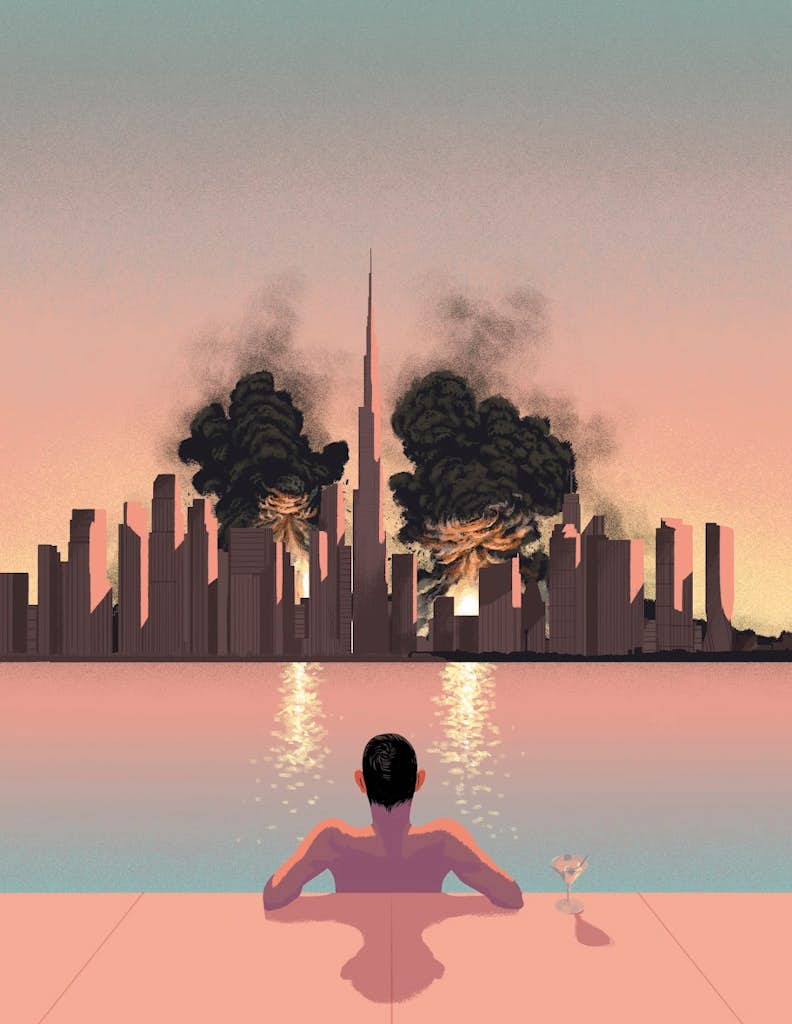
On the seventh day of Iranian strikes against Dubai, the British Social Club decided to host a pub quiz in a display of defiance against the regime of the recently deceased Ayatollah. It was a balmy Friday evening in the Emirates Golf Club and the mood was surprisingly ebullient, given the city had been struck with a once unthinkable barrage of cruise missiles and drones.
For members of the British Social Club, the anger at this fire and fury was not to be channelled across the Strait of Hormuz, but back home at their fellow countrymen.
In Britain, the club chat held true, an even more dismal scene was playing out. Those without the wherewithal to transcend Britain’s grim social contract had been willingly fooled by Iranian propaganda and Guardian columnists into thinking a more harmonious model for the 21st century was about to collapse. This nonsense only vindicated the wisdom of club members who had the foresight to leave Britain.
That morning one of their fellow citizens, a 60-year-old man, had been arrested and thrown into one of Dubai’s notorious jails for filming a drone strike at the airport. His plight elicited little sympathy. The club secretary, smoking a cigar in a posture of opulent ease, likened his actions to the sort of careless talk that might have benefitted the Nazis during the Second World War.
“If there is any incoming fire,” announced the quizmaster in his nasal voice, “then I shall have to ask you to briefly shelter inside. Although I doubt the Iranian Revolutionary Guard will have much interest in targeting the British Social Club of Dubai.” There was nervous laughter. But he was right. The war being fought amongst the British in Dubai was not against the Mullahs of Iran, but amongst those who had chosen to escape Britain and those who had not.
The war in Iran was a slight inconvenience for the British Social Club. At the start of the conflict, the club had been due to host a yacht party, touring Dubai’s faux archipelago of World Islands and toasting the rapid influx of members since Rachel Reeves became chancellor. But the outside chance of an Iranian drone sending the best of British in Dubai to the bottom of the Arabian Gulf was too much to bear.
For a club acutely aware it was representing Britain’s growing — and increasingly influential — contingent abroad, it was less the prospect of women and children drowning, but the gleeful reaction it might have triggered amongst their enemies at home. Dubai, by expat population, competes with Norwich, Oxford and Milton Keynes. It plays an even larger role in the imagination of a nation that has lost its way when it comes to discerning its 21st century identity.
Those attracted to Dubai are either channelling the hustle and pioneer spirit that has been relied upon throughout Britain’s history to rescue it from ambient mediocrity, or betraying a collective hearth built on the modern nation’s now Herculean habit of post-war muddling on. What is striking about Dubai is how it is less a place of alien refuge, than a place where Britain’s enduring archetypes are allowed to flourish.
An upper middle class of former diplomats, corporate lawyers and financiers recreate a neo-colonial lifestyle last seen in Burma in the 1930s. Thatcher’s children are flourishing in one of the most lucrative real estate markets taking shape around what is set to be the world’s largest airport, accompanied by a luxury suburb of residential lagoons in the middle of the desert confusingly named after Greek islands.
For British politics, the Dubai dream is either to be emulated or curtailed. Nigel Farage, mingling with Dubai’s elite at a private party, has fantasised about upgrading Clacton Pier into the Palm Jumeirah, the artificial promenade of luxury real estate and five-star hotels that leers out into the Arabian Gulf. There is a sizeable Reform presence here, spurred on by Nadhim Zahawi, where wealthy prospective donors mingle exclusively on rooftop parties and gaze out at vermillion sunsets and dream of a Britain Reformed.
Meanwhile, on behalf of Middle England’s increasingly impoverished shires, Ed Davey fantasises about forcing those fleeing from Dubai “like Isabel Oakeshott and washed-up old footballers” to cough up their tax breaks to fund the armed services. Some of Parliament’s new Birmingham Independents have even been caught by The Times encouraging their constituents to escape to a new mini city in the desert (replete with a fake Eiffel Tower) being run by two disgraced Pakistani businessmen banned from entering Britain.
✺
For as long as the city has existed, appalled visitors have fantasised about all of this collapsing. A.A. Gill, touring in the aftermath of the city’s post-2008 crash found a doomed place, the front cover of a dystopian sci-fi paperback full of “porn sex and pool parties and barbecues with a lot of hysterical laughing”. Then there’s the urbanist Mike Davis, seeing in the city a sort of Lazarus raised by all of history’s worst attributes. Dubai was “Albert Speer meets Disney on the Shores of Araby”. But for a city built on an apparent slow-burning vision of a twenty-first-century apocalypse, it is flourishing.
The city’s growth model for the rest of the century remains compelling. Dubai’s future is contingent on the managed decline of the West, the end of twentieth-century notions of the social contract, the rise of an unhappy upper and middle class from Bombay to Birmingham. The Economist has reminded its readers that since the pandemic, Westerners have been leaving their countries in record numbers. And there is a new class of innovators here who deal in chaotic predictions: the bloodbath of white-collar jobs at the hands of artificial intelligence, the unravelling of European democracies into the low-
level tedium of ageing populations, unaffordable welfare states and ethnic brawls. But what transpired was only one of the city’s kitsch imitations.
When, in the early days of the war, influencers filmed themselves having panic attacks on their balconies, those who had long fantasised about Dubai’s apocalypse seemed excited to see their wish made flesh. But what transpired was only one of the city’s kitsch imitations. The sparse air-conditioned malls, whose aerosolised aftershave pumped into this sudden desolation gave less the impression of a dying civilisation than a down-season Butlins for unemployed high-class prostitutes and overworked corporate lawyers, milling around in a surplus of luxury and ever attendant Nepalese concierges.
Dubai relies on these sorts of disasters for rare moments of self-reflection such as the collapse of the property sector in the post-2008 downturn or the local police force getting a bit handsy in a prison cell with a badly-behaved expat. This has led to the fine-tuning of a highly technocratic, enlightened despotism, one that in its short history has come to quash labour protests, liberalise its approach to vice and engineer financial regulations that court everyone from the world’s largest banks to its most prolific criminals.
Those in the know about Dubai’s reforms were confident it would survive the latest hurdle as it pumped billions of oil profits into a logistics and shopping-tourism economy that had become fleet-footed. At the very worst, if it became a frontier city on the edge of America’s increasingly unpredictable empire, it wouldn’t collapse, but merely linger on in a state of seedy, entirely competent enchantment forever. This was not necessarily at odds with the city’s goals of becoming the New York of the twenty-first century.
True, some people fled and a smattering of civilians died in the war with Iran. But the city’s civic ethos of pragmatism and ruthless ambition created an atmosphere of forced indifference. Indeed, Dubai might be the best place on earth to watch a barrage of lethal ordnance try to rain down hell.
When an Iranian cruise missile is struck by an interceptor, it disperses debris weighing up to 100kg across a footprint of several square kilometres. But the explosion can easily be confused for one of the city’s gaudy light displays that run daily from the Burj Khalifa. The collateral damage from this impromptu light show ranges from a scuff of damage on the facade of a five-star hotel to the mutilated remains of a Pakistani delivery driver on some forgotten desert highway.
Merely raise these dents in Dubai’s image and you are treated like one of the confused hysterics back home. Somehow the mutilated Pakistani deliveryman had died for the cause. When you arrive at Dubai Airport, you are confronted with the city’s Eight Principles. Phrases such as “Politically neutral business-friendly global hub” and “Dubai has always relied on talented tradesmen and dreamers for its success’ jump out.
The delivery drivers and construction workers with a habit of being taken out by missile debris all find themselves speaking in this inspirational patois. There are many criticisms of Dubai, but few places on earth can manage to bestow a sense of civic purpose on someone who might die from delivering a matcha latte to a retired OnlyFans star.
✺
Seeing the Instagram influencers sell an escape from Britain, I was left with the clear impression I was not going to survive the twenty — first century unless I followed suit. If I worked an office job, they told me from beside their pools in Dubai, that job would not exist by the middle of the century. I was doomed to live in a flat owned by BlackRock, overlooking some dismal extended suburb of London surrounded by low-level civic disorder and drift. The only way to survive was to achieve what they called “financial freedom”. Happily, this could be brought about by a mere change in mindset.
In essence, you can sit around moaning about the state of the world, and pretend to take things such as democracy seriously. But ultimately you are powerless: the rational option is to untether yourself from the old society and become a new type of twenty-first century man, the antithesis of a civilisation at its dead end that has ended trying to justify places like Slough and the geriatric and increasingly reactionary shires of England.
George Katodrytis is one of Dubai’s more strident architectural apologists and he has a simple idea of what Dubai can offer in this regard. The profligate shaping of concrete and sand that ranges from what will soon be the world’s largest airport to the failed theme park project of Dubailand is merely an exercise “in building the brand”.
And for those who come here, such a rapacious approach to building can extend to the remaking of the human soul. Providing your aspirations are merely a zero-sum game of survival in which you are willing to forgo your past self and ruthlessly build an entirely new idea of yourself, Dubai is the best place on Earth.
In this regard, the ruler of Dubai, Sheikh Mohammed bin Rashid Al Maktoum, is the ultimate expression of anything Dubai has resembling an ideology, being a cross between Chairman Mao and Diary of a CEO podcaster Steven Bartlett. He is a businessman, family man, entrepreneur, thought leader, horse breeder and enlightened despot. A man whose childhood started in a world under British rule where his countrymen lived in shacks crafted from palm foliage now sees himself wandering through shopping malls trying to bestow calm upon the world’s wealthiest housewives.
I never heard a bad word about “Sheikh Mo” as the expats endearingly call him. You can Google his name and read about daughters driven insane and bullying outbursts. But he has gifted his citizens permission not to care about trivial naysayers and cynics. For them, failure, or an inability to accept Dubai on its own terms, betrays a failure to accept the virtues of success, opportunity and personal struggle. This simple understanding of life is exactly what those who had come to Mo’s desert kingdom seem to want.
I chose to build my own brand at the Dubai Marina, a genteel multicultural place of Irish boozers where you can watch the darts next door to shopping malls with built-in mosques blasting the call to prayer. It is also home to one of my idols of branded resurrection.
No one seems capable of rising from the depths as dramatically as Brian Rose. The former Wall Street trader somewhat defiled himself at the peak of YouTube in the late 2010s: running a failed bid for London mayor, interviewing David Icke and extolling the health benefits of drinking your own urine.
Back in Blighty, Rose was a rogue, dodging accusations of scams and being an all-out odd bloke. His former business partner had stated ominously that he “needed to be stopped”. But in Dubai he has rebranded himself as a man-about-town, flipping luxury properties and riding the wave of what he liked to call “the largest transfer of wealth in human history”. When Iranian drones struck an apartment block in Marina, it was Rose who bestowed a sense of reassurance on the community by filming himself pumping his ageing biceps in the gym and gorging on steak in a deserted beachfront restaurant.
Rose has much in common with the young expats who primed my interest in becoming a new man in Dubai — a sense of shamelessness in the face of mediocrity elevated to the level of virtue. Their milieu stretched from Dubai to Bali and Bangkok. They have recast themselves from provincial salesmen and office drones into bronzed, self-sufficient men who run transnational businesses covering everything from Airbnb renting empires to headhunting companies and AI — generated porn. They believe they are set to inherit the
twenty-first century.
✺
Ben Moss was my choice of Guru. At some point Benjamin Mossman lost interest in his life in England. He tapered his scouse accent to a more transatlantic drawl, moved to Dubai and became Mr Moss. His heroes were Donald Trump, Sheikh Mohammed and Brian Rose — and he wanted to become an Instagram influencer who would sell the world positivity and fun.
I was in a personal spiral of despair when I first met Mr Moss in an abandoned shopping mall after a comedy night, one of Dubai’s desperate attempts to lighten the mood in time of war. There an international crowd had found common ground only in laughing at the diminutive size of the subcontinental penis and the city’s penchant for bad traffic. I immediately fell for his carefully marketed British charm. It was people like Mr Moss that were Dubai’s soul.
He was, as he explained to me in confidence, “in it for the long haul”. To go back to England now, even in time of war, would be an admission of defeat. This plumbing the depths of ambition placed him in the pantheon of England’s self-exiled idealists: a Lord Jim whose struggle to live up to some fantasy would either result in personal redemption or self-
destruction.
I soon became the Boswell to his Johnson, jotting down his remarks as he tried to hold together Dubai’s tourism sector with paid videos of him scoffing “Greggs-style pasties’ in a British-themed cafe in the sterile air-conditioned depths of yet another mall.
Mr Moss, in between stints of demonstrating the jaunty spirit of the Dubai Blitz, was occasionally prone to flourishes of disturbing lucidity. Whilst wandering an abandoned mall in Dubai’s financial district, in search of another video to make, he had talked himself into a visionary fugue. “This place is like a dystopia,” he said, confusingly, with the same infectious awe as his videos. “But dystopia is not always a good thing,” I said. “No it’s not,” he replied. “But it’s like a good version of dystopia. It’s like a sci-fi movie. You can live under a barrage of missiles and everything’s still perfect.” But he didn’t seem convinced by his musings. He turned to me and said: “We’re all just idiots really. I’m not naive to the fact that this whole business, influencers I mean, just attracts absolute idiots.”
✺
By the fourth week of the war, the US had spent nearly $50 billion bombing Iran. The UAE had dropped its routine of mimsy innocence when it came to decisive matters of foreign affairs and was now pushing the Americans for all-out regime change in Iran. I found Mr Moss lounging by a pool at the Dubai Marina.
Around us was a polyglot cast of sexy people frolicking in the water and being fed vodka through a funnel by a coterie of bemused Indian waiters. There was talk of hiring a van and driving it up to the border of Iran in anticipation of the regime’s collapse. The next stage in Mr Moss’s brand would be to bring Dubai to Tehran.
“Well, the human condition is a complex thing,” I said, pompously contemplating Mr Moss’s plan aloud. Alluding to the frenzy by the pool, I added: “Surely the people of Iran will want more than this.” Mr Moss thought about this, but he wasn’t convinced. In my deepest moments of contemplation whilst following Mr Moss, I wondered if one day the entire world might resemble Dubai. Life here was undeniably easy, if you succeeded in not really thinking about anything. Why wouldn’t the people of Iran, having gone through the tedium of the most reactionary twentieth-century ideologies, not enjoy a brief honeymoon modelled on this?
The Dubai Cup is the world’s most lucrative horse race and one of the few times the Emiratis, Western expats, the growing Indian middle class and subcontinental and African workers are forced to come together and pretend they are part of something. At the start of the war, Dubai had been written off by a formidable array of Guardian columnists and commanders of the Iranian Revolutionary Guard. But the bustling crowds — and the show — were still determined to go on.
Filing through the gates were long queues of sunburnt estate agents and a few exiled former Tory staffers who, as one sternly put it, “were working here to embed the eight principles of Dubai in the work of their clients’. They looked diminutive, even vulnerable in front of the majestic skyline, the Burj Khalifa silhouetted by a late evening desert glow rising like a longing finger reaching for God. Even if Dubai were one day to collapse and recede into the desert, its ruins would surely be one of the most beautiful things mankind had ever created.
“The brasses are half price, the hotels are half price and there are cheap flights,” said a young man from Essex by the luscious green of the racecourse when I asked him whether the dream of Dubai would survive. I sensed a fellow optimist. When I asked him why he had moved here, one of his friends pulled up his shirt and revealed a livid pink scar under his abdomen: he had been stabbed for his watch on a night out in Essex.
“You’re a journalist, we can tell,” another said. Soon I was surrounded by a posse of worryingly gym-fit men with brilliant white teeth and unaffordable watches shaking me down for secret recording devices. The men I had spent months aspiring to be had turned on me.
The young men from Essex hated journalists and those who had been laughing at Dubai back home. To them, I had exposed the rotten core of a country allergic to the preferences of this brave new world.
“Dubai has a good way of working out the life people really want. If this had happened in England,” one of my searchers said referring to the Dubai Blitz, “then they would be rioting on the streets.” Soon this would no longer be the case, because Britain’s growing emigré class would return to England and remake it in the image of their new lives.
That evening, after the Dubai Cup, I went to visit Tuan Bucket in his apartment in the workers’ district of Al Quoz. Tuan is a Sri Lankan waiter. Tall and stocky, he still manages to move about with a gentle elegance.
He was the most complex of the Dubai boosterists I met, and was sympathetic to the Telegraph op-eds of Fleet Street’s most famous Dubai expat, Isabel Oakeshott. He had a family of three at home. He told me his brother had moved to Dubai; and that he had tried to show him that temporary servitude would in time bear fruit. But he couldn’t hack it, returned home to Sri Lanka and committed suicide.
In a modest apartment in which he shared a room with another waiter, I asked him what his brand was. “What do you mean?” he said. I told him about Brian Rose. “To survive in Dubai, you have to have an idea of yourself you think will succeed,” I tried to explain.
Then he started speaking about the science fiction writer Arthur C. Clarke. “He wrote about how great the future was going to be then ended up living a simple life in Sri Lanka and scuba diving,” he mused. “Why?” I asked. “Maybe he got bored, or maybe he didn’t believe the future he imagined was really going to happen.”
Before Tuan let me go back to my apartment in the Marina, a place costing me more in a week than he earned in a month, he showed me around his neighbourhood. Its bustling streets were the busiest I had seen in Dubai. They gave the impression that the entire world outside of the West — from Africa and the Indian subcontinent to Indonesia — was assembling on the periphery of the city ready to inherit it. “One day, you will join us here,” he said in a way which meant I wasn’t sure if it was a joke, a threat, a serious vision or all three.
And as if to explain, he whipped out his phone and showed me the home he was building: a modest villa shaded by tropical palms, not too far from Clarke’s residence in Colombo.
Like everyone else who had escaped their country, he had it all worked out.