A judge has overturned a £585,000 fine imposed on Sussex University for adopting a transgender policy which limited free speech and led to Professor Kathleen Stock feeling she had to resign.
The High Court ruled today the Office for Students (OfS) watchdog had no power to impose the penalty following a landmark judicial review claim.
The judgement may have far-reaching consequences for free speech at universities, as it could limit how far the regulator can intervene in future.
Professor Stock, a gender-critical feminist, resigned from Sussex in 2021 over feeling pressured to ‘self-censor’ her work, amid pro-trans student protests.
The OfS said the situation arose because of the university’s transgender policy, which led to the ‘chilling’ of free speech on campus.
The policy said all courses ‘must positively represent trans people’ and ‘transphobic propaganda … will not be tolerated’.
However, lawyers for Sussex said the OfS did not have the power to impose a fine based on this policy, because it does not constitute a ‘governing document’.
It said the watchdog is only permitted to scrutinise ‘governing documents’ of an institution under the remit of the Higher Education and Research Act 2017.
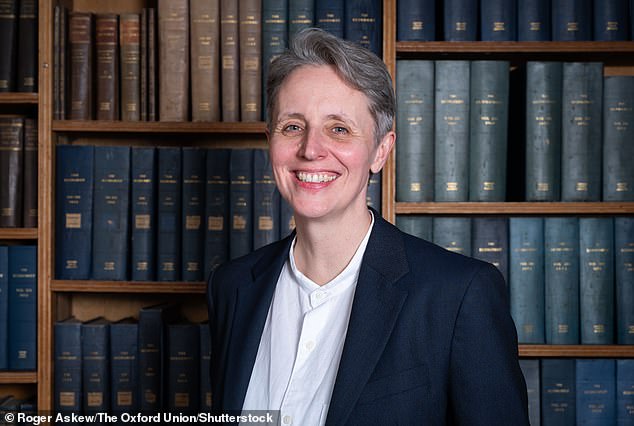
A judge has overturned a £585,000 fine imposed on Sussex University for adopting a transgender policy which led to Professor Kathleen Stock (pictured) feeling she had to resign
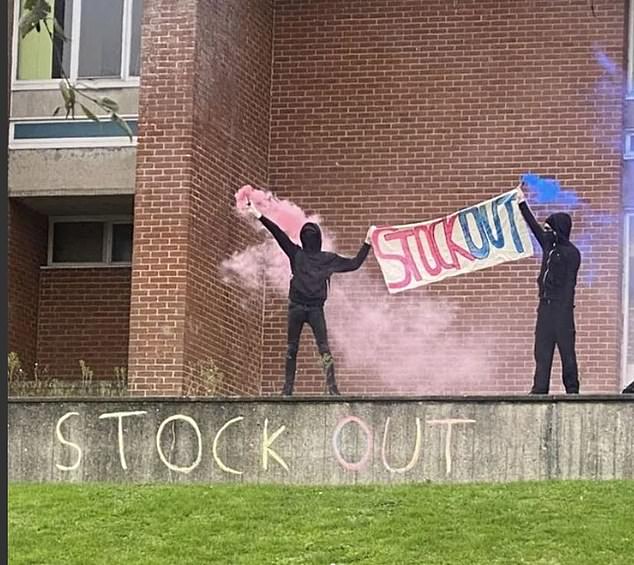
The High Court ruled today the Office for Students (OfS) watchdog had no power to impose the penalty following a landmark judicial review claim (pictured: trans activists at Sussex in 2021)
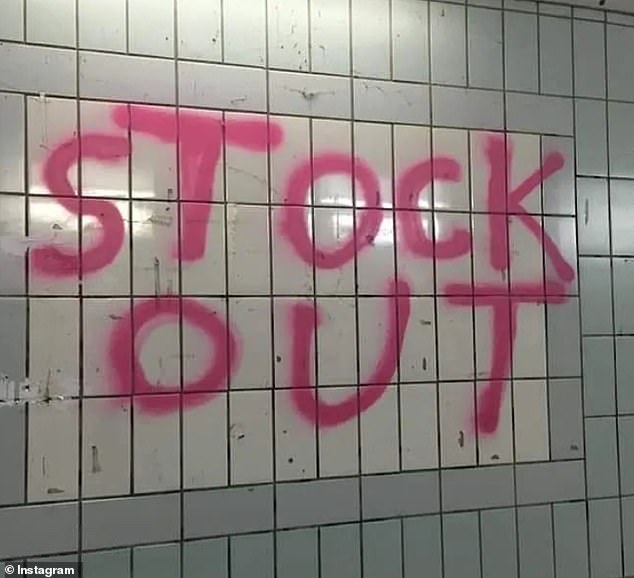
Professor Stock, a gender-critical feminist, resigned from Sussex in 2021 over feeling pressured to ‘self-censor’ her work, amid pro-trans student protests (pictured: grafitti by activists in 2021)
In her judgement handed down this morning, Mrs Justice Lieven ruled in the university’s favour, finding the OfS ‘misdirected itself’.
She added it had made a ‘clear error of law’ and that a ‘chilling effect and potential for stress and anxiety are irrelevant considerations’.
She also said the regulator was guilty of ‘bias’ as it had approached the decision ‘with a closed mind and had therefore unlawfully predetermined the decision’.
Following the judgement, Sussex’s vice chancellor, Professor Sasha Roseneil, said it was a ‘vindication’.
She added: ‘It is a devastating indictment of the impartiality and competence of the OfS, implicating its operations, leadership, governance, and strategy.
‘It raises important and urgent questions for the Government as it plans to grant ever more powers to the regulator.’
The OfS said it was ‘disappointed’ and considering its ‘next steps’.
Meanwhile, the Free Speech Union campaign group said on X: ‘This judgment will effectively leave academics like Kathleen Stock defenceless, while empowering activists to hound off campus anyone they disagree with. We very much hope the Office for Students appeals and if it does we hope to intervene.’
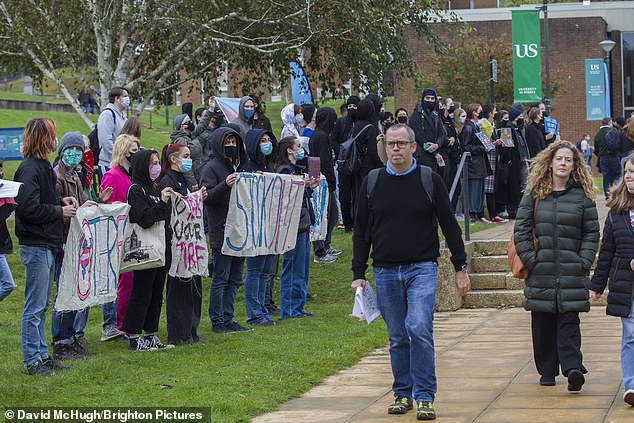
The OfS said the situation arose because of the the university’s transgender policy, which led to the ‘chilling’ of free speech on campus
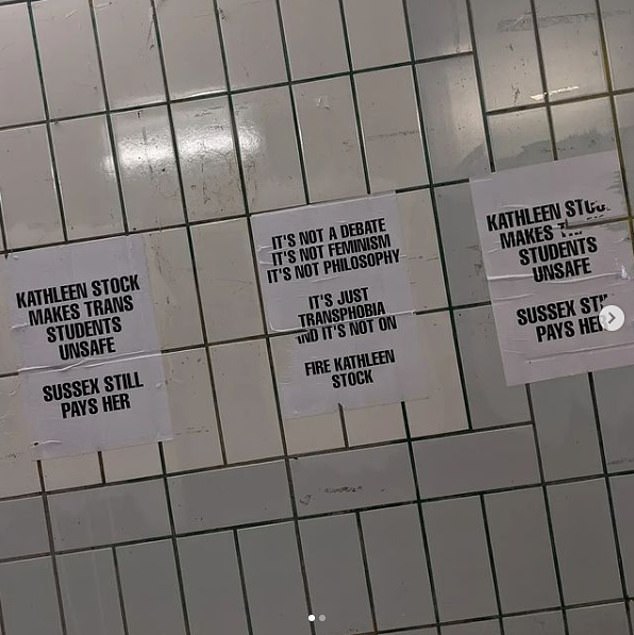
Posters put up in the tunnel from Falmer station to the University of Sussex’s campus said Professor Stock ‘makes trans students unsafe’ and ‘we’re not paying £9,250 a year for transphobia’
Sussex was the first ever to be issued with a fine for free speech.
In a previous hearing, Chris Buttler KC, acting for Sussex, told the High Court the affair has had a ‘severe’ effect on the university – particularly on its ‘reputation as a bastion of free speech‘.
He pointed out that the policy was taken from a template produced by Advance HE, the higher education charity, and that a number of other universities had done the same thing.
He said the policy was ‘not a governing document’ and therefore could not lead to disciplinary action against any academic.
After Professor Stock was hounded out, the policy was updated in 2022 and 2023, with the latter version saying it did not justify ‘sanctioning academic staff for questioning or testing received wisdom or putting forward new ideas, including controversial or unpopular opinions within the law’, or ‘disproportionate restrictions on freedom of speech’.
Mr Buttler said the OfS did not have the power to investigate the student protesters, so instead focussed on the transgender policy, on the grounds that it was a ‘governing document’.
However, it was a ‘paper exercise’, in which no academic was interviewed aside from Professor Stock, he said.
Monica Carss-Frisk KC, acting for the OfS, said in written submissions that the university had breached one of the conditions of registration.
This condition commits vice chancellors to ensuring their governing documents safeguard academic freedom and freedom of speech.
She said the university’s grounds for appeal ‘should be dismissed’.
She added: ‘The OfS had jurisdiction to consider all relevant matters; it conducted a careful and detailed investigation, correctly interpreting the relevant regulatory conditions.’
She said the suggestion that the trans policy was ‘not a governing document’ was ‘misconceived’ and ‘pays scant regard to the wording’ of the law.
Today, Professor Roseneil said she will be seeking a meeting with Education Secretary Bridget Phillipson to discuss its ‘implications’ of the judgement for the sector.