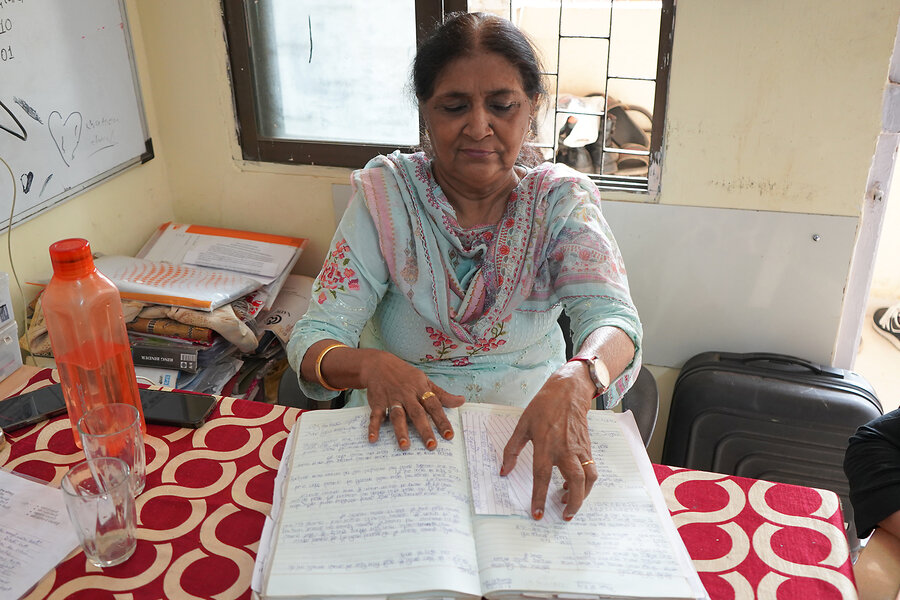
Located in the bustling heart of Mumbai, the nondescript office of the Bharatiya Muslim Mahila Andolan (BMMA) is easily missed. But hundreds of Muslim women in legal distress have sought refuge here, often guided in by a staff member waving her hand out the grilled, first story window.
Some have been abandoned through an antiquated religious practice known as “triple talaq,” which instantly grants a divorce to men who say “talaq” three times. Others have been cheated out of inheritances, or denied custody of their children without grounds.
All have fallen through the cracks of India’s legal system, which allows religious communities to govern themselves in matters such as marriage and adoption, among others.
Why We Wrote This
In India, a group that advocates for Muslim women finds itself caught in the crossfire of the broader debate over a Uniform Civil Code, a sweeping reform that could redefine India’s approach to religious liberty.
Originally, India’s system of personal laws was framed as a way to respect religious diversity. Rather than impose a single civil code, shortly after gaining independence in 1947, the country allowed Hindus, Muslims, Sikhs, Christians, and other groups to continue following their own customs.
But unlike other personal laws in India, Muslim family law remains largely uncodified. Women are particularly vulnerable as they navigate a patchwork of loose directives, interpreted differently by clerics, family members, and police officers – whose own personal biases can delay or even derail justice.
One solution, the BMMA’s leaders argue, is to formalize Muslim personal law. The group’s push for codification has placed them in the crossfire of a hot political debate over whether to replace India’s personal laws with a Uniform Civil Code.
Most Muslim groups oppose a national UCC, viewing it as a form of religious discrimination by the country’s Hindu nationalist government. Some are withholding judgment until there is a draft law. But BMMA members see value in having a clear civil code on the books.
“Earlier, [our main fight] was about triple talaq. Now, it’s polygamy,” says Noorjehan Safiya Niaz, who co-founded BMMA (whose name loosely translates to “Indian Muslim Women’s Movement”) nearly two decades ago. “Police say, ‘It’s allowed in your community,’ so what can we do?”
“If there is a law, we can hold the police accountable and ask them to act,” adds Ms. Niaz. “For over 20 years, we have been the ones raising this demand. There are people who want codification, but open, visible support has not come. … People are afraid, and the hold of religious groups remains strong.”
Gaps in women’s rights
Without a comprehensive civil code, activists and reformers have had to take a piecemeal approach to protecting the rights of Muslim women in India.
Triple talaq, for instance, was only criminalized in 2019 – decades after neighboring Pakistan and Bangladesh banned the practice – thanks in part to a grassroots campaign and public interest litigation filed by the BMMA. That same year, the group petitioned the country’s Supreme Court to ban polygamy, a plea that is still pending. These practices are declining across India, but persist in some communities.
Tasleem Mohsin Saliq experienced both in 2021, when her husband took a second wife and abandoned her. She was five months pregnant with their third child.
“It was not even a triple divorce,” Ms. Saliq recalls. “He repeated it at least 17 or 18 times.”

The men in the family then went to the nearest mosque, where a maulana – a respected Muslim scholar – pronounced the divorce valid, despite Ms. Saliq’s pregnancy and the 2019 law. Today, she is raising her three sons alone, earning about $71 each month at a Montessori school.
“I have gone to the police station many times,” she says. “But each time, they just wrote a report and sent me home.”
Sitting in the BMMA’s two-room office, she clutches these reports in a thick binder. Next to her, Zubeda Khatoon Shaikh, a longtime member of the organization, is trying to reach Ms. Saliq’s sister-in-law on the phone.
“The advantage of a place like this, or any legal aid center, is that women know they are not alone,” says Ms. Niaz. “They can fight if they know someone is standing with them.”
Still, that fight is a lot easier when rights are cemented in law – something a UCC, they hope, could accomplish.
The push for uniformity
Ever since the country’s founding, there have been calls to unite India under a single civil code. After Prime Minister Narendra Modi and his Bharatiya Janata Party came to power in 2014, the call has grown louder – and the BMMA has gathered ideas on how to make a national code work for India’s large Muslim minority, which numbers more than 200 million.
In 2017, the group issued a 25-point proposal on codifying Muslim family law, developed over years of community consultation. “We traveled across 15 states. We sat with women, with lawyers, and with religious groups who were open to talk,” Ms. Niaz says.
They shared the proposal with the National Commission for Women and the Law Commission of India, two government bodies responsible for researching and recommending legal reforms, but haven’t been able to connect with policymakers. “There is no willingness to talk to us,” says Ms. Niaz. “This government functions on its own steam: ‘This is what we want to do, and this is what we will do.’”
Meanwhile, ruling-party lawmakers have been testing the waters for a national civil code by introducing such codes on a state level. Last year, Uttarakhand became the first state to implement a UCC, which legal activists and Muslim leaders have criticized for expanding state power over personal lives without delivering meaningful protections for women. Some measures – including a mandate to register live-in relationships – have yet to be enforced, but human rights lawyer Audrey D’Mello says it sets a troubling precedent.
“It’s just increased control of the state,” says Ms. D’Mello, the director of Majlis, a Mumbai-based legal center for women and children. What India needs, she explains, is “equality of rights, not uniformity of rights.”
Nevertheless, several BJP-ruled states are following suit. In March, Gujarat became the second state to pass a UCC, and Maharashtra’s legislative council is considering a similar change.
Demand for transparency
As the idea gains momentum in Maharashtra, opposition leaders say there has been little transparency over what a local UCC might entail.
“Whether by the state or the [central government], any proposed law must first be shared with the public,” says Arif Naseem Khan, a four-time member of the state legislature. “People should know what is being changed and why.”
Ms. D’Mello warns that changing Muslim personal laws without understanding them could actually harm women on the margins.
“If you want to bring about change, bring it from within the community, not by fighting against it,” she says.
That’s what the BMMA has been trying to do.
Alongside their push for legal reform, leaders such as Ms. Niaz and Ms. Shaikh – known in the BMMA community as Khatoon apa (or “Big sister” Khatoon) – conduct regular workshops on legal literacy and Islamic jurisprudence. They also teach women how to approach the police and file an initial report. The BMMA admits it has struggled to build wider community support for codification, but these other programs are seeing success.
While the early years were marked by resistance – including attacks on BMMA offices – Ms. Naiz says they are now fostering a new generation of women who are eager to fight for their rights.
“The girls are getting educated, that’s the main thing.”