In his first inaugural address, in March 1801, President Thomas Jefferson spoke of the United States as “a rising nation, spread over a wide and fruitful land” and “advancing rapidly to destinies beyond the reach of mortal eye.” By the end of 1803, the U.S. had indeed advanced considerably: The Louisiana Purchase, through which a huge territory west of the Mississippi River was transferred from French to American hands, nearly doubled the nation’s size.
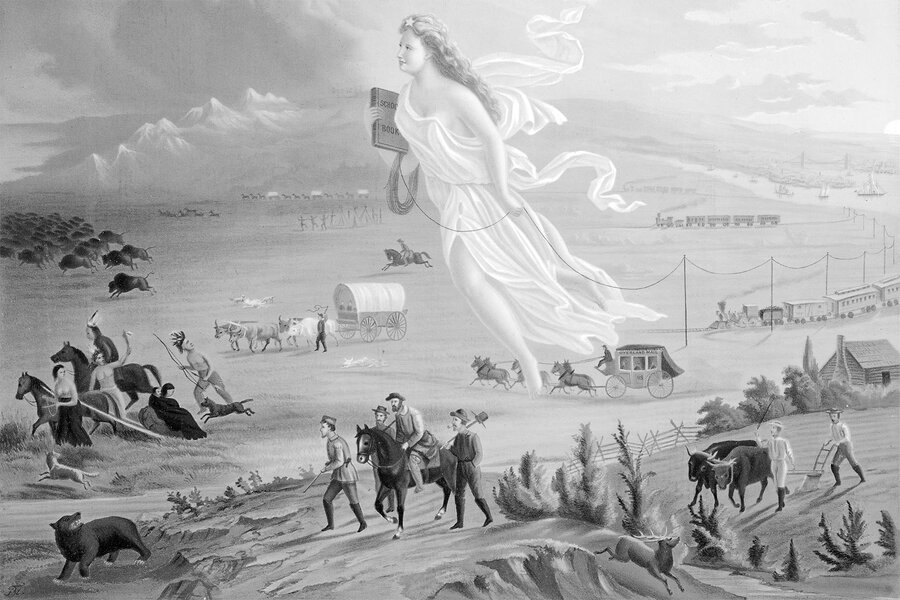
Historian Megan Kate Nelson’s splendid new book, “The Westerners,” cites Jefferson’s vision of national progress as one of the first articulations of the “frontier myth.” Historian Frederick Jackson Turner is credited with giving the myth its fullest expression in a renowned 1893 essay, “The Significance of the Frontier in American History.”
Turner posited that the conquest of the West was foundational to American identity. American exceptionalism, he argued, stemmed not from the nation’s European roots but from the violent clashes between “savagery” and “civilization” that eventually pushed the country’s domain to the Pacific Ocean.
Why We Wrote This
Daniel Boone, Davy Crockett, and Kit Carson have all loomed large in the popular imagination. “The Westerners” offers a more expansive view of the 19th-century American West, demonstrating that Indigenous, Black, Mexican, and Asian women and men were also vital to the frontier experience.
Nelson notes that the frontier myth celebrates pioneers implicitly understood to be white and male; men such as Daniel Boone, Davy Crockett, and Kit Carson have loomed large in the popular imagination. “The Westerners” offers a more expansive view of the 19th-century American West, demonstrating that Indigenous, Black, Mexican, and Asian women and men were also vital to the frontier experience. The book serves as a forceful corrective to American history as it has long been told.

The vivid narrative traces the paths of seven fascinating individuals. Nelson begins with Sacajawea. In 1804, the Native American teenager became part of the expedition of Meriwether Lewis and William Clark to explore the Louisiana Territory and the Pacific Northwest. She served as an interpreter and a guide. Her knowledge of the landscape and her skills at foraging provided the explorers not only with additional food sources but with scientific specimens that Jefferson had asked Lewis and Clark to collect on their journey.
Of course, Sacajawea’s story is a familiar one, though its details, down to the spelling of her name, have been subject to debate. (The author appears to agree with the historical consensus that Sacajawea died in 1812, but recent scholarship based on Indigenous oral tradition claims that she lived into old age.) Nelson’s other subjects are far less well-known today but were prominent in their time. Some, like Sacajawea, were cultural brokers, adept at navigating different worlds during a period of great flux.
María Gertrudis Barceló, for instance, was a successful businesswoman, operating a Santa Fe gambling saloon that thrived for decades and amassing a fortune in the process. Until 1821, when Mexico won independence from Spain, she was a Spanish subject, and Nelson notes that Spanish women had more rights than their American counterparts: They could legally own property and run businesses.
Barceló became a skilled dealer of the Spanish card game monte. With the 1848 signing of the Treaty of Guadalupe Hidalgo, which ended the Mexican-American War, her national identity changed once again. Barceló went from being a Mexican Northerner to an American Westerner. Her business survived these shifts because of what Nelson calls “her ability to assess the rapidly changing geopolitics of Nuevo México.” During the war, the author writes, “the American occupiers became her friends, lovers, and customers. She passed on information to them, and they, in turn, gambled at her monte tables and protected her interests.”

Another intrepid Westerner with keen survival instincts was Jim Beckwourth, the son of an enslaved Black woman and her white enslaver. Beckwourth was born in Virginia around the turn of the 19th century. After being emancipated by his father, he set out for the West, where, in Nelson’s account, he appears to be everywhere at once. Before his death in 1866, he worked as a fur trapper, a gold miner, a farmer, a rancher, and a courier for the U.S. Army during the Mexican-American War. He also spent several years living as an adopted member of the Apsáalooke band in the Rocky Mountains.
The restless Beckwourth published a popular autobiography in 1856 detailing his many adventures, which, in Nelson’s view, were possible only because the Western territories were so vast and unregulated. As a biracial man, Nelson writes, “he often chose to pass as Indigenous or white as the circumstances demanded in the dynamic communities of the American West.”

Manuscripts Division, Department of Special Collections, Princeton University Library
The book’s other characters are equally compelling. They include Little Wolf, a Northern Cheyenne chief who for years resisted the U.S. government’s demands to relocate his people to a reservation, and Polly Bemis, a Chinese woman who was trafficked to Idaho and built a life there in the face of federal legislation targeting Chinese immigrants.
“Before the Civil War, the West was chaotic and unstable, a landscape of transformation,” Nelson observes. “Because of this, men and women from a variety of racial and ethnic communities were able to claim spaces for themselves there.”
After the war, the government increasingly asserted its control over the once wild West. Nelson sees a connection between the fact that the exploits of white settlers were acclaimed while the opportunities for people such as Barceló, Beckwourth, and Bemis contracted.
“Removing people from a central national narrative effectively eliminates them from the body politic, making it easier to take their land and their civil rights away,” the author notes. In reminding us of these extraordinary stories, she has crafted a fuller and more accurate picture of the mythic American frontier.