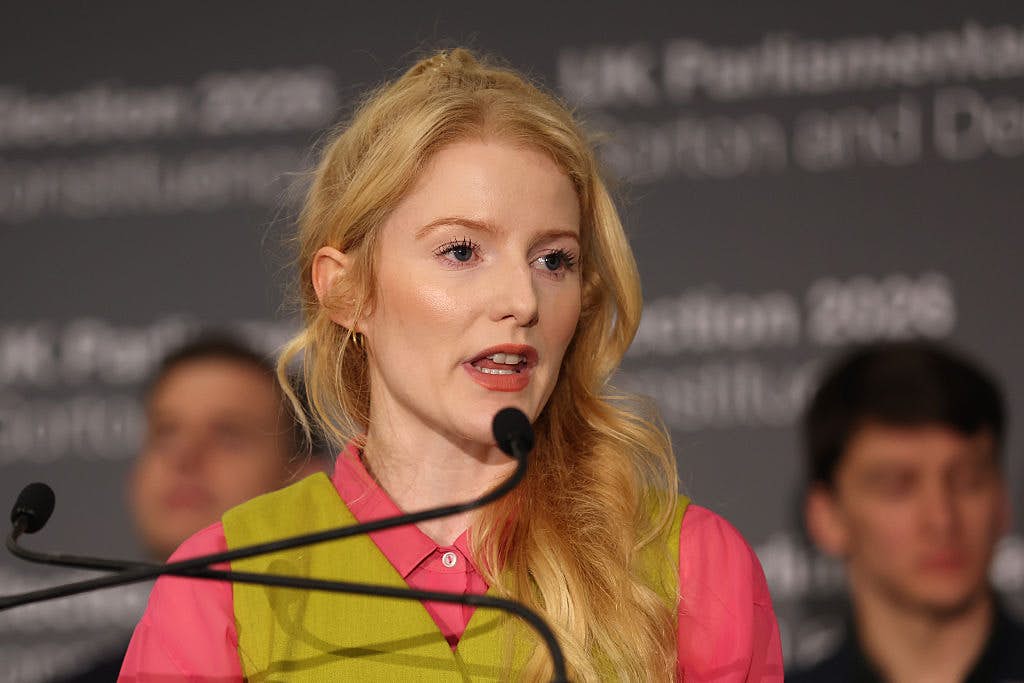
As next month’s local elections loom ever closer, the Green Party has alighted upon a new stick with which to beat Labour: MPs drinking.
The spark for this latest bout of national humiliation was an interview with Hannah Spencer, their newly elected MP, in which she alluded to being able to smell booze on people in the division lobbies. Spencer has a very high opinion of her performance in Parliament for a Member who has not spoken once since her maiden speech, and that comment is a telling insight into why.
Puritanism is a natural refuge for the inadequate. If one lacks ideas or accomplishments, the easiest way to better oneself without the time-consuming effort of actually improving is to make sins of habits you don’t have. For people who don’t do very much, a standard which measures virtues by things abstained from is immensely congenial.
It isn’t an ironclad rule, of course, and perhaps Spencer will yet evolve into one of those earth-shaking Temperance politicians the Victorian era tended to produce. But it is an excellent general rule that someone who praises themselves or others with lists of vices they don’t have is short of genuinely positive things to say.
That Spencer’s comments have attracted a lot of support online — and that Zack Polanski clearly feels they speak sufficiently to popular sentiment to work them into his campaign pitch — tells us nothing good about modern Britain. But what, exactly, does it tell us?
Part of it is surely just the general attitude of spite towards politicians which has prevailed since the expenses scandal. Another, more understandable part might be resentment that MPs (and journalists) continue to enjoy a workplace drinking culture which has otherwise more or less died out in both the public and private sectors. Yet there do seem to be plenty of people who sincerely agree that, to quote one mind-boggling example I found on X, it is no longer proper to drink at the office Christmas party because “times move on”.
The idea that reasonable alcohol consumption is always and everywhere incompatible with doing good work is, we should make very clear, a deeply strange one that is not evidenced by history. There are certainly roles( medical personnel, operators of heavy machinery, and so on) where working drunk would be dangerous, and others (some customer service roles) where it would be inappropriate.
But this is manifestly not the case in other areas of work, and especially not in anything that requires strategic relationship building. Strong evidence for this — or at the very least, evidence against the temperance thesis — is that Britain has historically combined a much bigger culture of workplace drinking with vastly higher levels of both economic dynamism and political governance. Who thinks our nation or economy is better governed today than when the drinks cabinet was an office staple?
(All of this, of course, is beside the fact that MPs are not employees. They are representatives, who have the right to attend the Commons by dint of being elected. The prerogatives of the role are entirely incompatible with the total imbalance of power that governs the normal relationship between an employee and their employer, or HR department.)
Looking more widely still, it is strange to see celebrations of the fact that Gen Z drink less than their elders sitting alongside endless worry about their being lonely and depressed, without many people seeming to draw the obvious line between the two.
So why is this? Well, it presents a chicken-and-egg problem. I suspect that whilst nothing is monocausal, the fact that we have been in an economic slump for almost 20 years is not entirely unconnected from our more miserable, puritanical, risk-averse culture. Humans were doing agriculture for booze almost as long, if not longer, than we were doing agriculture for food. It has been the lubricant of organisation for thousands of years. It would be very strange if a societal turn against it had no effect.
When you lack confidence in your ability to achieve things, it is natural to shift your emphasis from outcomes to processes
But it could also simply be a mass manifestation of what I described above: cope. When you lack confidence in your ability to achieve things, it is natural to shift your emphasis from outcomes to processes. The virtue of process is that they insulate you against risk; so long as you have followed procedure, nobody can say you did anything wrong. In government, that manifests in a culture that emphasises box-ticking over the end result; in the wider economy, in an expansive and zealously-enforced HR culture that insulates employers from lawsuits (the UK has the second-largest HR sector in the Western world, after the Netherlands).
Provided you believe these new rules to be what really matters, perhaps it is possible not to mind that Britain is approaching its second decade of stagnant productivity, real wage, and per-capita GDP growth, or that the House of Commons is now tangibly worse at producing and scrutinising legislation than it was in the 1970s. One grandee recently tried to dispute my charge that the calibre of MPs has declined. His first point of evidence? They don’t drink as much!
We should be careful, of course, not to exaggerate the Temperance tendency just because they’re noisy online. Some of them are clearly living in little bubbles of their own — one was flabbergasted to learn that buying your barman a drink is still something done, which perhaps says more about him than society.
But if MPs don’t want the scolding mob to eventually come for their bars and terraces, they would do well to reflect on how the laws they have laid down have helped to turn Parliament into such an outlier — and start getting them off the statute book.