Last October, Maxwell Aidoo was scrolling TikTok from his home near Ghana’s capital, Accra, when a video caught his eye.
A Ghanaian man describing himself as a travel agent explained that he was recruiting for cleaning and construction jobs in Russia. The pay – $4,000 a month – was many multiples of what Mr. Aidoo and his mother earned running their small general store.
So he sent a message. The agent got back to him quickly: Would he be interested in working as a “helper” moving equipment for the Russian military?
Why We Wrote This
Citizens of Ghana, Kenya, and several other African nations are ending up on the front lines in Ukraine as Russia looks overseas to bolster its armed forces. Some governments are now sounding the alarm.
That seemed easy enough. “I thought, ‘It pays well,’” Mr. Aidoo recalls.
When Russia launched its full-scale invasion of Ukraine in February 2022, the Kremlin imagined a quick, decisive victory. Instead, the war has become the deadliest conflict in Europe since World War II, with combined casualties expected to surpass 2 million this year. The grueling war has killed as many as 325,000 Russian soldiers and wounded nearly a million more.
To make up for these staggering losses, the Russian military is recruiting more than 30,000 new soldiers each month. And to find them, Moscow is casting an increasingly wider net.
Since November, the number of foreigners fighting in the Russian military has risen sharply from about 18,000 to nearly 28,000. Among them are citizens of at least 36 African countries.
Many have no idea what they have signed up for.
“They didn’t say I was going to war,” Mr. Aidoo says.
A once-in-a-lifetime offer
Recruitment efforts like the one that ensnared Mr. Aidoo follow a remarkably consistent script.
In countries across Africa, headhunters pepper social media with ads for high-paying civilian jobs in Russia, including roles in cooking, housekeeping, and security. Some also advertise military positions.
In December 2025, a friend of Vincent Ndung’u told him about a company recruiting Kenyans to join the Russian army. Mr.
Ndung’u had long dreamed of becoming a soldier, and the salary the agent promised – $2,500 per month and a $12,400 signing bonus – stopped him in his tracks.
“I had never been paid that kind of money in my life,” says the father of three, who worked piece jobs in construction and catering. “I saw the opportunity to change my life, and my family’s fortunes forever.”
And so, without telling anyone the specifics, Mr. Ndung’u signed up. From there, he says, things moved “unnaturally” fast. He was sent to the capital, Nairobi, then quickly put on a plane to Moscow.
“All I knew is I was going to join a military,” he says. “I had no idea there was a war between Russia and Ukraine.”
Mr. Ndung’u is one of about 1,000 Kenyans who have been recruited to fight in Russia since the war began, according to lawmakers there, many under false pretenses.
Mr. Ndung’u’s first flicker that something was wrong came soon after he arrived in Russia. He received a panicked WhatsApp message from the friend who had encouraged him to enlist, who was already in Ukraine.
“You should either disappear or wait to die,” his friend told him. “Africans are dying.”
A “crazy decision”
For recruiters, who pocket bonuses for each soldier they sign up, young African men like Mr. Aidoo and Mr. Ndung’u are an easy mark. One-third of the continent’s population lives on less than $2 a day, and fewer than 1 in 5 adults have a salaried job. Those who want to work or study in wealthier countries usually find the doors bolted shut.

Courtesy of Maxwell Aidoo
In this context, a job in Russia promises the extraordinary: a prosperous life in Europe.
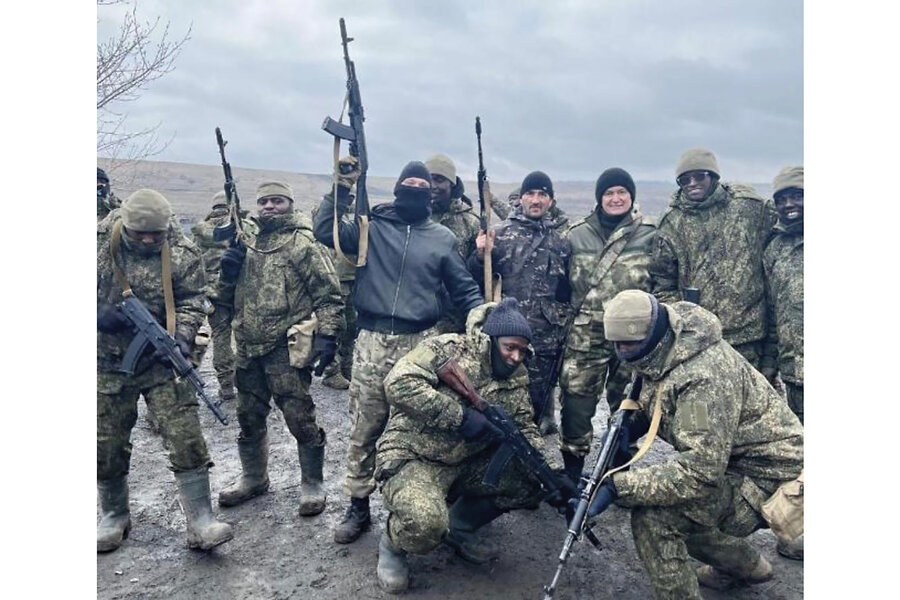
When Mr. Aidoo arrived in Russia last November, he was eager to begin earning and supporting his mother. But he was surprised to find there was no “helper” position waiting for him. Instead, he was given a contract to sign in Russian, which turned out to be for a position as a soldier with the Wagner Group, a state-funded private militia. Then he was sent to the war-battered Ukrainian region of Donetsk.
Still, Mr. Aidoo tried to make the best of the situation. He sent home photos of himself in military camo, posing in the snow with an assault rifle slung over his shoulder. He took shaky phone videos of abandoned tanks and storerooms packed with ammunition. “A [expletive] crazy decision I took,” he says in one. “But it’s all good.”
Behind the facade, however, Mr. Aidoo was terrified. “I saw people die every day,” he says.
Nearly 1 in 4 Africans enlisted in the Russian army have been killed, according to a list of African recruits obtained by Inpact, a Swiss investigative research organization. And while compensation to the families of slain Russian soldiers can exceed $180,000, relatives of slain foreign fighters receive nothing.
In December 2025, Mr. Aidoo’s battalion was advancing toward a Ukrainian position when something exploded nearby. The next thing he remembers, he was lying in a military hospital in Moscow.
Fearing he would be returned to the front line, he fled with the help of a friend to the Ghanaian Embassy, which arranged a ticket home. On the flight at the end of March, a single thought looped through his mind.
“I would close my eyes and just wish the plane would land so I [could] see my mother again,” he says.
Pushing for change
In recent months, as a growing number of stories of young men tricked, trafficked, and killed in Russia have circulated, African governments have begun to sound the alarm.
Kenya’s government recently shut down some 600 recruitment agencies and has also started prosecuting suspected traffickers. Meanwhile, in February, Ghanaian Foreign Minister Samuel Okudzeto Ablakwa traveled to Kyiv to personally appeal to Ukrainian authorities to release two Ghanaian prisoners of war.
“This is not our war, and we cannot allow our youth to become human shields for others,” he wrote in a post on Facebook at the time.
Russia appears to be doing damage control, too, albeit covertly. Earlier this year, a blacklist began circulating in soldier recruitment networks of 43 countries whose citizens can no longer sign contracts with the Russian military. Among them were more than a dozen African nations, including both Ghana and Kenya.
But the policy is unofficial and unevenly enforced. And the new rules are little comfort for the families of men still in Ukraine.
Mr. Ndung’u, the Kenyan father, heeded his friend’s warning from the front line, and managed to escape back to Kenya before being deployed to Ukraine. But after that January message, his friend abruptly stopped responding to texts.
“His family keeps asking me where he is,” says Mr. Ndung’u. “I just tell them to be patient, that he’ll come back. But deep down, I know he’s no more.”