This article is taken from the March 2026 issue of The Critic. To get the full magazine why not subscribe? Get five issues for just £25.
King Charles’s book Harmony: A New Way of Looking at Our World was “a call to revolution”. Published in 2010 when he was Prince of Wales, it was his manifesto for mankind to accept its place as a part of, and not apart from, the natural world.
Charles II’s Royal Society propelled the Scientific Revolution; Charles III has increasingly framed his legacy as patron of a counter-movement dedicated to recognising and reviving traditions and continuities of thinking that we discard at our peril.
Despite persistent media scepticism, the King’s reputation for early prescience has gradually grown. This month’s release on Amazon Prime of Finding Harmony: A King’s Vision, narrated by Kate Winslet, will give his ideas a far wider international platform.
Standing on a plinth built from fragments of ancient wisdom from Egypt’s landscapes and the goddess Ma’at onwards, his Harmony theory proposes responses to a range of contemporary crises. It spans landscapes, organic farming, sustainable urbanism and a “whole-istic” approach to science and technology, all based on principles founded in the natural world but submerged beneath modern culture.
It explains the ecological mechanism by which growth is renewed through decay and the Platonic insight that the more unbalanced a system becomes, the more radical the compensations required to stabilise it, until collapse becomes the only remaining correction.
It draws evidence from the Fibonacci sequence and the Stradivarius violin, Botticelli’s Primavera, the great cathedrals of Europe and even the Georgian door of No. 10 Downing Street. He argues that these disparate objects share not just style, but divine proportion: geometric relationships and natural patterning that resonate psychologically, physiologically and culturally, and which we instinctively experience as health, coherence and beauty.
This is not mere devotion to decorative mysticism. Alongside landscapes and architecture, Harmony accords equal attention to seeds, soil, wool, food systems, craftsmanship and the social structures that allow communities to function.
In this sense it belongs squarely in the lineage of Vitruvius, Geoffrey Jellicoe and E.F. Schumacher: designers less interested in novelty than in the deeper question of how human beings might inhabit the world without systematically undermining the conditions of their own existence.
Vitruvius, writing in the first century BC, proposed that all good architecture must embody firmitas, utilitas and venustas: strength, function and beauty. Harmony posits that these technical necessities mirror a cosmic order, a natural balance already present in the structure of reality.
The symbolic dimension made explicit by Jellicoe, whose The Landscape of Man saw landscape architecture as a form of collective psychology, is echoed by King Charles’s aims to design urban landscapes to address what he frames as society’s less healthy inner states.
Harmony expands Schumacher’s critique of industrial gigantism in Small Is Beautiful, where he asked what the right size for economic systems might be. Whilst embracing localism the King asks a more profound question: what kind of relationship can a technologically powerful species sustain with the world that supports it?
Over the past 40 years the King has pursued what might be described as a revolution-by-example, through the King’s Foundation, placemaking at Highgrove and Home farm, and through the Duchy of Cornwall, an organic food brand that has generated £50 million for charity.
He instigated Poundbury, an extension to Dorchester based on the principles of traditional human proportions and crafts and designed around walking, and the nascent extension to Faversham in Kent with landscape architect Kim Wilkie.
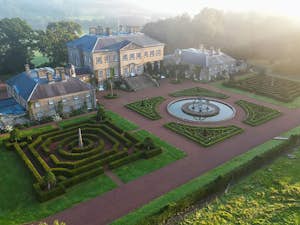
At Dumfries House in Scotland he has restored buildings, gardens and landscape and with them a certain self-belief in the local community. As the King admits, he is a convener of expert thinkers and a synthesiser of knowledge and ideas, but the ripples of inspiration that his collaborations have set in motion are evidenced worldwide in this film: from elderly communities dancing together, to food waste restaurants in London, to 270,000 trees regenerating the deserts of Rajasthan, to works of art.
Harmony updates current landscape design through the lens of systems thinking and offers a framework for future prosperity. Its core claim is disarmingly simple: much of modern life is structurally out of tune with the systems that sustain it. The result is not merely environmental damage, but cultural incoherence: a civilisation that has forgotten how to read, interpret and negotiate the world it depends upon.
A constant voice through chaotic times, the King’s work may weigh well against Ma’at’s feather long after film critics have spoken.