European officials were, on the whole, not surprised when they heard news reports last month that the Trump administration had drawn up a list of NATO allies who should be punished for failing to support the U.S. war in Iran.
Nicknamed the “naughty and nice” list, it was on brand for President Donald Trump, who often says that Western allies are not as valuable to the United States as America is to them.
The scorecard reportedly suggested suspending Spain from NATO for refusing to let U.S. military planes fly over its airspace to attack Iran. It also floated the idea of returning the Falkland Islands, administered by the United Kingdom — which also didn’t let Mr. Trump use its bases for the Iran war — to Argentina, whose president, Javier Milei, is a Trump ally.
Why We Wrote This
President Donald Trump’s reported plan to punish NATO allies over Iran war disputes, alongside troop pullbacks from Germany, has renewed Europe’s efforts to strengthen independent defenses. It also signals a faltering transatlantic security bond.
Joel Linnainmäki, research fellow at the Finnish Institute of International Affairs, sees the “naughty” list as a calculated move. “It’s difficult to believe that it would be a coincidence that these options would be leaked without there being some type of signaling intent to put pressure on some European allies,” he says.

It was also foreseeable, he adds. Secretary of Defense Pete Hegseth last December warned that “model allies that step up” to help the U.S. will “receive our special favor. Allies that do not,” he said, “will face consequences.”
European officials widely dismissed the most inflammatory of the naughty list’s penalties. There is, for example, no legal mechanism within the North Atlantic Treaty for expelling alliance members like Spain, they noted.
But Mr. Trump tends to see NATO as less a military organization than as shorthand for a collection of European allies who “freeload” on American military protection. He has treated the alliance as largely expendable, a posture that has prompted growing confidence among members that a European approach to military matters may not be such a bad thing.
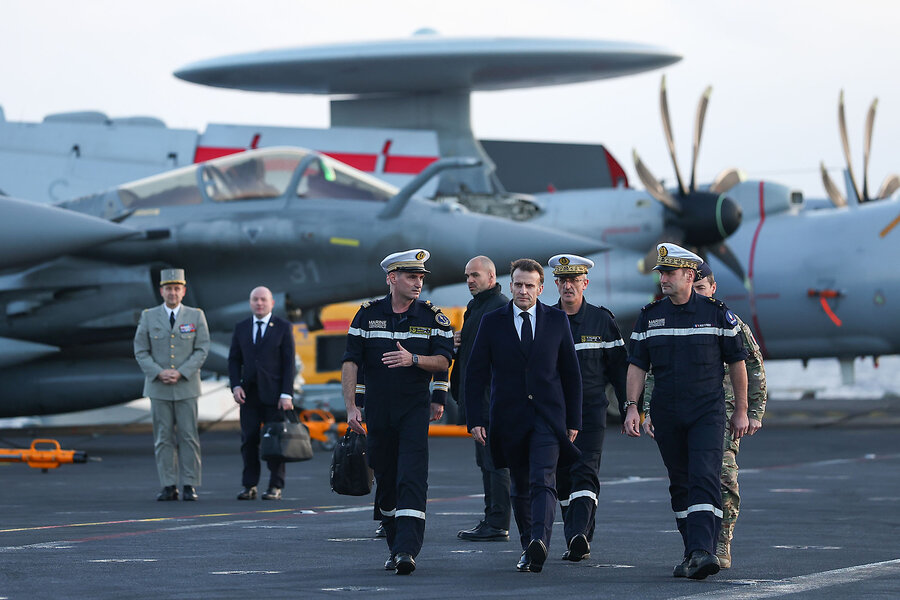
When it comes to defense, “Europeans are taking their destiny into their own hands,” French President Emmanuel Macron said Monday, “and building their own common solutions.”
Talk about a European army
Mr. Macron has been pushing for a joint, coordinated European military force for years. As far back as 2018, during Mr. Trump’s first term, the French president warned that Europeans could no longer rely on the U.S. to defend them. The continent, for this reason, needed “a true European army,” he said.
The idea hasn’t gained much traction since, but it received a boost in legitimacy last week with President Trump’s announcement that he plans to withdraw 5,000 U.S. troops from Germany. This came after German Chancellor Friedrich Merz told German schoolchildren that the U.S. was being “humiliated” by Iran.

Germany is home to about 35,000 active-duty U.S. troops. The removal of 5,000 of those service members would bring U.S. troop levels in Europe back roughly to pre-2022 levels, before the Russian invasion of Ukraine.
Still, the punishment has nudged European Union leaders to explore how the E.U. mutual defense clause, known as Article 42.7, would actually work in practice. While NATO’s Article 5 mutual defense clause, which states that an attack on one member is an attack on all, is widely recognized, the rules governing it in the EU treaty are not.
Last month, when asked during an EU summit for clarification on how a country might invoke Article 42.7 (Cyprus, not a NATO member, was concerned about Iranian drones on its shores), the European Council president, António Costa, said he was planning to put together a handbook to clear up all the questions about how the defense clause works.
Mr. Trump’s NATO efforts
The Iran war isn’t the first time President Trump has tried to get NATO more involved in the Middle East. In 2020, Mr. Trump floated the idea of creating a NATO Middle East branch, for which he suggested the “beautiful” acronym, NATOME.
Today, many European leaders have declined to participate in what they have described as America’s recent “war of choice” in Iran, which has expanded to missile and drone strikes in Israel, Lebanon, and surrounding countries.

In a minor concession to transatlantic partnership, countries led by France and the U.K. have held meetings about how best to protect safe and free transit in the Strait of Hormuz. The aim is to “reassure commercial shipping and support mine clearance,” U.K. Prime Minister Keir Starmer said in a statement after one such meeting last month. At least a dozen countries have pledged help in the form of military assets, with many others in discussions to join forces.
Mr. Starmer added, however, that this planned task force will only move forward “when conditions allow”; in other words, when the Iran war ends.
Mr. Trump called the NATO allies “useless” after that.
Trends in military spending
More concrete efforts have been made, and championed by Mr. Trump, to dramatically boost military spending among NATO members.
Military spending being allocated to defend Europe has surged to levels not seen since the early Cold War years. It is rising more quickly than at any time since 1953, according to an annual report from the Stockholm International Peace Research Institute (SIPRI).
Germany has emerged as the leader in this group, with military spending rising 24% to $114 billion between 2024 and 2025.

Spain’s defense budget has meanwhile increased by 50% to $40.2 billion, bringing it above 2% of gross domestic product for the first time since 1994. Mr. Trump has been pushing nations to raise these rates to 5% of their GDP.
Still, the trend line reflects “the ongoing pursuit of European self-reliance alongside increasing pressure from the U.S. to strengthen burden sharing,” Jade Guiberteau Ricard, an SIPRI researcher, said in a statement.
U.S. Undersecretary of Defense Elbridge Colby, who is trying to redirect Pentagon investment in Europe into countering China, called Germany’s strategy “a clear, credible way forward to NATO 3.0.”
Boris Pistorius, Germany’s defense minister, said that NATO must become “more European” to remain a transatlantic force.
Talking about Russia
So far, Europe has been putting much of its increased spending into aid for Ukraine, marking a strategic divergence from the U.S. toward Moscow.
At the same time, European nations are growing increasingly frustrated by the impacts of the Iran war, a conflict that has caused soaring gas prices and diverted funds from what many NATO members see as the more pressing Russian threat.

Though Estonia was deemed by Secretary Hegseth to be a “model” ally, the Pentagon recently delayed the delivery of six critical rocket systems to that country to redirect the weapons to the ongoing war in Iran.
And for Finland, which also shares a border with Russia, the U.S. easing of oil sanctions against Russia has caused serious concern. It has given Moscow a massive influx of oil-related funds, equivalent to “supporting the Russian war machine,” Antti Häkkänen, Finland’s defense minister, told Euronews in March. Those oil sanctions “are vital for European security,” he said.
Trading barbs
After the “naughty” list news, Spanish Prime Minister Pedro Sánchez, not one of Mr. Hegseth’s model allies, said he had “no worries” about the latest dustup with Mr. Trump.
Italian Prime Minister Giorgia Meloni, once considered a Trump whisperer, got on the president’s bad side when she denied the U.S. use of Italy’s bases for its war with Iran and then criticized President Trump’s remarks about the Pope as “unacceptable.”

Francesco Sforza/Vatican Media/Reuters/File
“She’s the one who’s unacceptable,” Mr. Trump replied.
One week later, when asked if he would pull U.S. troops out of Italy and Spain, as he said he plans to do in Germany, Mr. Trump said, “Probably.”
Prime Minister Meloni is reportedly hoping to do some damage control when she meets with Secretary of State Marco Rubio on Friday.
Troop removals
There is a possibility that these U.S. troops in Germany may be moved further east rather than sent back to the U.S. altogether, an adjustment that some say could better serve American and NATO security anyway. Still, Donald Tusk, Poland’s prime minister and another one of Mr. Hegseth’s “model” allies, has recently questioned whether the U.S. would come to Europe’s aid if it was being attacked.
For now, NATO officials are considering scaling back the number of big alliance meetings for the remainder of Mr. Trump’s second term, as an effort to sidestep “opportunities to create new crises within the alliance,” Mr. Linnainmäki of the Finnish Institute of International Affairs says.
But the big annual NATO summit, scheduled for July, remains on the horizon. The meeting location, Ankara, Turkey, is a plus, considering that President Recep Tayyip Erdoğan “is basically a strong leader in the template that Trump generally respects,’’ Mr. Linnainmäki adds.
Turkey’s strategic location also makes it important to U.S. interests. If Mr. Trump threatens to boycott the meeting, President Erdoğan will likely find a way to get him there to hammer out solutions, Mr. Linnainmäki says. “Erdoğan would have an interest in ensuring that Trump does come to the summit at the end of day.”