This article is taken from the May 2026 issue of The Critic. To get the full magazine why not subscribe? Get five issues for just £5.
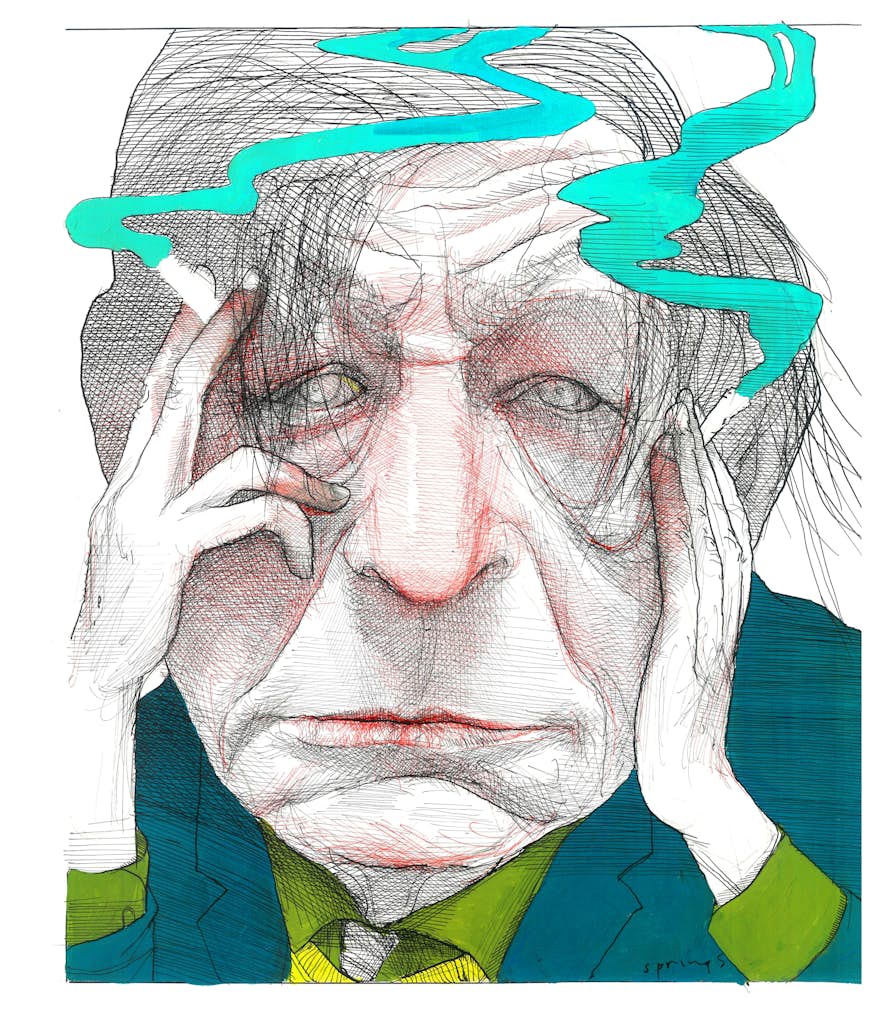
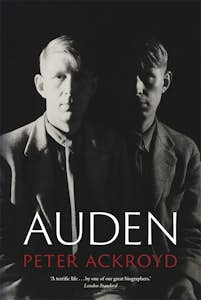
W.H. Auden was, to borrow Louis MacNeice’s phrase, “incorrigibly plural”. In this new biography, Peter Ackroyd paints a fascinating portrait of the man in all his variegated glory: poet, dramatist, critic, editor, friend and lover. The book’s 1930 cover photograph by Cecil Beaton sets the tone with its two Audens, one half-illuminated, the other in shadow. As Auden wrote in The Double Man (1941), citing Michel de Montaigne, “We are, I know not how, double in ourselves.”
Auden grappled with a youthful “passion of imitation”, tearing his way through Thomas Hardy, A.E. Housman and Robert Frost as a teenager. He shook off the anxiety of influence and emerged as a distinctive literary voice, both classical and vibrantly modern, in the 1930s. Graham Greene felt sufficiently confident to use the word “Audenesque” in a film review as early as 1933, only three years after Auden’s major debut Poems.
But despite his fiercely independent intellect, he was a keen collaborator. Ackroyd brings his artistic partnerships into sharp relief, positioning Auden amidst a constellation of his contemporaries. These collaborators included Louis MacNeice, Christopher Isherwood and his lifetime partner, Chester Kallman, as well as musical giants such as Benjamin Britten and Igor Stravinsky.
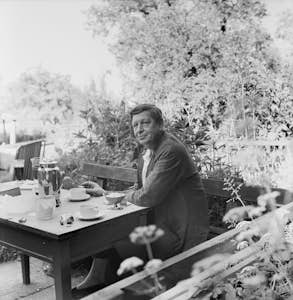
Ackroyd’s mise-en-scène is superb: every chapter is richly peopled by the poet’s friends, lovers, acquaintances and creative influences. Auden himself comes vividly to life, striding across the pages in his famously shabby outfits, habitually checking his watch and carrying his books in a worn shopping bag. The tortuous relationship between Auden and Kallman, in particular, is brilliantly captured.
Auden is the “old mother”, the eccentric genius seeking a “marriage” with his beau; Kallman is the flamboyant and capricious younger man who ended the physical side of their relationship after less than two years. Yet the two remained in a spiritual communion of sorts for over three decades, sharing houses and collaborating on projects. “I’ve lost my criterion,” Kallman wrote when Auden died in 1973.
Ackroyd is at his strongest when he quotes from the source material and allows Auden’s verse plenty of space. He has an intuitive ear for the music of poetry and a masterful understanding of prosody; he glosses complex literary devices and communicates them clearly to the reader, couching them in terms of effect rather than simply technique-spotting.
His analysis of Auden’s longest poem, The Age of Anxiety: A Baroque Eclogue (1947), is exemplary in this regard. A cross between “a modern Pilgrim’s Progress” and “an elaborate masque”, the poem is densely packed with allusion and intricate verse forms, which Ackroyd elucidates without labouring the point.
The book’s evocation of place is particularly striking, as in its depiction of Auden’s “comfortable Edwardian childhood” in York and Solihull. Ackroyd pays close attention to the “landscapes of Auden’s imagination”, as well as his childhood fascination with the nearby railway and gas works; his scene-setting ranges from the glaciers and mountains of Icelandic sagas to the mines, pits and caverns of George MacDonald’s The Princess and the Goblin (1872). We learn of childhood holidays where the Auden brothers “collected fossils and rocks, visited hill forts and stone circles, investigated Norman churches and Anglo-Saxon stone crosses” and trekked to “factories and lead mines, waterworks and slate quarries”.
The young Auden was entranced by the cadence of the liturgy and the tender rituals of faith. He grew up steeped in his mother’s devout High Anglicanism, which he would re-embrace in the 1940s. Family prayers preceded breakfast, and Sundays were marked by morning and evening services.
He imbibed what he called “the magical rites” as a “boat boy” in Solihull parish church: six-year-old Wystan wore a red cassock and white cotta, carried the vessel that contained incense and sang as a treble in the choir. Later, he learned the organ and took the opportunity to play Anglican hymns lustily whenever he could — a habit that would last a lifetime.
Ackroyd traces the intricacies of Auden’s personal and poetic development, from his education in Surrey and Norfolk to his undergraduate spell at Christ Church, Oxford, followed by a formative year in Berlin and a brief stint in Spain during the Civil War. The most crucial change in Auden’s life came when he moved to New York with Isherwood in 1939. He would settle there, establishing himself as the most important Anglo-American poet in the wake of T.S. Eliot.
Auden’s summers in Europe are amongst the most vivid and atmospheric passages in the book. In 1948 he discovered Ischia off the Bay of Naples. The island, with its glittering limestone coastline, profusion of foliage, Italianate heat and louche society of artists, held an irresistible allure for Auden and Kallman. As Auden wrote in “Ischia”, a poem written that first year:
What design could have washed
With such delicate yellows
And pinks and greens your fishing ports?
The abundance of flowers, sea, sex and sunshine proved a heady concoction, and the couple summered there from 1948 to 1957. Ackroyd’s portrayal of the Austrian farmhouse Auden bought in 1958 is equally charming: he captures the idyllic setting, with its cast of memorable village characters and the rhythms that make up daily life, right down to the ratios of the couple’s vodka martinis at 6.30pm. We take in the scene: a rough-hewn rectangular table and chairs of light-toned wood; Auden’s chair with a volume of the Oxford English Dictionary for him to sit on; drawings of Stravinsky and Richard Strauss alongside an etching of Yeats by Augustus John; and the “usual detritus of the Auden household” (the poet famously lived in squalor, which is strange considering his obsessive timekeeping and meticulous working practices).
Given the breadth of material Ackroyd has to cover, including decades of Auden’s prolific and versatile output, the biography moves with a steady, metronomic pace. Each chapter title is taken from Auden’s own words: “But It’s the Wrong Blond!”, “Have Started Biting My Nails Again”, “Beloved, We Are Always in the Wrong”, “I’m a Neurotic Middle Aged Butterball”. Initially opaque, these are cumulatively suggestive of the man’s temperament and voice.
Occasionally I had to flip back to find a date and orient myself in time, which is the drawback of these allusive echoes — a lay reader opening the book might be perplexed by the contents page. I came to like them, however. They felt like secrets to discover or clues to follow in the quest to know Auden. The chapters flow smoothly and resist the crass titillation of the cliffhanger, instead preferring understatement.
There are only three endnotes, which refer to major collections of primary works. Nothing else is sourced. This struck me as an omission for such an intricately detailed biography. You can see why Ackroyd took this approach — to streamline the narrative, avoid pedantry and keep the pace up. But a few more dates or references wouldn’t have gone amiss. Endnotes would have been a valuable resource.
The final chapter spans the last eight years of Auden’s life, then briefly sums up the circumstances around his death and funeral and notes that Kallman died less than two years later: “He may also have died of grief,” Ackroyd observes. There is no afterword or coda, no attempt to summarise, pan out or consider Auden’s legacy. But after such a vivid and quietly passionate chronicle of his life, there is no need. The effect is unexpectedly moving.