It’s only natural when you come across the aftermath of a collision to wonder who was to blame

This article is taken from the March 2026 issue of The Critic. To get the full magazine why not subscribe? Get five issues for just £5.
It’s only natural when you come across the aftermath of a collision to wonder who was to blame. And it is to be asked about the crash between reality (in the form of the two sexes) and ideology (in the form of the belief that sex is trivial in comparison to self-chosen gender identity)?
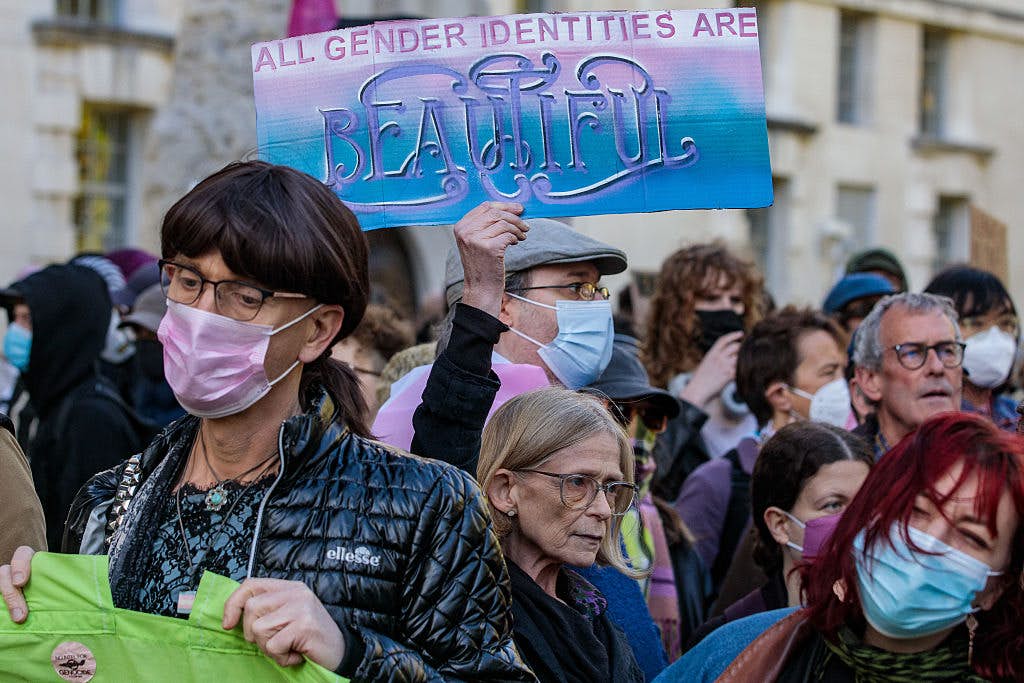
To choose just a handful of the recent news stories, whose fault is it that a trainee prison guard was sacked because he wouldn’t call male prisoners women? That NHS nurses must accept trans-identifying men in their changing rooms? That boys are winning medals in girls’ sports? That children who feel ill at ease with their sex are told they can switch?
For many, the answer is obvious: feminists. At its crudest, the argument goes like this. It was feminists who started the whole equality malarkey.
So isn’t trans activism, which denies that the sexes are distinct categories and permits men into women’s spaces, the natural consequence? Aren’t feminists just getting a taste of their own medicine? For the bottom-dwellers of the manosphere, either women can have their own category at the price of accepting that it is the inferior one, or they can’t complain about being denied a category at all.
This straw woman is easy to knock down. It’s true that some feminists have elided the claim that women are men’s equals with the claim women and men are identical. Such overreach is tempting when men have so often used sex differences to justify women’s oppression.
But the foundational claim of feminism isn’t that men and women are the same, it’s that women are fully human. And it doesn’t follow from the demand to admit women to the voting booth that men must be allowed into women’s toilets and changing rooms.
Women don’t exclude men from these spaces because they’re where the world is run, but because our physical vulnerabilities make men’s presence embarrassing and dangerous. The contrast between places from which men used to exclude women and those from which women still seek to exclude men is testament to the reality of sex differences, not a pretext to pretend they don’t exist or that women are naturally inferior.
But there’s a version of “blame feminists” that’s less tendentious. It’s undeniable that most self-professed feminists and women’s organisations now insist that “trans women are women”. It took a Supreme Court judgment and threats of further legal action to make the Women’s Institute and Girlguiding return to their original mission of providing women and girls with opportunities long denied on the basis of sex.
It doesn’t work to say “well, those aren’t real feminists.” As with defenders of communism who dismissed the failure of the USSR by saying real communism had never been tried, feminism is what women who say they are feminists do.
Trans-inclusive feminism would be unrecognisable to any previous generation of feminists, but words mean what they’re used to mean (and no, that doesn’t prove “trans women are women”; most people still use “woman” in its time-honoured fashion.) Even if the centuries-long fight for women’s liberation isn’t to blame for trans ideology, feminism certainly seems to have taken a recent wrong turn.
In “The Great Feminization”, a viral article published last October in Compact, a right-leaning online magazine, the journalist Helen Andrews extends the rap sheet to the all of wokeness, and the guilty parties to all women.
The problem with women, she argues, is that we prioritise emotion over reason and consensus over truth-seeking. We are less likely than men to support free speech, and more likely to support cancellation as punishment for causing offence. “Everything you think of as wokeness,” she writes, “involves prioritizing the feminine over the masculine: empathy over rationality, safety over risk, cohesion over competition.”
As fields of endeavour — law, academia, the media — that were shaped by men become majority female, Andrews argues, they are inevitably reshaped to favour women. Nowadays, she writes, “women can sue their bosses for running a workplace that feels like a fraternity house, but men can’t sue when their workplace feels like a Montessori kindergarten.”
Andrews mentions genderism, the wildest and least empirical of woke positions, only in passing. But it’s beyond doubt that it’s disproportionately women who tell pollsters they support it. It’s also enforced and proselytised by women. If you misgender someone at work, it’ll be someone from HR (four-fifths women) who drags you through a disciplinary. It’s in school that children are first taught genderism, and three-quarters of teachers are women.
Most academics and students in gender-addled fields such as education and sociology are women too. Some of their graduates go on to become lecturers in the same subjects; many others become teachers. And so the woman-to-woman indoctrination cycle continues.
It’s also well-established that men’s and women’s average psychological profiles differ — though the claim that men are more rational and women more emotional can stand only if you think rage and lust are conducive to clear thinking, and indeed aren’t emotions. Women are keener on working with people and less keen on working with things (tools, computers, technical systems). This no doubt tilts workplace norms in fields that women enter en masse.
But the posited mechanism of the Great Feminization is more specific: female entry is supposed to rewire institutions to replace masculine rationality and empiricism with feminine emoting and consensus-seeking. A more accurate diagnosis is that men and women each have characteristic weaknesses, and sometimes bring out the worst in each other.
Take women’s aversion for conflict and preference for consensus. This isn’t happenstance: it’s because our psyches have been shaped by having to share a planet with the half of humanity that is stronger and more aggressive. We placate men in order to live to fight (covertly and indirectly) another day. And we keep seditious thoughts to ourselves out of prudence, so of course when asked about expressing such thoughts we say it’s often best not to.
Evolution has shaped both sexes to be alert to potential mates but also to threats, which for both sexes largely come from men. The result is an asymmetry: women notice what men in general want, but men are largely oblivious to the wishes of all but the women they are interested in.
This shapes the sexes’ differing attitudes towards trans ideology, which gives a few men what they most want and leaves the rest largely unaffected while making onerous demands of all women and punishing those who refuse to comply. You might think this would mean women would be most strongly opposed.
But when men insist they are women, that demand is backed, as all male demands of women are, with the implicit threat of violence. (Many) women express enthusiasm about genderism because (some) men are so keen on it and courage is hard. The remaining men have the luxury of dismissing it as stupid and trivial (it is). The male tendency to bully women and the female tendency to placate men are both cause and consequence of each other.
It’s also simply not true that women have imposed genderism on the world. It’s been pushed above all by governments and corporations, which are run not by the teenage girls and young women who tell pollsters that “trans women are women”, but predominantly by middle-aged men. I’m sure hardly any of them believe this. But they don’t care about the harm it causes because it’s a cheap virtue-signal that doesn’t hurt them.
And finally, trans ideology isn’t a random, senseless reason why a minority of men bully women, any more than women’s capitulation is random or senseless. Sexologists have known for decades that what motivates many men’s identification as transwomen is a fetish known as autogynephilia — an obsessive, fetishistic imagining of themselves as women.
The women who play along so enthusiastically are just doing what many women have always done in the face of unreasonable male demands: placate and fawn because that’s safer and more profitable than female solidarity. When I look at the gender catastrophe, I see the consequence of collusion between both sexes at their worst.