Presidents love interest rate cuts. They help economies grow. But some of President Donald Trump’s signature policies are making such cuts less likely.
The tariffs that dominated the first year of the president’s second term raised prices. Now, his nearly three-week war with Iran has sent the price of oil – not to mention that of natural gas and petroleum-based fertilizer – soaring.
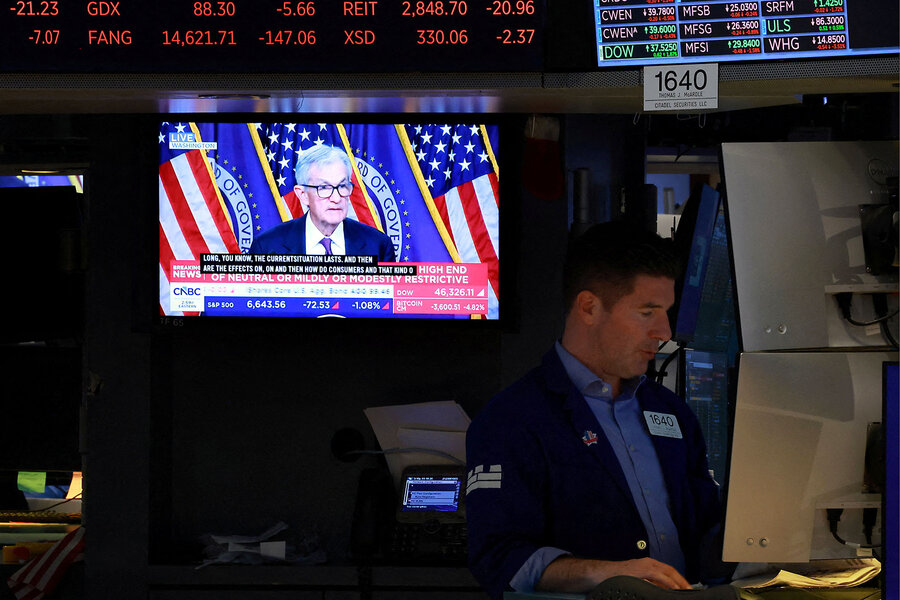
So, it came as no surprise on Wednesday when the Federal Reserve announced it was keeping interest rates steady. “We’re in a difficult situation,” Fed Chair Jerome Powell said during a news conference. “We have to just wait and see what happens. And it will come down to how long the current situation lasts and then … the effects on prices.”
Why We Wrote This
President Donald Trump has been pressuring the Federal Reserve to lower interest rates. But the Iran war and surging oil prices are complicating the economic picture, prompting the U.S. central bank to hold rates steady.
The immediate picture suggests the central bank’s progress in fighting price increases has stalled. Core inflation inched up in January on an annual basis, according to the federal Personal Consumption Expenditures price index released last week. On Wednesday, wholesale or producer prices rose more than expected. Also, the job market unexpectedly shed jobs in February, suggesting the economy is slowing even as prices are rising.
All these indicators measure conditions before the effects of the Iran war unfolded this month. Since the conflict began, oil prices have soared, reaching four-year highs on Wednesday. The three key U.S. stock indexes each lost more than a percentage point on Wednesday, continuing downward trends.
But stock traders and the Fed’s medium- and long-term outlooks are far more positive. Many on Wall Street still expect the war to wrap up in a matter of weeks.
The Fed also released on Wednesday its Summary of Economic Projections, which tracks where its rate-setting committee believes the economy will head by the end of the year. That so-called “dot plot” suggested the economy will grow a touch faster in 2026 than the committee expected in December.
While core inflation would tick up from 2.5% to 2.7% by the end of the year, the projection notably pointed to a resilient job market for the rest of 2026. It also suggested the Fed would cut interest rates once later this year and twice in 2027.
All of this depends on a relatively quick resolution to the Iran war.
Not all analysts are on board with that assessment.

“Surging oil prices driven by negative supply shocks can create a challenging outlook for global growth, particularly in the scenario of a protracted Middle East conflict,” analysts from Citi wrote in a market commentary last week. “Volatility is likely to persist until markets see clearer signals of a durable resolution, which we see as unlikely in the near-term.”
On Wednesday, in the war’s latest damage to energy infrastructure latest tit-for-tat exchange in the Iran war, Israel attacked Iran’s giant South Pars natural gas field, leaving it in flames. In retaliation, Iran vowed it would strike other Middle East oil and gas facilities.
Should Tehran hard-liners hold on to power in the coming weeks and continue to keep the Strait of Hormuz closed to oil tankers, the conflict could drag into the second quarter of the year.
“The risk of … a longer conflict that expands into 2Q is growing,” Bank of America said in a note to investors on Tuesday.