Two things can be true at the same time.
First, Alaa Abd El-Fattah should have received a free and fair trial in Egypt. The long years of detention, the suffering of his family, and the lack of due process are not things any democracy should be comfortable with. There ends my sympathy.
There is a second truth. The comments he made on social media about violence against Jews, white people and the police, amongst others, are disgusting and abhorrent.
They were also anti-British, which begs the question how officials rubber-stamped this application without escalating to then Home Secretary.
The Home Secretary should now look at all possible options, including whether his citizenship can be revoked and he can be removed from Britain.
British citizenship is more than a passport. It means subscribing to our values. Our country is our home not a hotel. But let’s ask ourselves how this mad situation occurred.
Celebrities campaigned for his release as Western politicians, various media outlets, and human rights organisations helped sanitise El-Fattah’s story. I was only aware of his case in passing when discussed in parliament and on the news.
El-Fattah was always presented as a symbol of democratic resistance. It’s now clear from the comments which emerged that many who were supporting him had brushed aside his own published political views, including explicit endorsements of violence.

Egyptian-British activist Alaa Abd El-Fattah spent years in and out of prison thanks to his pro-democracy activism
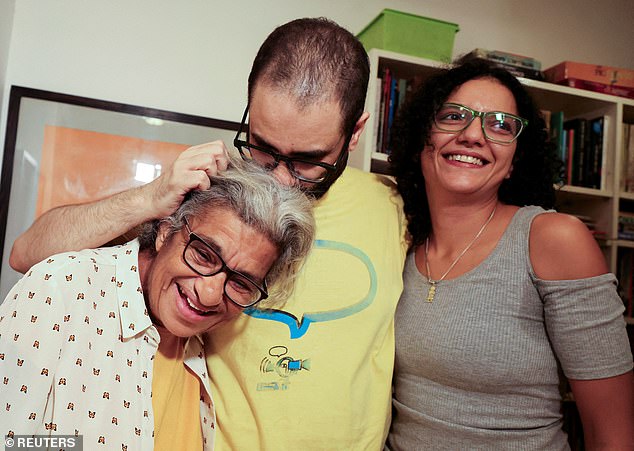
Al-Fattah, pictured with mother Laila (left) and sister Sanaa (right), was released in September but has only just returned to the UK
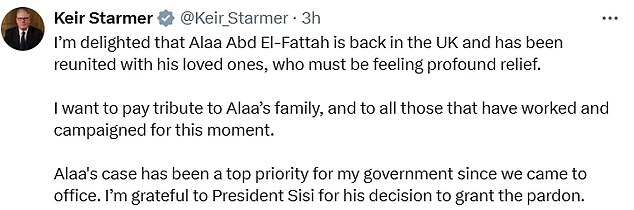
Sir Keir Starmer initially expressed his ‘delight’ at El-Fattah’s return – but now says he was unaware of ‘abhorrent’ posts’ made by the activist. In one, he said: ‘I consider killing any colonialists and especially Zionists heroic, we need to kill more of them’
Those views were not obscure in those circles. They were serious enough to cost him a major European human rights award years ago.
It is one thing to work for someone’s release from prison if they’ve been treated unfairly as previous governments did. It is quite another to elevate them, publicly and uncritically, into a moral hero.
The British government did not just work quietly for his release, it rushed to celebrate it: our Prime Minister expressed ‘delight’.
This rush to moral posturing has consequences. Firstly, it risks validating the narrative of Western unseriousness. Middle Eastern authorities have repeatedly expressed concerns about the kid gloves with which the West treats extremists who are not allowed to operate within their borders.
There is a deeper problem here which I have spoken and written about frequently.
Too many people now enter Parliament to act as activists and campaigners, not as legislators. This is not about doing the work of a Foreign Secretary on consular cases, or about campaigning for real human rights victims like Jimmy Lai, it is about those who prioritise virtue-signalling over due-diligence.
Those who push colleagues to act quickly, publicly, and emotionally, without doing the hard work of scrutiny that governing actually requires. It is why we have Prime Minister and Home Secretary who signed letters to stop the deportation of foreign rapists and murderers.
That culture in our parliament has consequences. Yes, it is mostly on the left, but let’s be honest, all parties indulge in this nonsense, including on occasion the Conservatives. I recall senior figures in Reform UK, including David Jones, at the time a Tory MP, leading the charge for El-Fattah’s release in Parliament.
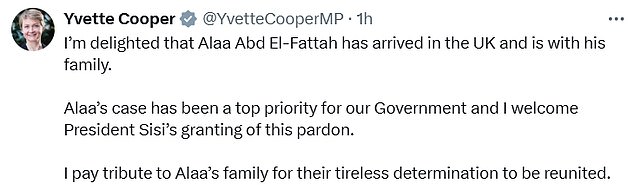
Home Secretary Yvette Cooper was another of the senior politicians to celebrate El-Fattah’s release and return to the UK
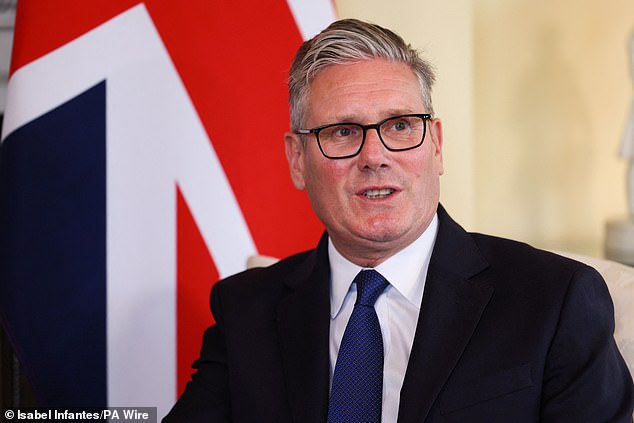
The PM (pictured) has rowed back from his earlier comments in which he sparked backlash for saying he was ‘delighted’ by Alaa Abd El-Fattah’s return to the country.
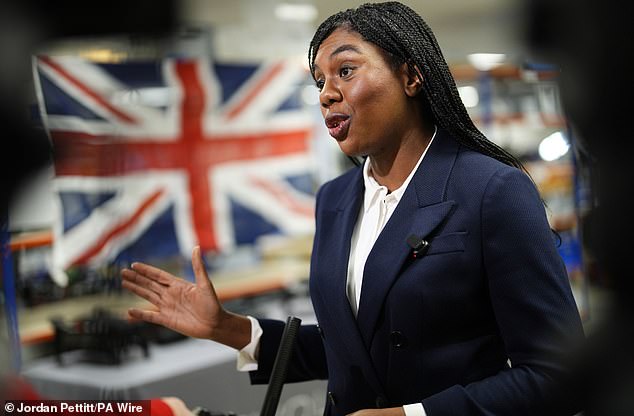
Conservative leader Kemi Badenoch (pictured) is calling for Alaa Abd El-Fattah’s citizenship to be revoked and the activist to be deported on the back of his historic social media comments, which also included a post reading: ‘There was no genocide against Jews by the Nazis – after all, many Jews are left’
It is inconceivable that no one saw Alaa Abd El-Fattah’s published statements over the years. Ten years ago, some people may have dismissed comments advocating the killing of Jews as offensive but unserious, or merely loose talk. After 7 October 2023, that excuse no longer exists. We now live in a very different world.
Since October 7, we have seen a sharp rise in the intimidation and terrorising of Jewish communities. We have seen antisemitic rhetoric translate into real-world harm with violence and murder in Manchester, in Bondi Beach, and elsewhere. In that context, calls for violence against Jews cannot be brushed aside.
I do not want people who hate Britain coming to our country. And where such views are part of an individual’s public record, they must be considered when decisions are taken about citizenship. We have been too complacent for too long.
Another serious problem is that there will be junior officials and decision-makers within parts of the Civil Service who hold these views, or see nothing wrong with them. Some will have absorbed an activist mindset that treats antisemitism as contextual, or worse, morally right. That is unacceptable. This ideology must be rooted out of our institutions.
This case also illustrates a broader Conservative point. When the state tries to do too many things, especially in complex areas like foreign affairs, it often fails to do the most important things well.
We do not currently have a system that consistently applies the level of due diligence that today’s security environment demands because we are spending a lot of time getting involved in things we have no capacity for.
Conservatives under my leadership will do things differently. I have already changed our policy, making it tougher to get British citizenship, but more must be done. Citizenship decisions must be grounded in rigorous assessment, not box-ticking.
They must take account of social media activity, public statements, and patterns of belief. And they must be guided by a clear test of whether granting citizenship is conducive to the public good.
That is the lesson of this case. And it is one we intend to act on.