Experts have warned of a ‘significant risk to the public’ as Zootopia 2 sparks sales of dangerous snakes.
The animated movie features a friendly blue snake named Gary De’Snake, voiced by Ke Huy Quan, who has become a firm favourite with fans.
However, the movie’s popularity has triggered a ‘boom’ for exotic pets as fans flock to import Gary’s real-life counterpart, the Indonesian pit viper.
In China, where Zootopia 2 was a massive hit, unscrupulous pet dealers have even started selling dangerous blue snakes on social media and online marketplaces.
These potentially deadly snakes are being sold for as little as £191 (1,800 Chinese Yuan) with absolutely no safety restrictions.
Some sellers tried to cash in on the trend by calling their Indonesian pit vipers ‘the same little blue snake as Gary from Zootopia 2’.
However, while these snakes might be branded as cute, experts warn that this is a species which is particularly prone to biting humans.
Dr Nicklaus Brandehoff, Executive Director of the Asclepius Snakebite Foundation, told the Daily Mail: ‘I wouldn’t recommend this snake to a novice handler at all. They are very bitey, like a lot of tree vipers are if you get in their space.’
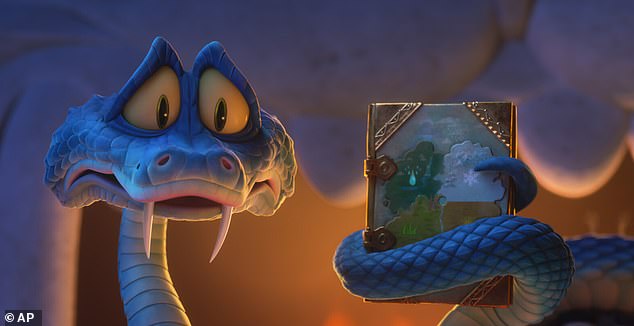
Experts have warned of a ‘significant risk to the public’ as Zootopia 2 sparks sales of dangerous snakes. Pictured: Gary De’Snake, voiced by Ke Huy Quan, in Zootopia 2
The Indonesian pit viper, or Trimeresurus insularis, is a strikingly coloured snake native to Southeast Asia.
Despite being a venomous member of the pit viper family, its incredible colouration has made it an enticing choice for snake owners around the world.
Dr Brandenhoff says that these snakes were already popular with handlers in the US, while research conducted by the charity Born Free found that there were at least 21 being legally held in the UK.
However, following the release of Zootopia 2, there has been a sudden surge of interest in Indonesian pit vipers.
Dr Brandenhoff says: ‘There’s been sort of this explosion of interest from people who just don’t understand this snake and the complexity of caring for it.’
In China, this increased interest appears to have been fed by a network of online traders with a willingness to skirt local wildlife rules.
On the Chinese marketplace Xianyu, which is owned by the Alibaba Group, the Daily Mail found one seller offering an Indonesian pit viper for just £191 (1,800 Chinese Yuan) under the common nickname ‘Island blue bamboo’.
The seller gave no indication that the snake was dangerous, and the animal was being sold alongside several common non-venomous pet species.
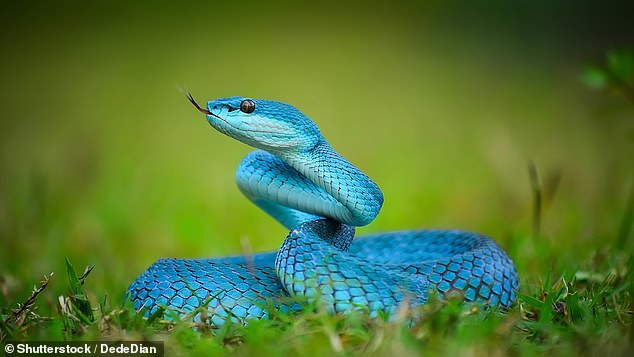
The popularity of the character Gary De’Snake has led to a ‘boom’ in demand for Gary’s real-life counterpart, the venomous Indonesian pit viper (pictured)

In China, unscrupulous pet dealers have attempted to cash in on the trend by selling the dangerous snakes online. The Daily Mail found this Indonesian pit viper for sale on the marketplace Xianyu for just £191 (1,800 Chinese Yuan)
Likewise, research conducted by Shanghai-based media outlet The Paper found multiple accounts selling Indonesian pit vipers on Xianyu and the popular TikTok-like social media app RedNote.
The majority of these listings were removed following The Paper’s report; however, the Daily Mail still found multiple venomous snakes available on both sites, including the mildly venomous Baron’s Racer snake, Philodryas baroni.
On RedNote, these live snakes were included in searches for ‘Gary the blue snake’ and offered alongside plastic toys for children.
Dr Brandenhoff says the big concern is that the popularity of Zootopia 2 has convinced many people to buy an exotic pet without doing the appropriate research.
While the online sellers offer little to no information about their wares, the Indonesian pit viper is an exceptionally dangerous snake to its owner.
Asked what advice he would give someone considering buying their own Gary De’Snake, Dr Brandenhoff’s advice was simple: ‘Just don’t do it.’
‘This is not a beginner snake. There’s no way that I should ever have one of these snakes, and I’m fairly confident with how to do these things.’
As ambush predators, these snakes’ only interaction with humans is usually through feeding.

Zootopia 2 is China’s top-grossing foreign animation of all time, raking in more than £379 (3.55bn Yuan), and fans have fallen in love with the iconic blue snake
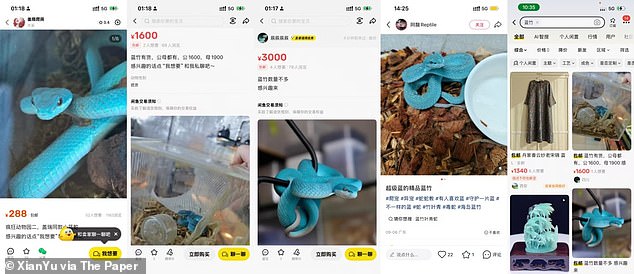
Chinese social media and marketplaces were flooded with sellers offering the dangerous snakes, often with no indication that they were dangerous
‘They become habituated so that when there’s contact with humans, it’s feeding time, so that makes them more apt to bite,’ says Dr Brandenhoff.
These risks are even higher for inexperienced snake owners who might be buying an animal from social media.
Each specific species of snake requires a particular set of handling protocols to avoid bites, as well as specialist equipment and skills.
These risks are so high that Dr Brandenhoff says responsible snake owners will often undertake an apprenticeship with an experienced handler to learn the skills.
He adds: ‘Responsible snake owners don’t get them from social media. I would think that very few of these people know how to actually care for these snakes.’
The venom of the Indonesian pit viper leads to painful swelling, toxicity of the blood, and increased bleeding.
While bites do not typically cause death, fatalities have been recorded in areas where this species naturally lives.
However, the pit vipers’ biting habit is especially problematic because there is no specific antivenom for their bite.

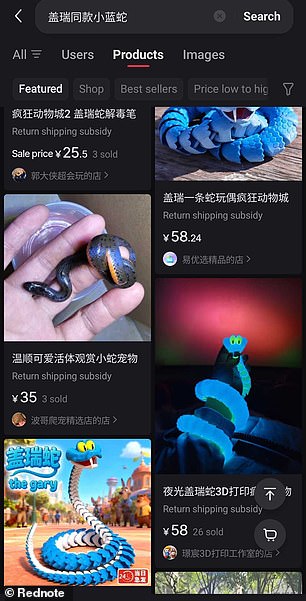
On the TikTok-like social media RedNote, the Daily Mail found live snakes being sold alongside plastic toys under the search term ‘Garry the blue snake’
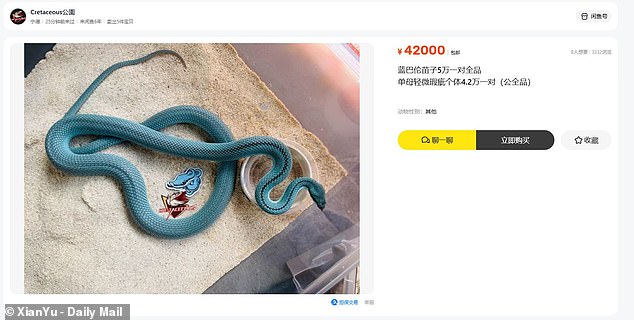
Many posts selling Indonesian pit vipers have been removed, but other venomous species, such as the baron’s racer (pictured), were still available
Dr Brandenhoff says he has used antivenom intended for the green pit viper to treat bites with some success, but the chances of encountering a doctor with his level of knowledge are low.
He says: ‘You’re talking about a bite that may be only partially covered by antivenom, if you can even get the antivenom, and if you can get somebody who knows what they’re doing medically to be able to treat the snake.
Currently, experts believe that the surge in demand for Indonesian pit snakes and other blue species isn’t likely to spread to the UK.
Evangeline Button, Senior Scientific and Policy Officer at the RSPCA, told the Daily Mail: ‘They can only be kept with a licence, granted by local authorities, after an inspection of the keeper’s facilities.
‘Because of these safeguards, we would fortunately not expect there to be a surge in ownership as a result of Zootopia 2, and we’re not aware of any currently being offered for sale.’
However, TV, films, and social media can and do drive interest in exotic pets, which can have dire consequences for the species in question.
‘Exotic animals, like snakes, have needs that can be difficult to meet in a home environment,’ says Ms Button.
‘They require living conditions that mirror the wild, which includes the right environment and diet, and awareness of their behaviour, size, and lifespan.
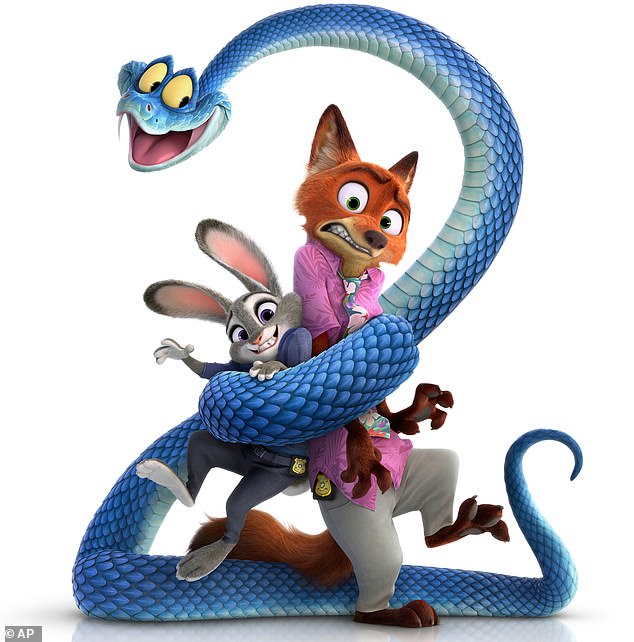
Experts say that the real Indonesian pit viper is exceptionally prone to biting owners, and that fans of Zootopia 2 should not be tempted to buy one
‘This means that some people may take on these animals without fully understanding the level of care and commitment involved, which can sadly lead to poor welfare and suffering.’
Likewise, although many pet snakes are bred in captivity, spikes in demand can outstrip what the legal market can sustain.
It is well documented that exotic pets, including members of endangered species, are often poached from conservation areas to fuel demand abroad.
Chris Lewis, captivity research manager of Born Free, told the Daily Mail: ‘Sudden surges in demand for specific, less commonly traded, species increases pressures on wild populations, with individuals, sometimes illegally, taken from the wild.’
Likewise, Dr Brandehoff says he ‘would have a hard time’ believing that many of the pit vipers listed for sale were not poached from the wild.
He adds: ‘I suspect that, with the boom, the captive-bred population isn’t able to keep up, so a lot of them may be being poached from areas that are highly sensitive to encroachment.’
Xianyu and RedNote were contacted for comment.