The next BMW you order might have been pieced together by an I, Robot-style humanoid.
The German car giant has recruited AI-powered robots at its Leipzig plant to help assemble its latest models at lower cost.
With Europe’s auto industry struggling against to keep pace against an onslaught of cheaper Chinese newcomers entering the market, the Bavarian firm is the latest vehicle maker to employ humanoids in an effort to reduce labour and manufacturing costs.
This follows a successful trial of humanoids in one of its factories in the US last year.
And BMW isn’t alone in using human-like robots on its assembly lines; Hyundai, Tesla and a number of major car firms are heavily investing in the humanoid market, which is forecast to boom over the coming years.
Bosses at the car maker said the humanoids are taking over tasks that are particularly demanding in terms of ‘repetition, speed and accuracy’ as well as being ‘physically exhausting’ for employees.
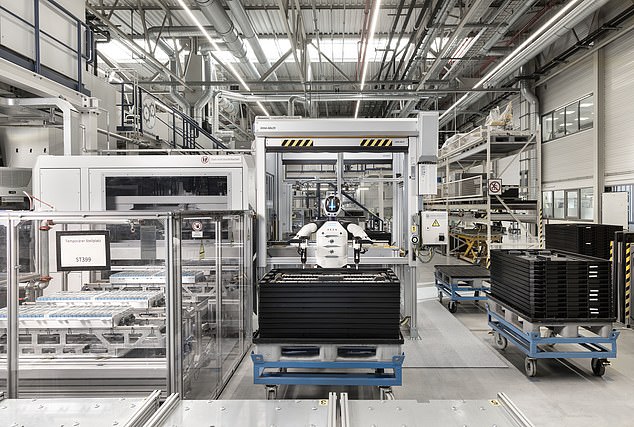
German car giant BMW is using AI-powered robot humanoids on its assembly line in Leipzig where the 1 Series, 2 Series and Mini Countryman is produced
BMW said it is aiming to ‘integrate humanoid robotics into existing series production of cars’ to ‘explore further applications in the production of batteries and components’.
It has not revealed how many humanoids have been deployed at the factory, though says it is in the ‘single digits’.
The robots are supplied by Swedish firm Hexagon, which is just one firm among a market that Morgan Stanley predicts to be valued at $5trillion by 2050.
They have been posted to the car company’s high-voltage battery assembly line where staff are required to wear layers of protective clothing on safety grounds.
The aim of the project is to utlise the humanoids in the most undesirable and demanding roles within the environment of car production hubs.
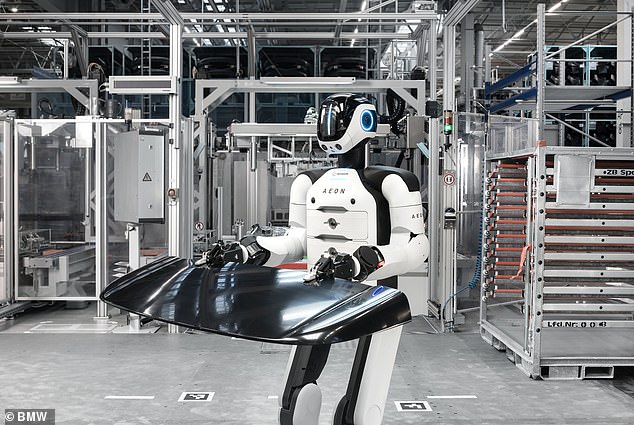
The humanoids are being deployed to reduce labour costs, streamline production and takever panstaking and reptitive jobs that are most exhausting for employees
In its plant in Spartanburg, South Carolina, last year, BMW used humanoids to takeover the painstaking job of precision positioning of sheet metal panels for welding used in more than 30,000 X3 SUVs over a 10-month trial.
They were designated to the production line for 10-hour shifts five days a week to great success and reduced burden on staff.
‘The results demonstrated that Physical AI can deliver measurable added value under real-world conditions,’ the car giant said in its statement on Friday.
‘The pilot confirmed that humanoid robots can safely perform precise, repetitive work steps,’ it added.
The Leipzig plant – where the BMW 1 Series, 2 Series and Mini Countryman are produced – will have a test deployment from April before rolling the project out permanently later in the year.
The company said it will ultimately ‘relieve employees and further improve working conditions,’ though failed to reference if any job losses would result from the acquisition of a new robot workforce.
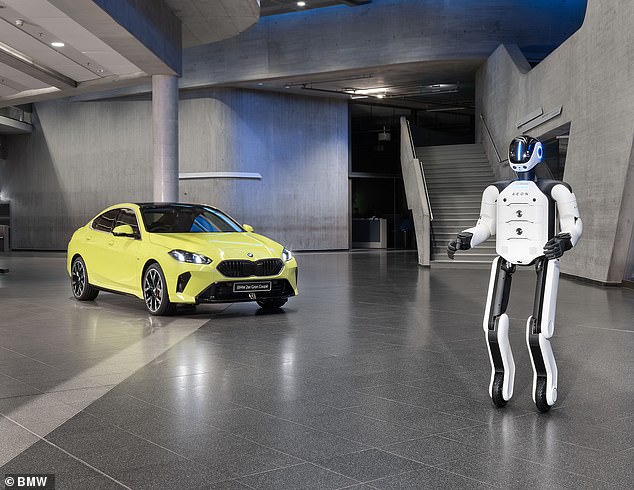
The robots have been supplied to BMW by Swedish firm Hexagon. Morgan Stanley has forecast the value of the AI-based robot industry to be worth $5trillion by 2050
And BMW might not stop at using the humanoids in its vehicle assembly plants; bosses too have hinted that they could take over other tasks outsourced to suppliers.
‘This gives us opportunity to do more production in-house,’ said Michael Strobel, head of process management at BMW.
The automotive sector, using its engineering expertise, considers itself a prime industry for the development and deployment of humanoids, not only to reduce labour costs and improve productivity but also as a potential new revenue stream.
Hyundai is already testing humanoids in some of its factories using products supplied by its Boston Dynamics subsidiary that have been specifically tuned for the factory floor.
Toyota earlier this month also announced it will rollout a team of humanoids at its plant in Canada, while BMW’s biggest rival, Mercedes-Benz, has been utilising them for quality control in its Berlin factory.
Ford too has dabbled in the use of humanoids at its largest European manufacturing hub in Cologne.