Preparing my Easter sermon, and looking for inspiration, I leave the flower arrangers and choir practice and go for a gentle wander around Kew Gardens, a few hundred yards from my lovely church.
The blossom is out in full now, cherry, magnolia and blackthorn. The woods are carpeted with bluebells. You can just feel the whole place bursting into colour.
I don’t know why I bother with a sermon. This place proclaims the wonder of new life more than I ever could from the pulpit.
A few months ago, all was hidden under hard cold earth – winter’s tomb. Now, once again, the miracle of existence has exploded before our very eyes. Nature doesn’t struggle for words to describe the miracle of resurrection.
‘L’chaim’ as our Jewish friends like to say: to life. For me, this is the shortest possible description of the message of the whole Bible.
It begins with the book of Genesis, a glorious ode to the very fact of existence, to the goodness of creation. God breathes life into everything. And before we mess things up, human beings are placed within a garden, an earthly paradise.
Adam, the a first human, is the Hebrew word for soil, earth. In the story, God takes a handful of earth, shapes it into human form ‘and breathed into his nostrils the breath of life.’
The garden is where everything begins, where all things come alive and flourish.

Rev Giles Fraser (pictured) says you don’t need to go into space to appreciate the cosmic nature of the Easter story – just pop into your garden
Throughout the story of the Old Testament, the Jewish people struggle to assert life in the face of forces that threaten to overwhelm it.
Even the sacrifices of the Temple, when understood properly, are a celebration of life – the Jewish priests offering back to God the life-gift that has been given to us all. ‘All things come from you O Lord and of your own do we give you.’
The New Testament continues this toast to life, exploring one of the most convincing counterarguments to the victory of life idea – the fact that we die.
Doesn’t death contradict this celebration of life?
Easter says no, even death cannot defeat God’s insistence on the power of life. Life is stronger than death. That’s the bones of every Easter sermon. That’s why Christians celebrate. L’ chaim, to life.
But this is not just a sermon for the inside of churches, even though we would love to see you there. It’s a sermon preached by creation itself, by the bluebells and the blossom.
And what better way of taking part in this great celebration of life than spending some time in the garden.
There is a beautiful line in John’s Gospel where the resurrected Jesus makes his first appearance to Mary Magdalene. At first, she doesn’t recognise him – ‘Supposing him to be the gardener’ the Gospel says.
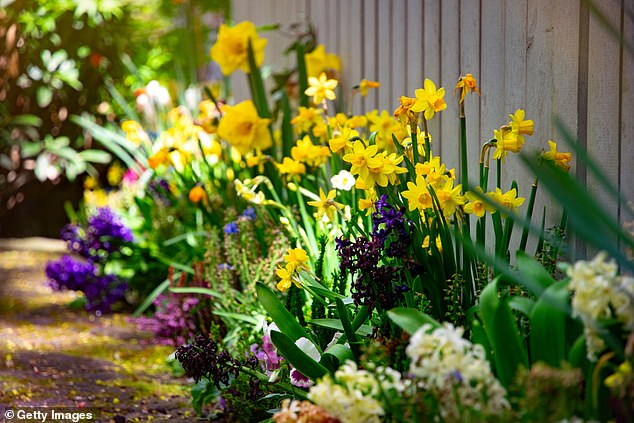
What better way of taking part in this great celebration of life than spending some time in the garden, says Rev Giles Fraser
But the wonderful subtlety of John’s story is that Mary is also right, he is indeed a gardener.
Human beings were expelled from paradise, from the Garden of Eden, and here is the author of life inviting them back in. The garden is the holiest of places.
Not just in Christianity, of course. Islamic gardens, with their calm, cool shades and running water, describe a place of restful sanctuary.
Tranquil Zen gardens encourage meditation. For centuries, monks of all traditions have learnt as much about the nature of God from their time in the garden as they have in their more formal places of worship.
You don’t even need to be religious. On your knees, hands in the dirt, coaxing existence from the seeds and caring for green shoots, this is the most faith adjacent activity there is.
Planting something is always a work of hope, an investment in the future. Even the cress seeds my children place in an egg box with wet cotton wool elicits in them a wonder at the miracle of life.
The delight they take in these sprouts of green is a reflection of something deep within us, some sense of alignment with a world that throbs with life. Here is the story of the Bible sat on our kitchen windowsill.
Whether you have an allotment, several acres of parkland or a window-box on the 17th floor, this is the place of spiritual enrichment for millions of people.
Indeed, a third of the UK population think of themselves as regular gardeners, making it a more popular activity than going to concerts, the cinema or participating in sport.
Those of us who love our gardens are a great untapped resource in the fight for a greener, more life-filled future for our grandchildren. But for all this grassroots support, our political parties seem to betray this natural instinct.
The Green Party concerns itself more with the politics of the Middle East than the health of the planet. The Conservatives have long since lost the instinct to conserve.
Twenty years ago, David Cameron rebranded the party using an oak tree as its logo, but this signalled little in terms of conservation.
Here in Kew Gardens they are preparing for a warmer future in which native trees are at serious risk of dying out.
My parish has a claim to being the most biodiverse in the world. Trees and plants were brought from all over the planet. One tree was planted here sometime around 1762.
Yet more than half of the 11,000 trees in Kew may not survive this century. Scientists modelling weather patterns have advised that in 50 years our weather may look more like that of southern Europe, and so are looking to plant the next generation of trees that are native to places with a hotter, dryer environment.
Native oaks, like that on the Conservative logo, may become a thing of the past.
Hope is hard to find. But hope springs eternal. Up in space, a work of extraordinary scientific achievement is heading towards the Moon, a vessel named after the Greek goddess of nature, Artemis.
The first astronauts who went to the Moon spoke of their surprise that the thing they learnt most about their adventure was not about the Moon, but about the Earth. Seeing the planet from space made them appreciate how fragile it appeared.
It came to be called the overview effect, and was often associated with a new way of thinking about the existence of our planet and a greater appreciation for life itself.
Here in church, we will also be celebrating the overview effect this Easter. It is a big-picture story, where a man is cruelly hung on a tree 2,000 years ago and yet where he comes back from the grave to give life to all.
You don’t need to go into space to appreciate the cosmic nature of this story. Go into your garden. Sit quietly for a moment. Consider the birds of the air and the lilies of the field.
Once more, life is renewed. Alleluia!