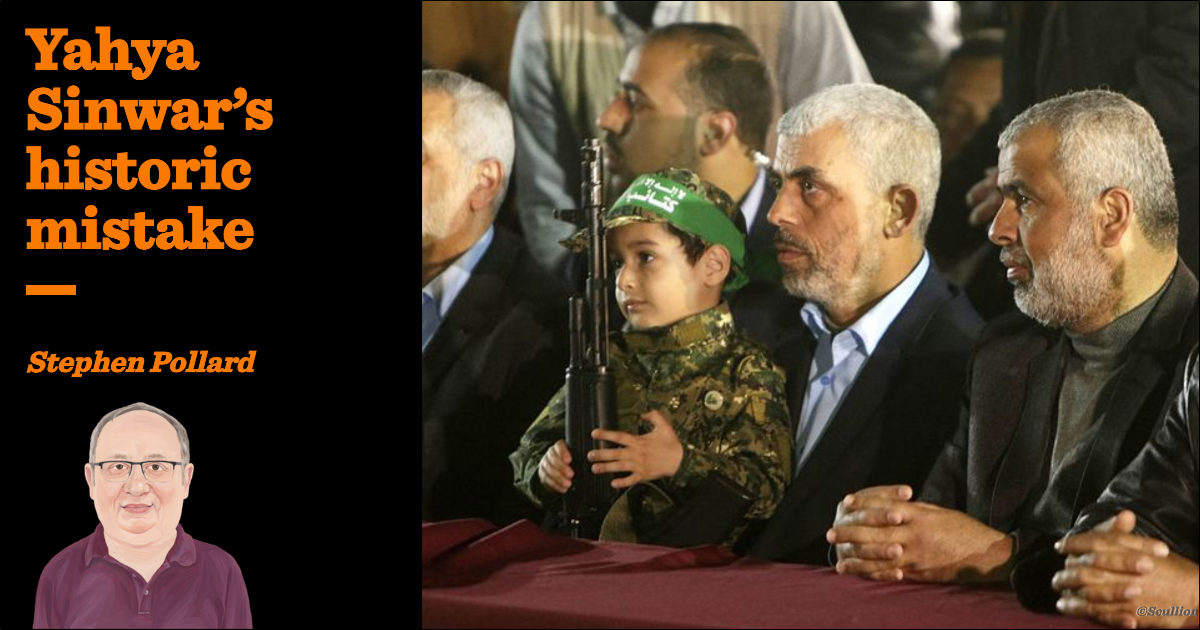

In the long history of terrorism, there have been few more horrific atrocities than the Hamas massacre of some 1200 Israelis on October 7, 2023. Planned by Hamas’ leader, Yahya Sinwar, with the support of its patron, Iran, the intention was manifold, from the slaughter itself — one of Hamas’s oft-expressed aims is to kill Jews for the sake of killing Jews — to the wider goal of sparking a reconfiguration of the region through a wider war via the so-called “Axis of Resistance”. This is the coalition conceived by the Iranian Supreme Leader Ayatollah Khamenei as a strategic instrument, including Hezbollah in Lebanon, the Houthis in Yemen, various Iraqi militias, and Hamas itself in Gaza.
The Axis of Resistance was an extension of Khamenei’s “Ring of Fire” — the strategic doctrine of surrounding Israel with a network of armed proxies and militias aimed at undermining its security and expanding Iranian influence whilst avoiding direct war.
Hamas certainly succeeded in killing Jews, with over 1200 murdered. But in every other aspect, the October 7 massacre can be seen now as one of the most counter-productive acts of terror in history. Sinwar and Khamenei’s plan certainly reshaped the Middle East — but, as the Israeli-US attack on the Tehran regime is just the latest demonstration, entirely in Israel’s favour. The Middle East of October 6 2023 has vanished; the Middle East of October 8 onwards is very different. As a result of October 7, Israel now has near-complete security, and that is only going to get better and stronger as the reshaping of the region develops.
The October 7 massacre was, patently, a disaster for Israel, and a humiliation for both its security apparatus and for Benjamin Netanyahu, whose entire political sell was as Mr Security. Contrary to the caricature in much of the media, Netanyahu had always been cautious to the point of inaction with regard to use of Israeli forces. He had, for example, warned about Iran’s nuclear programme for many years without ever acting. And Israel only responded when attacked — it did not launch pre-emptive strikes under Netanyahu.
The Gaza war which followed the October 7 massacre fitted that pattern, too. Israel was responding to Hamas’s terror. Indeed, most observers had concluded before October 7 that the region was unusually quiescent. But cautious as he has been, Netanyahu is also one of the great strategic analysts. Even his political opponents recognise his sophisticated and supple understanding of the world around him. So, while Israel was engaged in a normal military operation in Gaza to degrade Hamas’ capability, Netanyahu understood that October 7 had shaken the kaleidoscope and presented an unprecedented opportunity for Israel to ensure that the pattern that finally emerged would put Israel’s security on a new footing.
That meant a variety of approaches to a variety of enemies. The pager bombs which wiped out the entire Hezbollah leadership was a uniquely Israeli approach, and that was followed by strikes on the Iranians’ nuclear facilities which also destroyed its air defences. And when the Houthis launched missiles at Israel, Netanyahu responded with strikes which many analysts had said were logistically impossible.
In the pantheon of catastrophically awful military or terrorist strategists, Yahya Sinwar must surely stand alone at the top
Add to that the fall of Assad in Syria and one can see that within a year or so of October 7, almost all Israel’s enemies had either been destroyed or suffered severe, crippling setbacks. Such has been the impact of the new regional order and Iran’s desperate response to it that we have now witnessed the previously unthinkable — Qatar taking down Iranian fighter jets.
Israel and the US have not only taken out Khamenei and the rest of what, until very recently, constituted the Iranian regime’s leadership, they have established a new paradigm in which Iran, whether the regime stays or falls, no longer appears to be a serious threat either to it or to its Arab neighbours.
In the pantheon of catastrophically awful military or terrorist strategists, Yahya Sinwar must surely stand alone at the top, with October 7 as his greatest disaster.