Not since 1941 has Iran been conquered.
That year saw the armies of Britain and the USSR combine their air, land and sea might to rush the country during the Second World War to defeat the severely under-developed military set up by Iran’s then-ruler, Reza Shah.
Donald Trump appears to be angling to emulate the success of the UK-Russian invasion with his roiling war in the Middle East, as for the first time since the conflict began the US sent 5,000 US Marines to the Middle East.
The US troops will head to the conflict from Japan, as a defiant Trump told press last night that the war would end ‘when I feel it’, while defence secretary Pete Hegseth told CBS that the US is ‘willing to go as far as we need to’.
The deployment of US boots on the ground came despite White House press secretary Karoline Leavitt saying last week that ground operations were ‘not part of the plan right now’.
But Iran is a notoriously difficult country to invade, thanks to its tough terrain.
The country is home to vast salt flats, dense and swampy marshes, and a series of rocky mountains that create a natural, nationwide fortress, in which countless military and nuclear sites hide.
Iran’s dominance over the Strait of Hormuz, a waterway to its south, means that any enemy vessels in either the Gulf of Oman or the Persian Gulf may become sitting ducks.
Some experts have warned that America could face a worse environment than they encountered in Afghanistan, Iraq and even Vietnam.
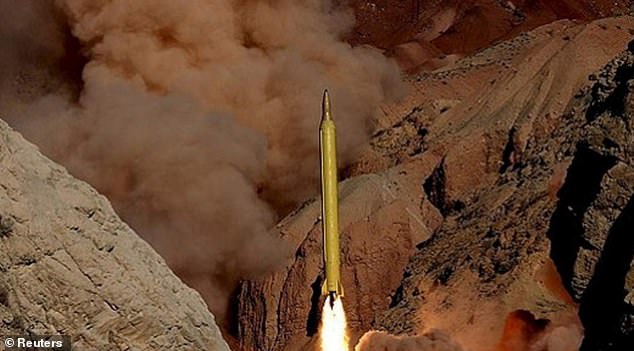
Iran has hidden countless missile facilities across its mountains (File image)
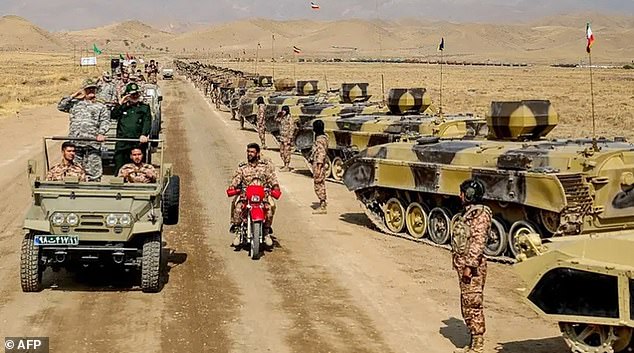
Islamic Revolutionary Guard Corps (IRGC) seen taking part in a military drill in the northwestern region of Aras along the borders of Armenia and Azerbaijan in 2022
Analyst Çağatay Balcı wrote in Turkish newspaper The Daily Sabah: ‘A comprehensive ground intervention could prove even more strategically costly than Vietnam, Afghanistan and Iraq combined.’
Iran is one of the biggest countries in the world, coming in at just over 630,000 square miles.
Its total land mass is larger than France, Germany, the Netherlands, Belgium, Spain and Portugal combined.
It also has one of the largest populations in the world, with more than 93million citizens.
Comparing these statistics to its neighbours, it’s easy to see why Iran has emerged as such a dominant player in the Middle East.
It is four times bigger than Iraq, and nearly three times bigger than Afghanistan. Meanwhile, it has a nearly twice as big a population than both nations.
The whole country has an incredibly high elevation. Tehran, Iran’s capital, sits at 3,900ft.
For comparison, London’s elevation is just 139ft at its peak.
According to the US Air Force Medical service, military personnel operating in locations above 4,000ft can cause ‘acute mountain sickness, the most common and mild form of altitude illness, and decreased performance’.
This requires significant training and acclimatisation, something which may not be possible for a full ground invasion of a country.
Iran is not only a large and significantly elevated country – much of it is based on mountains.
The nation has three major mountain ranges, the biggest being the Zagros range.
They run for around 990 miles from Iran’s northwest border with Turkey towards Bandar Abbas on the Strait of Hormuz.
It towers over the Persian Gulf, the home to some of the most important oil ports in the world.
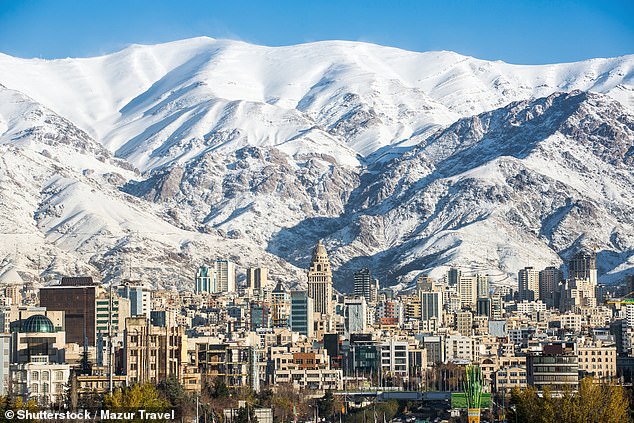
Tehran is protected by the Alborz Mountains (pictured)
The highest point on this range is Mount Dena, which pierces the sky at 14,465ft.
Along the Caspian Sea is the Alborz Mountain Range, which also protects Tehran’s northern side.
The Alborz Range is home to Iran’s tallest mountain, Mount Damavand.
At its peak, the mountain stands at 18,405ft.
And lastly is the Makran mountain range, which stretches across Iran’s portion of the Gulf of Oman.
These mountains are where much of Iran’s population is concentrated.
On top of this, an analysis of publicly available information shows that the vast majority of Iran’s military and nuclear assets are hidden throughout its three mountain ranges.
Mountains are notoriously difficult to fight in.
According to NATO’s Mountain Warfare Centre of Excellence, they present vast challenges including difficult access, rugged terrain, extreme weather conditions and high altitude.
Soldiers and military vehicles in this environment have to deal with steep inclines, narrow paths and potentially lethal falls.
As a result, NATO recommends that armies are split up into smaller-than-normal units to allow for flexibility and agility.
But this increases the risk that each unit is dominated by opposing Iranian forces.
Kris Osborn, military affairs editor of defence publication 19FortyFive, warned that the Islamic Revolutionary Guard Corps could easily mobilise large numbers of fighters who are all trained in guerrilla warfare and would know their terrains far better than an invading army.
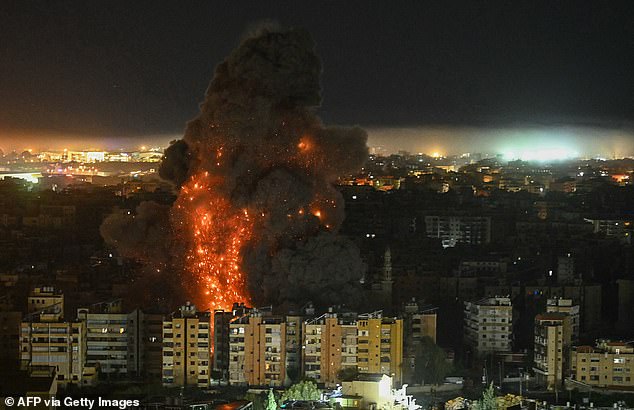
A fireball rising from the site of an Israeli air strike overnight in Beirut on March 11
He said: ‘Even if the United States defeated Iran’s conventional army, these irregular forces could continue fighting for years.’
The only part of Iran’s borders that isn’t elevated is the Khuzestan province, which sits at the head of the Persian Gulf.
But an invading force would run into a different, equally arduous problem.
The region is known for its wide marshes. Among the biggest are the Shadegan Ponds, a series of wetlands covering 400,000 hectares.
Wetlands are notoriously difficult for invaders to pass through. Heavy vehicles, like tanks, can easily get stuck in saturated soil.
And the terrain around marshes is often both too complex for ordinary land vehicles and too shallow for waterborne vehicles.
Any invading troops that do walk through marshes will have to follow predictable routes, which makes them easy pickings for Iranian soldiers who know these lands like the backs of their hands.
What if the US decides to take a leaf out of Franklin D. Roosevelt’s book and launch a paratrooper invasion of Iran?
During WW2, as part of Operation Overlord, the US launched up to 17,000 paratroopers and gliders into Normandy to secure vital routes.
The creation of the Normandy airhead allowed the Allies to then land amphibious vehicles.
But this relies on dominance in Iran’s southern waters. The Strait of Hormuz is littered with Iranian vessels already aggressively pursuing tankers trying to reach or leave its Gulf neighbours.
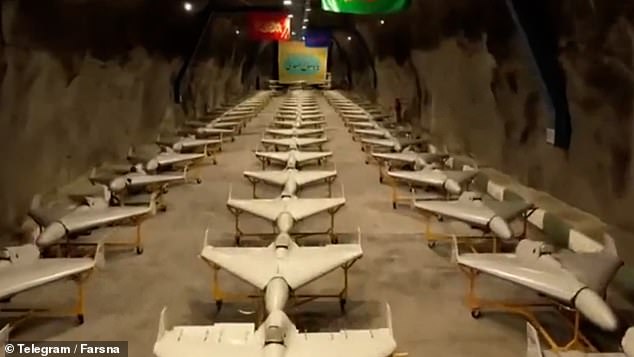
Iran showed off a sprawling underground network of tunnels filled with row after row of drones and rockets
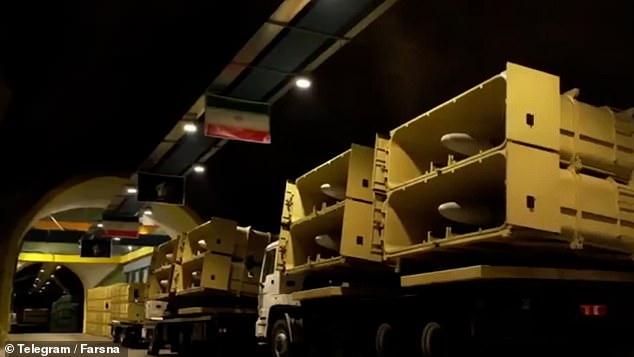
Shahed drones were seen in their launchers on the back of a pair of lorries
The waterway is a chokepoint in the global oil trade, where roughly 20 per cent of the world’s oil would ordinarily pass through daily.
But as a result of the roiling war, oil shipments have been largely blocked from using the shipping artery.
Iran said on Tuesday it would not allow ‘one litre of oil’ to be shipped from the Middle East if the shipments were from the US or Israel.
And given that almost all of Iran’s coast is met with severe mountain ranges, the rate of coastal elevation is stark, increasing the risk of a sea-borne invasion.
For instance, the town of Nikshahr sits at an elevation of 1,673ft just 60 miles from the Gulf of Oman.
As a result, even if an airborne invasion were successfully pulled off, the size and geography of Iran would make it incredibly difficult to mount a full invasion from the sea.
Iran is also home to two major salt flats, Dasht-E Kavir and Dasht-E Lut. These cover a total of 50,000 square miles, largely covering the central and east parts of the nation.
They are also some of the only sections of the country that aren’t at a significant elevation.
But desert warfare comes with its own challenges. Often, deserts have very poor infrastructure, making the movement of troops and supplies more difficult.
Deserts rarely have any water in them, let alone enough water to sustain entire armies. Finding and maintaining enough sources of water would be a significant hurdle for an invading force.
Temperatures in Dasht-E Kavir reach as high as 50C, which can present problems for soldiers not used to fighting in conditions like this.
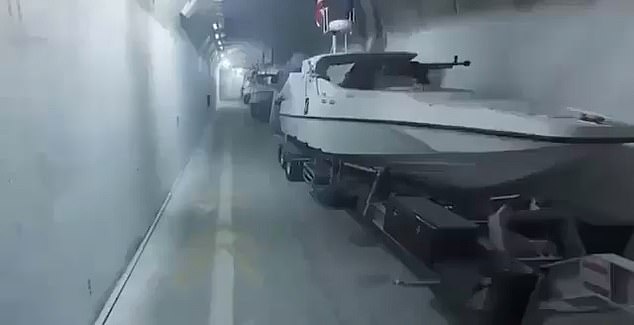
Iran has displayed its armada of explosive naval drones which it is using to shut the Strait of Hormuz and cripple the global economy

The Islamic Republic released a video boasting of its underground tunnels stocked with naval drones, anti-ship missiles, and sea mines
But similarly, deserts can quickly drop their temperatures overnight. With little moisture in the air, temperatures in deserts are unstable. As a result, when night falls, the cold can be an unexpected problem for the US, were it to invade.
On top of this, salt flats are notoriously hard to operate in. Salt dust is incredibly corrosive, capable of quickly degrading protective material, as well as internal machinery and electronics, and rendering them useless.
Iran’s natural terrain makes it a hardy adversary, and may severely limit what a full invasion could achieve.
Thomas Bonnie James, a professor at Qatar’s AFG College with The University of Aberdeen, told Al Jazeera that while a full invasion may not be possible, a limited mission to take Iran’s nuclear materials away would present a much smaller risk.
He said: ‘It is far more likely to refer to limited, specialised operations involving small units targeting specific facilities, potentially supported by rapid-deployment forces, such as the 82nd Airborne Division.’
This would help achieve Trump’s aim of defanging Iran’s nuclear capabilities.
James said that if the US were to send troops to Iran, their aim would be to target its most critical nuclear facilities, including the Natanz Nuclear Facility, the Fordow Fuel Enrichment Plant and the Isfahan Nuclear Technology Center.
He said that this would likely involve ‘penetrating hardened facilities, collecting intelligence, and locating or securing sensitive nuclear materials with the overall emphasis on speed, precision and limited exposure’.
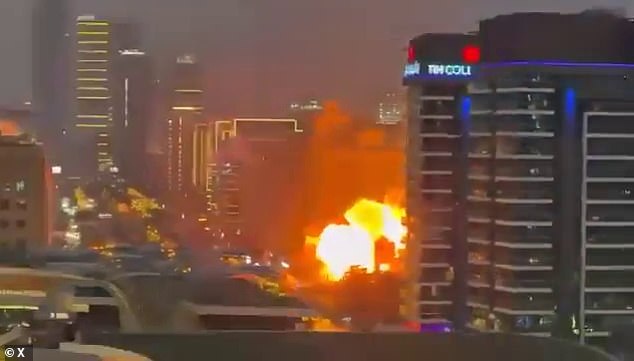
Dubai has been dragged into the conflict between Iran, the US and Israel
He said: ‘Any limited ground operation would likely begin with gaining air superiority and suppressing Iranian air defences to allow aircraft and support assets to reach targets safely.’
It would then end with a rapid exfiltration, with American troops quickly moving to extraction points and leaving the country as soon as possible.
However, this may not result in the end of the conflict, Neil Quilliam of Chatham House warned.
He said: ‘These would be high-risk, complex and lengthy operations taking place in very hostile environments and against facilities heavily protected by the country’s security forces.’