Judges have ordered the Home Secretary to re-think a decision blocking a woman from returning to Britain after she travelled to Syria and ‘aligned’ with Islamic State.
The woman – who can only be identified as ‘T7’ – is assessed by the Security Service, MI5, to have been ‘an active and willing participant’ in the decision to move to Syria with her husband in 2014.
MI5 has also concluded that ‘once there she aligned with ISIL’, before being seriously wounded in an airstrike.
But despite the Home Secretary’s decision that T7 should be barred from entering the UK because she poses a ‘national security risk’, her case must now be looked at again.
The Home Office stripped T7 of her British citizenship in 2017.
Backed by her UK-based family, she has since mounted several legal attempts to secure permission to come back to Britain.
After a previous court ruling, the then home secretary Yvette Cooper last summer ruled that she was ‘not willing to grant her application in light of the national security risk’.
Ms Cooper added: ‘I am entitled to take a precautionary approach and that is my decision.’
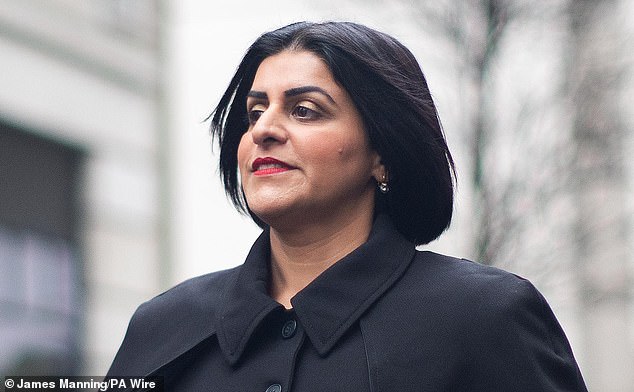
Home Secretary Shabana Mahmood must reconsider the case of Islamic State ‘aligned’ woman, known as T7, who is seeking to return to Britain from a refugee camp in Syria
Now judges in the Special Immigration Appeals Commission (Siac) have ruled that Home Secretary Shabana Mahmood must reconsider that decision.
The court heard that T7 has a son, ‘CD’, who was born in Syria in 2016 but is a British citizen, and is the ‘sole carer’ for his mother, who is partially paralysed and suffers neurological problems.
Mother and child are living in the Al-Roj refugee camp in north-east Syria which is under the control of Kurdish armed forces.
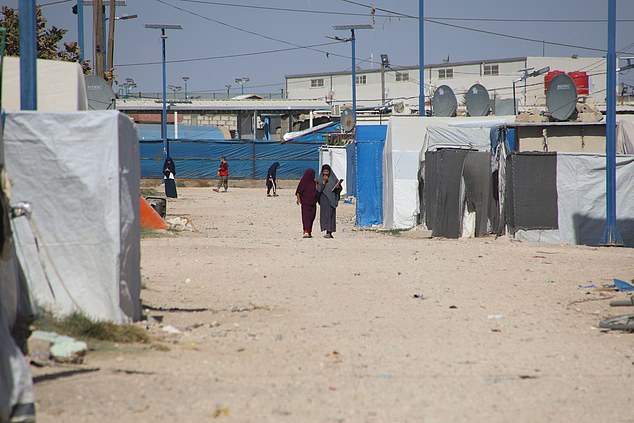
The woman, T7, was stripped of her British citizenship in 2017 and is living in Al-Roj refugee camp in Syria, pictured last year, with her son who was born in 2016
T7’s husband is presumed dead.
Siac’s ruling, first reported by the Politico website, said the Home Secretary’s decision to refuse permission for T7 to return to the UK was ‘inadequately reasoned’.
The judges said there was a ‘need for more rigorous examination’ by the Home Secretary ‘even though the appellant has no prior right to enter the UK’.
There had been an ‘inadequate explanation of the Secretary of State’s reliance on a precautionary approach in the circumstances of this case’, the ruling went on.
‘It follows that the decision falls to be set aside, and a fresh decision will need to be made.’
A series of other grounds of appeal brought by T7’s legal team, including a claim under Article 8 ‘right to private and family life’ of the European Convention on Human Rights, were rejected by the judges.

In another case involving an ex-British citizen in Al-Roj refugee camp, Shamima Begum has now taken her legal fight to the European Court of Human Rights in Strasbourg
The panel of three Siac judges, led by Mrs Justice Steyn alongside upper tribunal judge Doron Blum and Sir Stewart Eldon, indicated it may set a date by which a new decision must be made ‘in light of earlier unacceptable delays’ by the Home Office.
A Home Office spokesman said: ‘We note the court’s decision on this case and are considering the judgment.
‘The Government will always take the strongest possible action to protect our national security and our priority remains maintaining the safety and security of our citizens.’
T7 did not seek to challenge the removal of her British citizenship in the most recent legal action.
Her case therefore differs from that of ‘jihadi bride’ Shamima Begum, who was found in the same Syrian refugee camp in 2019, four years after she travelled from east London to territory controlled by Islamic State as a 15-year-old.
Begum has taken her case to European judges in Strasbourg after losing a bid to bring an appeal in the UK’s highest court.