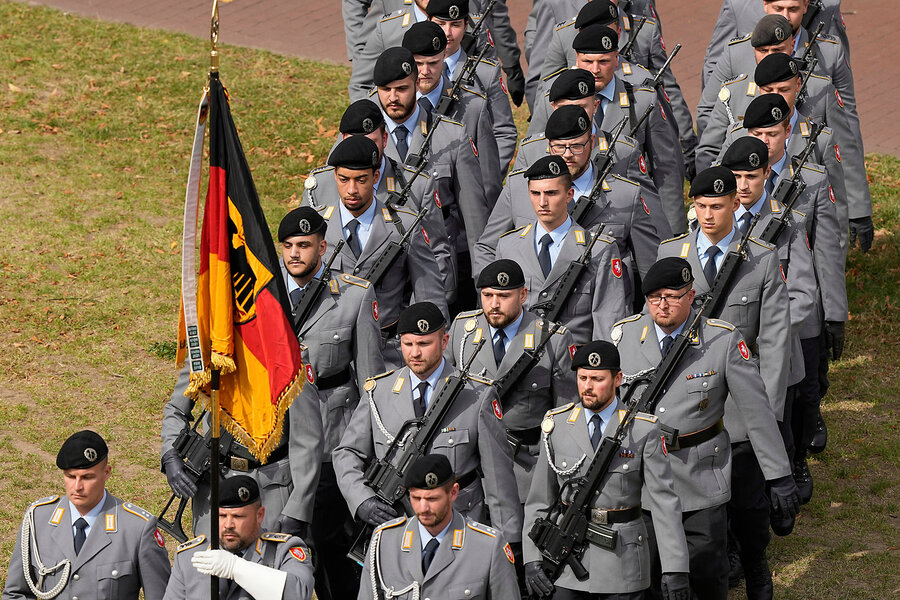
Germany’s army is desperately in need of a few thousand good soldiers. Theo Riebel will most certainly not be among them.
“I don’t want to fight for this country,” says the student at Berlin’s Technical University, sitting on a bench outside the cafeteria.
To him, the Russian threat seems remote, and diplomacy is a better solution anyway. Besides, why would he take up arms for a government that he says has only made his life harder, with crumbling schools and a rising cost of living?
Why We Wrote This
With Europe worried over the threat from Russia and finding the United States increasingly unreliable, Germany is feeling pressure to lead the way on European defense. Whether Germans themselves are ready to pick up arms is another matter.
“Young people have enough problems already,” he adds.
Last Friday, the Bundestag, Germany’s parliament, passed a bill to increase the army from 183,000 troops to at least 255,000 by 2035. It is hoping volunteers will fill that gap. But in January, it is also requiring all 18-year-olds to fill out a form about their willingness to serve, as well as submit to a physical examination, if requested. The move is seen as a first step to reinstituting mandatory military service, should the push for volunteers fall short.
Across a Europe awakened to the Russian threat, other nations are taking similar steps. Yet Germany faces perhaps the toughest challenge and the highest stakes.
In the words of one expert, Germany’s efforts to remake itself as a peaceful nation after World War II have maybe been “a bit too successful.” Older generations have been shaped by a powerful peace movement that held sway for decades, while younger generations have grown up in a time of unprecedented peace – without mandatory military service since 2011. Over all looms memories of the atrocities of the Nazi army and a fear of the past repeated.
A recent poll found that only 18% of Germans were “definitely” willing to take up arms in a national emergency. The passing of Friday’s bill was met by school strikes nationwide.
Germans’ mental barrier
With Europe looking to Germany to lead, the country faces an immense task. To build an army capable of defending the nation, Germany will have to overcome the deep aversion to military might that has become a central pillar of its postwar identity.
“For decades, this antiwar culture played a largely positive role in shaping a new Germany: an open, peaceful, and diverse society,” says Dmitri Stratievski, chairman of the Eastern Europe Center in Berlin, in an email interview. “But in today’s world, this phenomenon also has another side. … This has created a significant mental barrier for millions of Germans.”

In many ways, this mindset is a testament to how thoroughly Germany has remade itself. A “remembrance culture” of the country’s Nazi past has instilled a wariness of patriotism and military power. It also fueled a peace movement that saw 1 million protesters take to the streets in 1983, when NATO sought to put nuclear missiles on West German soil.
More recently, Germany’s initial reluctance to send heavy weapons to Ukraine had former Chancellor Olaf Scholz fighting accusations that he and his Social Democratic Party were still bound by their pacifist roots.
There are signs this is changing. Especially since Russia’s invasion of Ukraine, there has been “an acceptance of realpolitik,” says Jannis Grimm, a political scientist at the Free University of Berlin. “To defend human rights, peace politics means we need to defend peace.”
The greater threat to Europe is not a strong Germany, but a weak one, says Patrick Keller, a defense expert at the German Council on Foreign Relations. “If Germany doesn’t lead, many others in Europe will not move. If we do nothing, others will do nothing as well.”
A November poll for Bild newspaper found that 58% of Germans say the restoration of national conscription is needed.
The view of German youths
The question is what Germany’s young people think.
Berlin’s Technical University is admittedly not the German army’s most promising recruiting ground. Posters promoting the Revolutionary Communist Party are plastered on trash cans and lampposts, alongside others containing antifascist messages against the weapons industry.

But Linus Wilke brightens when the topic of military service is mentioned. The student sees himself staying at the university, “but if I weren’t, I would consider it.” He has friends in the army, and they have only positive things to say. “It is a good plan to grow the military, because [Russia] could become a threat.”
The concerns voiced by Mr. Riebel, however, echo those of others nationwide. He feels like society is already throwing many of its unresolved problems on his generation’s shoulders, with higher rents, increasing stress on social services, and climate change. Now it wants to add another burden to his generation – without consulting them.
“Maybe if everyone was doing OK, it would be different,” he says. “Lots of people would want to defend their friends, families, and communities. But the country itself? It’s not really seen as worth fighting for.”
In Germany and beyond, youths are feeling threatened, says Dr. Grimm, the political scientist. “But these insecurities do not lead to wanting to take up arms and defend something, it leads to paralysis. You just don’t want to deal with it.”
Moreover, many German young people see Gaza – not Ukraine – as the urgent crisis.
“A conversation as a society”
As a result, there are doubts that Germany can hit its targets through volunteers. Only men are required to fill out the new form, and the German constitution states that no one can be compelled into military service; community service must be an alternative.
“It will not be possible to get the numbers without a mandatory component,” suggests Dr. Keller of the German Council on Foreign Relations.
“What we need,” he adds, “is a conversation as a society.”
Maybe that is beginning. After the Bundestag passed the military service bill, Defense Minister Boris Pistorius commented on the school strikes.
They were “fantastic,” he said. The prospect of young people wanting to be heard? “Be my guest; that’s how it should be.”