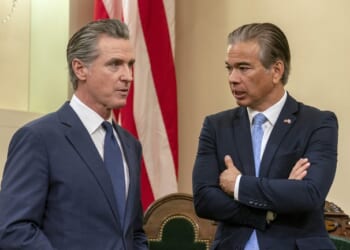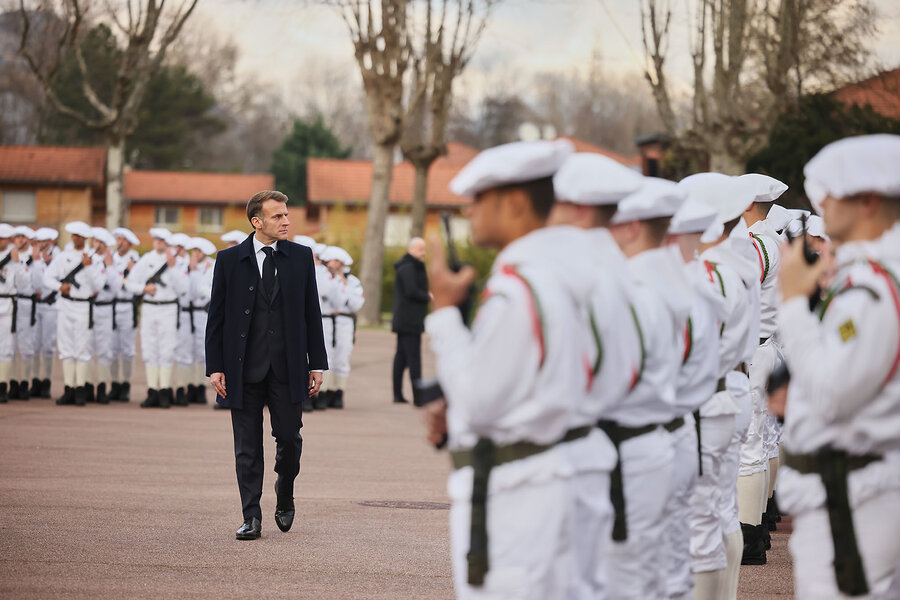
Last month, when French President Emmanuel Macron unveiled a new voluntary military program, he was met with record approval from the French public. The reaction, coming as the president’s popularity is dwindling, is evidence that goes beyond politics: France is ready to defend itself.
With the war in Ukraine looming just more than 1,200 miles away, there is a growing awareness in France that the nation must secure its borders in the event of Russian aggression.
The €2 billion program will offer 10 months of paid military training to 18- and 19-year-olds, with the goal of providing thousands of young people with domestic security skills, so that France has a deep pool of reserves in the event of an armed conflict.
Why We Wrote This
The potential military threat from Russia and the decreasing support from the United States have countries across Europe looking to conscript able-bodied citizens. But it’s a big ask after decades of peace and prosperity.
Mr. Macron is not the only one eyeing defense. As Russia’s war in Ukraine heads toward its fifth year and Europe faces the largest threats to its borders since the Cold War, leaders across the continent are taking a harder look at the strength of their militaries.
But as European leaders debate the benefits of mandatory versus voluntary service, for whom and how long, they are confronting an even bigger challenge: How to show the public the value of joining the ranks.
“First and foremost, the goal of the military is to build defense personnel,” says Jean-Claude Allard, an associate security researcher at the French Institute for International and Strategic Affairs. “You can’t tell young people, ‘Join the military, it’s going to be a Club Med vacation.’”

A balancing act
In 2017, Mr. Macron launched the National Universal Service – a military recruitment program to boost national pride and unity. The service focused on reducing delinquency among struggling French youth and building social cohesion, but did little to bolster France’s defense capabilities.
Now, say observers, France – and Europe – must reprioritize.
“Over the last 30 years, we’ve looked at our military to do everything except defense,” says Martin Quencez, managing director of strategic foresight at the German Marshall Fund of the United States in Paris. “Now, we are realizing that the military is not going to resolve all of society’s problems.”
Instead, Europe’s leaders are looking to bolster their professional armies and build up their reserve forces, as a Russian threat becomes more imminent.
On Dec. 11, NATO chief Mark Rutte offered a stark warning to Europe, telling leaders they must step up their defense efforts or risk a war on the scale that “our grandparents and great-grandparents endured.” U.S. President Donald Trump earlier this month called Europe “weak” and threatened to pull the United States’ support for Ukraine.
Europe has already begun responding to those calls.
This month, Belgium invited 17-year-olds to join its military for around €2,000 per month, and Germany announced it was reinstating its voluntary military service for 18-year-olds. Since 2023, the Netherlands has run a voluntary military program.
But those countries have stopped short of making military service mandatory. For much of Western and Central Europe, conscription programs ended 25 to 35 years ago in the wake of the Cold War. Forcing young people to join the armed forces is a leap that many governments are not yet willing to make, say observers.
“You don’t want to have to coerce anyone or end up with conscientious objectors,” says Elie Tenenbaum, a security expert at the French Institute for International Relations. “Reinstating military service is always a balancing act.”
Danger and duty
Nearly a dozen European Union countries, mostly bordering Russia or Ukraine, currently run a compulsory service program. The perception of a threat from Russia has been enough to push young people to fill their militaries’ ranks.
But geographical proximity is not the only reason why some military programs have been more successful than others. In Scandinavia, governments have managed to make military service part of the national ethos.
In November 2024, the Swedish government sent an “In Case of War” brochure to every home in the country to teach the importance of self-sufficiency and war preparedness. It also reminded people between age 16 and 70 of their “total defense” duty toward their country.
The messaging worked because “there is societal trust in Sweden that the government wants the right thing for you,” says Steven Everts, the director of the European Union Institute for Security Studies. “The government is ‘us,’ not ‘them.’”

Around 43% of Swedes view their national government highly – above the 39% average from the Organisation for Economic Co-operation and Development. Denmark and Finland also boast high levels of government trust and, though military service is compulsory there, they have not had to dip into their reserves to build troop numbers.
Still, not everyone in Europe equates military duty and national pride. Germany has spent decades trying to shed its Nazi past and restyle itself as a peaceful nation. When the government announced last week that it was reinstating a voluntary military service for 18-year-olds, tens of thousands of students across the country walked out of class in protest.
And even though only 34% of French people say they trust their national government, nearly three-quarters said they supported Mr. Macron’s volunteer military initiative, according to an Elabe poll, and 89% hold a positive view of the military more generally.
Observers say those figures represent a generalized perception of threat across Europe that outweighs other factors. This year, Poland announced it was introducing “large-scale military training for every adult male” and, in late October, Croatia announced it would reintroduce conscription after 17 years of voluntary service.
Meanwhile, the Ukraine war has revived Britain’s desire to seek closer cooperation with the EU, with British Prime Minister Keir Starmer, alongside Mr. Macron, leading the proposed “coalition of the willing” peacekeeping initiative in Ukraine.
“We need a European way to defend and prepare for war,” says Mr. Quencez, of the German Marshall Fund. “The effort needs to be not just about spending but making defense part of the societal model. … It’s all about adapting to new threats.”