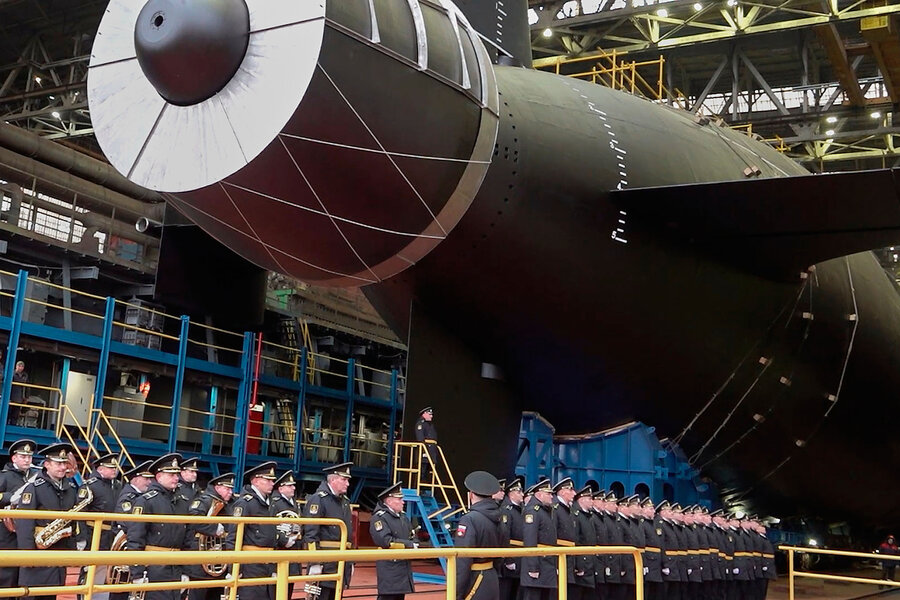
Early this month, the Russian navy launched the Khabarovsk, the first of a new generation of nuclear-powered submarines which Vladimir Putin says is part of a major nuclear modernization program that will ensure Russia’s strategic parity with the United States for the rest of this century.
What is potentially revolutionary about the Khabarovsk is that it’s specifically designed to carry a recently developed underwater drone – or smart torpedo – that is capable of delivering a nuclear warhead at high speed and over great distances, possibly to destroy aircraft carrier groups or even devastate port cities anywhere in the world.
The robot torpedo, called Poseidon, is one of a series of new weapons being rolled out that the Kremlin argues will confound any future U.S. attempts to develop an effective missile defense shield, such as President Donald Trump’s proposed “Golden Dome.” The Russians have been alarmed about the possibility of a U.S. breakthrough in defensive weapons – one that might nullify their deterrent force of intercontinental missiles – ever since President Ronald Reagan announced his Strategic Defense Initiative, popularly known as “Star Wars,” back in 1983.
Why We Wrote This
Russia has been conspicuously bringing new types of missiles, torpedoes, and submarines into service in recent weeks. Russian experts say that the fanfare is all about President Donald Trump’s “Golden Dome” missile defense proposal.
Analysts say the exotic weapons now coming online are the result of decades of Russian efforts to develop relatively low-cost ways to preserve a credible second-strike capability. They complicate the tenuous balance of arms control that once held between Washington and Moscow, but has been deteriorating over the last decade amid the two countries’ chill in diplomatic relations.
But they also come as Mr. Trump and Mr. Putin jockey for leverage over Ukraine’s future – a context that Mark Galeotti, a Russia expert and honorary professor at University College London, argues is shaping the weapons rollout. Mr. Trump keeps trying to make Russia accept a peace deal in Ukraine with alternating attempts of carrots and sticks, and Mr. Putin signals back that Russia is too strong to be strong-armed into any deal it doesn’t want.
“[Russia’s] decision to hype these weapons now is clearly a political one,” says Dr. Galeotti. “I think this is part of the shadow diplomacy between Trump and Putin.”

Russian Defence Ministry/Reuters/File
A novel arsenal
Russia’s new arsenal has been in the pipeline for some time but is being demonstratively rolled out now. A year ago, Moscow surprised the world by firing a new hypersonic, medium-range ballistic missile, known as the Oreshnik, at a factory in the Ukrainian city of Dnipro. The Russians say the Oreshnik can deliver six conventional or nuclear warheads at 10 times the speed of sound.
Last month, Russia also tested the Burevestnik, a cruise missile that’s powered by a miniature nuclear reactor that reportedly gives it unlimited range. A week later, at a Kremlin ceremony, Mr. Putin praised the developers of the Burevestnik missile, saying “it is of historic significance for our people. It ensures security and strategic parity for decades to come – one could safely say, for the entire 21st century.”
What all these new weapons have in common is that they embody novel technologies that potentially enable Russia to counter U.S. technological superiority without the investment of the Cold War era. As Russia’s current generation of leaders are painfully aware, the economic demands of trying to keep up pace with the United States in an ever-escalating nuclear arms race was one of the primary factors behind the Soviet Union’s collapse.
Russian analysts say that the new weapons are being openly displayed right now – Mr. Putin even said that a NATO warship was allowed to park nearby and observe the recent Burevestnik test – because Mr. Trump appears to be moving ahead rapidly on his Golden Dome plan, which the U.S. president calls “a cutting-edge missile defense shield to protect our homeland from the threat of foreign missile attack.”

Testing the strategic balance
The Russian military’s flexing comes against a background of diminishing strategic stability between Russia and the U.S. All of the Cold War-era arms control agreements between the two have, one by one, been abandoned, leaving both sides free to modernize and innovate in potentially dangerous ways, says Sergei Markov, a former Kremlin adviser.
If the U.S. places its bets on a defense shield, it could make a mockery of Mr. Trump’s earlier pledge to pursue “denuclearization,” apparently meaning some new level of arms control that might include other nuclear-weapons powers than the big two, such as China, and India, say Russian analysts.
Mr. Putin “is publicly showing these new weapons, which will make missile defense irrelevant, to say, ‘Please, please, Mr. Trump, don’t build that Golden Dome,’” says Mr. Markov. “We understand that he wants the missile defense to protect Americans, but that can only be achieved by creating a threat for others. Russia is making clear that it will do whatever it takes to maintain its deterrent.”
Critics worry that the new weapons inject even greater uncertainty into a strategic environment that is already deeply unstable. Some point out that these weapons are extremely complicated and hazardous to operate – particularly the nuclear-powered cruise missile. Some critics even wonder whether they are elaborate, fictional propaganda.

Vyacheslav Prokofyev/Sputnik/Kremlin/AP
“I seriously question whether these weapons, however worthy of a Bond movie, really give Russia any new strategic capability,” says Dr. Galeotti. “The Russians already had an ample second-strike capability.”
Russia’s test of the nuclear-powered Burevestnik missile drew an odd response from Mr. Trump, one that triggered confusion in Moscow. “With others doing testing, I think it’s appropriate that we do also,” Mr. Trump said, giving the impression that he meant testing of an actual nuclear device. Russian requests for clarification have so far gone unanswered.
“The only country that’s tested a nuclear weapon in the 21st century is North Korea. Nobody else has or needs to, because there are perfectly adequate ways to check the reliability of warheads without detonating one,” says Pavel Devyatkin, a Moscow-based expert with the Quincy Institute for Responsible Statecraft, a foreign policy think tank in Washington. “You have to wonder whether this is part of Trump’s style of escalating in order to de-escalate. But, in any case, it’s not good for strategic stability.”
MAGA at what cost?
A couple of arms control agreements are still hanging by a thread. One of those is the 1996 Comprehensive Test Ban Treaty signed by 187 nations, which would ban all nuclear weapons testing. Another is the 2010 Strategic Arms Reduction Treaty (START), which has almost lapsed, though the U.S. and Russia have tentatively agreed to extend it for one year.
But with Russia fielding a new generation of boundary-breaking weapons, and the Trump administration putting out conflicting signals about its intentions, experts say the outlook for achieving reliable stability through negotiated arms control is looking bleak.
“Many in Moscow have been surprised at what looks like Trump’s lack of competence in things he says” about nuclear testing and arms control, says Nikolai Litovkin, an independent Russian security expert. “Trump says he wants to make America great again, but at what cost? Russia is not going to allow itself to be sidelined. If you want security, it can only happen in a world that’s secure for everyone.”