For decades, the most important bridge connecting Canada to the U.S. has been privately owned – by an American family.
As the volume of 18-wheelers carrying everything from scrap metal to striker plates has grown, motoring between the auto industries of Windsor and Detroit, Canada has felt increasingly vulnerable to the whims of a single business tycoon. The Moroun family of Detroit in 1979 acquired the Ambassador Bridge, over which about a quarter of annual U.S.-Canada trade crosses today.
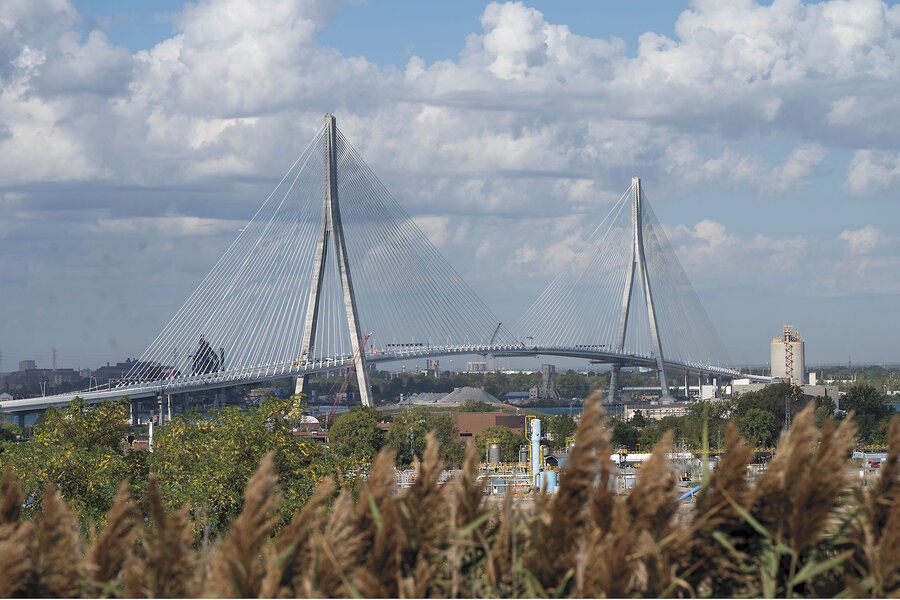
But this year, after decades of diplomacy and determination, Canada is unveiling the Gordie Howe International Bridge, a modern union of concrete and sparkling white steel that it funded entirely on its own.
Why We Wrote This
Relations between Canada and the United States have been rocky, as President Donald Trump accuses America’s northern neighbor of freeloading. But the new Gordie Howe International Bridge challenges that view.
The new bridge is an indication of just how important the automotive sector and free trade with the U.S. remain for Ottawa. But amid a tariff war that shrank trade and turned two longtime allies into foes – at times, bitter ones – this bridge opening is no longer a celebration of the inevitability of Canada-U.S. integration. Rather, it has emerged as a symbol of Canada’s growing efforts to assert its own economic and geopolitical position, no matter where the U.S. stands.
“This is a triumph of common sense,” says Roy Norton, a former Canadian consul general in Detroit who was posted in 2010 to lobby Michiganders to accept a bridge paid for by Canada.
A critical span
The Gordie Howe bridge sweeps 1.5 miles across the Detroit River, linking the sectors of the North American automobile
industry established after Henry Ford founded the Ford Motor Co. in Detroit in 1903.
Its main span – between its support towers – is the longest for any cable-stayed bridge in North America and among the longest in the world, according to the Windsor-Detroit Bridge Authority. It is modeled to resemble the hockey sticks wielded by the man for whom the bridge is named, a beloved Canadian player who brought the Detroit Red Wings four Stanley Cup titles.
The bridge marks the third major crossing, alongside the Detroit Windsor Tunnel and the Ambassador Bridge, over which approximately 8,000 trucks traverse daily. Total auto trade between the U.S. and Canada has climbed from $32 billion in 1995 – one year after the North American free trade agreement was signed – to almost $51 billion in 2023.
The bridge, says former Michigan Gov. Rick Snyder, was an investment by Canada and their belief in our relationship. Mr. Snyder helped push the project through American resistance. “It was such a good deal for the state of Michigan, people couldn’t believe it was true.”

Todd Mcinturf/Detroit News/AP/File
A Canadian commitment
In fact, if anyone has made the U.S. a deal it couldn’t refuse, it’s Mr. Norton, the Canadian diplomat.
Only a handful of international border crossings in North America are privately owned. This one was promoted by local business owners in the 1920s, but no government was willing to foot the bill, so they had to rely on private capital. Opening right before the Great Depression, the bridge ran into financing trouble from the start. The Morouns purchased it almost 50 years ago.
Canada never liked the arrangement, even less so after 9/11, when U.S. authorities immediately shut the border. Canada has been pushing for a new bridge ever since – and coming up against the Morouns. The family, which did not respond to a request for an interview, wielded its wealth and influence to sway Michigan lawmakers against a new bridge, says Mr. Snyder. Only in 2015, when Canada agreed to fund the megaproject by itself, using tolls to cover the costs and then agreeing to split toll revenue thereafter with Michigan, did the state give it the green light.
The issue of any doubts about the bridge even made it to the late-night comedy circuit. Mr. Norton, who traveled to town halls across Michigan with the former governor to convince the state to approve a bridge that it was getting for free, appeared on The Daily Show. It was a “hoot,” recalls Mr. Snyder. But at the groundbreaking of the bridge in 2018, the governor struck a more serious note: “Every Michigander should thank every Canadian,” he said.
An “antithesis to walls”?
Since then, the construction has captured the imagination of locals on both sides of the border, says Glenn Stevens Jr., chief automotive and innovation officer at the Detroit Regional Chamber.
When the two bridge decks, each extending from its own international boundary, finally met in the middle of the Detroit River in 2024, a Canadian steelworker and an American one, in their hard hats and neon vests, closed the gap with a handshake.
But today, in the second year of U.S. President Donald Trump’s second term, it’s hard to imagine a ribbon-cutting featuring such a full-bodied grip between Canadian Prime Minister Mark Carney and President Trump. The American leader has slapped 25% tariffs on Canada’s automotive industry, part of a larger tariff regime.
Last week, President Trump threatened new tariffs, at 50%, on all aircraft Canada sells to the U.S. Separately, he also said over social media that he would put 100% tariffs on all goods from Canada because Mr. Carney announced plans for a trade deal with China. The economic threats come after the Canadian prime minister, at the World Economic Forum in Davos, Switzerland, last month, received global praise for a speech focusing attention on the “rupture” in the global order and calling for the rise of “middle powers, like Canada.”
Thomas Harrison, who authored “Of Bridges: A Poetic and Philosophical Account” says today marks an “era of walls.” But historically, “bridges are always placed in antithesis to walls.”
Ryan Donally, who heads the chamber of commerce in Windsor, says almost everyone in Windsor knows someone who lives or works in Detroit – 5,000 Canadians commute to Detroit every day. Windsorites even use Fahrenheit to describe high temperatures (though they stick to the metric system, measuring in Celsius, in cold weather). “If it’s in the middle of summer, it’s 80 degrees,” he says. “In the winter it’s zero.”

He hopes the Gordie Howe International Bridge opening can offer a reset to politics, to more closely match the reality on the ground. “This is not just a right-now thing. This is a perpetual, long-lasting, relationship-building piece of infrastructure.”
Not a free rider
Anneke Smit, who directs the Centre for Cities at the University of Windsor, says in that sense, the bridge is reassuring in this border community. An “elbows up” mentality has taken hold in Canada, she says, referring to the stance the country has taken against the United States.
Canadians have boycotted American goods and avoided southward travel, which was down by about a quarter at airports and 30% at land crossings last October from a year earlier, according to Canadian census figures. Recent polling by the Environics Institute found that about a third of Canadians today see the U.S. as an enemy; a decade ago, only 1% felt that way. But interconnected border communities cannot afford to be so reactionary.
“For [the opening] to be happening at a time when other types of ties across the border feel particularly fractured,” Dr. Smit says, “that has definitely had some symbolism for many people.”
For Windsor Mayor Drew Dilkens, the timing of the bridge opening is “dreadful.”
“This is a marquee signature event in normal times where you have a $7 billion international crossing constructed that speaks about two nations and the cooperation and the collaboration and the friendship that we’ve had,” says Mr. Dilkens. “This should be a binational celebration of centuries of friendship and trading relationship and celebrating the commonality that we have.”
But this bridge goes some way toward setting records straight about a relationship in which both countries benefit from strong ties and where border communities are as intertwined as they’ve ever been. That’s the reality on the ground – and on a 1.5-mile span arching the Detroit River.
“To the extent that we are disparaged as being free riders, always taking advantage,” Mr. Norton says, “here’s some proof that we take the relationship seriously and stand up when necessary in support of a project that will be mutually beneficial.”
The lessons then are the same today as opening celebrations of the bridge near.
“Enough with the artificial barriers, enough with the opportunism,” Dr. Norton says. “Let’s let our peoples benefit to the maximum extent possible.”