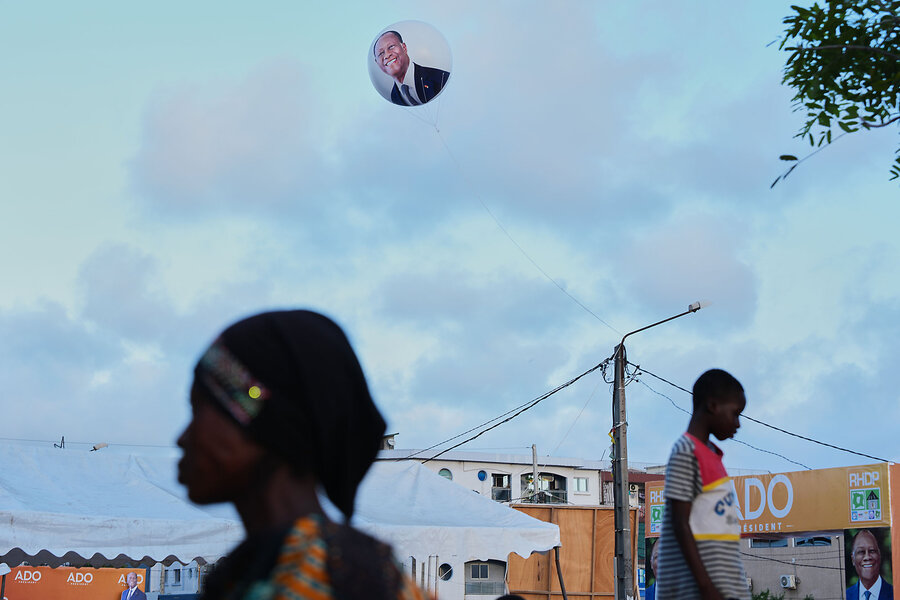
Ivory Coast’s presidential election is Saturday, but in the bustling Abidjan neighborhood of Yopougon, waitress Grace Gbizié made up her mind long ago.
There’s no point in voting, declares the 21-year-old as she darts between tables at a popular restaurant with a tray in her hands. “It’s always the same faces.”
The most familiar of those faces is President Alassane Ouattara, the octogenarian who has ruled Ivory Coast since 2010. With two of his main opponents barred from the polls, he is expected to easily win a fourth term.
Why We Wrote This
On the streets and at the ballot box, young people across Africa are demanding political change with increasing urgency. But in Ivory Coast, a presidential election with a foregone conclusion has left many Gen Zers cynical.
That leaves many young people, like Ms. Gbizié, apathetic about casting a ballot, even as they yearn for a better political future.
“Their indifference isn’t a rejection of democracy itself,” explains Rinaldo Depagne, deputy program director for Africa at the International Crisis Group. Rather, it is “frustration at a system that fails to address their actual concerns.”
A frustrated generation
That frustration isn’t unique to Ivory Coast. Across the continent, young Africans are fed up with poverty, unemployment, and corruption. Six in 10 say they are dissatisfied with how democracy is working.
Many Gen Z Africans see the problem as aging and out-of-touch leaders, and they are increasingly denouncing them.

Sometimes, those battles are waged at the ballot box. Last March, for instance, young Senegalese brought to power a firebrand 45-year-old opposition leader. And in October, Botswana’s young electorate unseated the party that had ruled there for more than half a century.
But in many countries, young people have grown cynical about the power of elections to make change. Polls show they are significantly less likely to vote than older generations. Instead, they often take their fight to the streets. This month, Gen Z-led protests in Madagascar toppled that country’s government. Meanwhile, mass political demonstrations have recently rattled the gates in Morocco, Kenya, and Mozambique.
In many countries in Africa, “democracy exists legally, but it is not truly inclusive,” explains Ousmane Ndiaye, a Senegalese journalist and author of “Africa Against Democracy: Myths, Denial, and Peril.” “Many young people see no value in it because decisions are made elsewhere, and these decisions don’t reflect their needs or concerns.”
Ivory Coast embodies that tension. A recent survey of 18- to 24-year-olds found that they are optimistic about their future – and their country’s. At the same time, many young Ivorians feel powerless to make political change. For instance, while three-quarters are younger than age 35, 97% of the deputies in the national assembly are older than 40.
Meanwhile, a constitutional revision a decade ago allowed Mr. Ouattara to seek additional terms, even though term limits technically remain in place. In this election, the country’s Constitutional Council has ruled his two most significant opponents – former president Laurent Gbagbo and former Credit Suisse CEO Tidjane Thiam – are ineligible to run. That clears the way for Mr. Ouattara to cruise to a fourth five-year term.
“Every election, they talk about youth, projects, billions … but our daily life doesn’t change,” says Marie Tchetche as she records a video for her TikTok on a Yopougon street corner. Her mother sells pastries outside their home; her father drives a taxi. “I don’t feel like voting because they’re all the same. They fight for their position, not for us.”
Stability vs. democracy
Back at the restaurant where Ms. Gbizié works, the rhythms of zouglou music thump from speakers, as conversations hum around plastic tables. Friends Cheick Abdel-Aziz Bamba and Siaka Mickaël Diarrassouba, who work together selling secondhand cellphones, say they are both hopeful and fearful about the election.

“We just want calm elections, no war, never again,” says Mr. Diarrassouba, referring to the civil war fought in Ivory Coast between 2002 and 2007, when the friends were young children. That conflict erupted after a failed coup split the country between a rebel-held north and a government-controlled south, fueling years of political and ethnic tension. Yopougon, a stronghold of southern loyalists, was hit hard by the violence.
After the 2010 election, the neighborhood became a battlefield again. Both Mr. Ouattara and his opponent, Mr. Gbabo, claimed victory. Violence ripped through the country. Yopougon, a stronghold of Mr. Gbabo’s supporters, was shelled by forces loyal to Mr. Ouattara. Dozens of civilians died.
Since then, “the country has progressed and is stable now, but it’s time to think about young people. We have degrees, but no jobs,” Mr. Diarrassouba explains.
For his part, Mr. Ouattara – who was born during World War II – bills himself as the candidate of the youth. “I have always been committed to offering the best to our youth, so that you can start businesses, work, learn, and be independent,” he told the crowd at a rally last week.
Some young people say they believe it. He wants “a better future,” says Fatoumata Kouassi, an economics student. “He’s a protector, and the country is stable. We just want him to stay.”
Out of touch
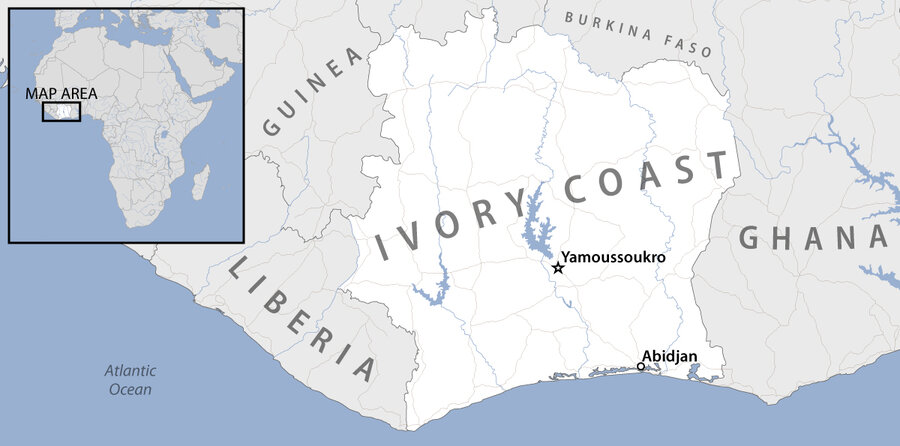
Indeed, there is evidence in Yopougon of the president’s commitment. A bridge straddling the Ébrié Lagoon was opened in 2024, connecting the neighborhood to Abidjan’s business district and easing chronic gridlock. Meanwhile, Yopougon General Hospital got a major upgrade in recent years, with new equipment and lab facilities. It now has reliable water and electricity for the first time.
Still, most of Yopougon’s residents work informally and live hand-to-mouth. In the neighborhood’s narrow streets, young men repair phones under makeshift awnings, while women sell grilled fish, secondhand clothes, or mobile credit from wooden stalls. Only about 55 percent of girls complete secondary school.
At the restaurant, Ms. Gbizié, the waitress, jokes that Ivory Coast’s leaders are out of touch with that reality. She says she once dreamed of being a nurse, but had to drop out of school when she gave birth to her son. Now, on a busy night at the restaurant, she is lucky to pocket 5,000 CFA francs ($9).
“Politicians should come work here themselves,” she says. “They’d see what life is really like.”