But it’s brown patchwork brocade,’ I say, with the same tone most people reserve for spotting mould. ‘They don’t even sell brocade any more.’
I am midway through helping my mum with her fifth house move, wrestling yet again with her beloved three-piece suite, which, predictably, won’t fit through the front door. ‘A minor detail,’ she says. When I suggest that it might be time to finally get a compact sofa more fitting for someone who lives by themselves, she gives me a hard stare. ‘We will just have to remove the window,’ she declares.
To be clear, this is no ordinary sofa. This is the sofa. The kind of sofa that neither myself nor the dog would like to be in competition with if there was a fire in the building and my mum could only save one thing.
It was bought on a whim on a trip to Dublin in 1987 for the then-scandalous sum of £3,200, and came with matching armchairs, a footstool and the sort of unapologetic presence that demanded polite posture.
‘I went out for a coffee and came back with a suite,’ she recounts. As if that is a perfectly normal thing to do while on holiday.
To be fair to my mum, the sofa was probably considered peak luxury at the time: brown patchwork brocade, unmistakably 80s: low slung, heavily cushioned, and unashamedly grand with coil springs. Back then, we didn’t sit on it so much as near it, in case we breathed too hard and left a mark. TV dinners were banned in our house, thanks to this sofa.
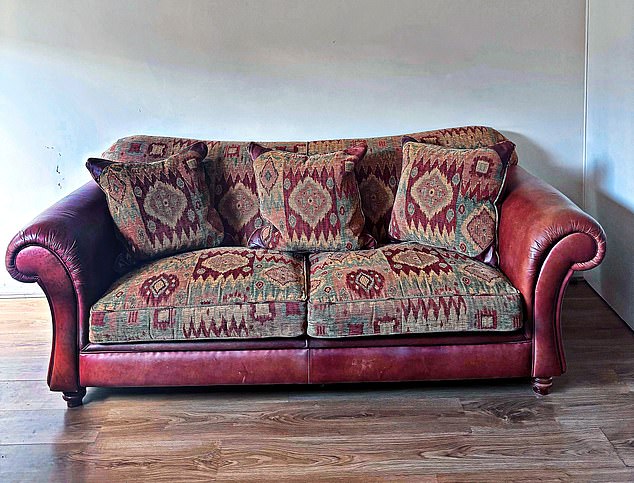
Hot seat: the cherished sofa, in all its 80s splendour
I didn’t understand the obsession then and I still don’t. To me, it’s a relic, not hideous per se, just deeply uncool. It’s now saggy in places, slightly faded on the arm where the sun hits it each morning and is not a piece of furniture that would ever feature on any Pinterest board. But to my mum – and to anyone else who’s ever fallen asleep with a sherry during Bake Off on it – it’s irreplaceable.
‘They don’t make sofas like they used to,’ she says. ‘Now they are shaped like lozenges, come flat-packed or have silly names like Butterbump and Sir Squishalot. Mine may not be cool, but it has stood the test of time.’
She has me there. This sofa has seen it all: two toddlers wielding felt tips, a puppy with zero respect for upholstery, the time I thought it would be fun to dye my hair plum, and several house parties that have remained a secret until now.
Part of the sofa’s longevity is the fact that it was preserved in plastic for years, and is Febrezed, hoovered and polished every weekend. The plastic was finally replaced – it is currently shrouded in a purple quilted velvet throw (four words that should never be seen together) and has been moved away from the window to avoid any further sun-bleaching.
You could argue that there is a heartwarming sustainability story here, albeit an unintentional one. That in an era of disposable interiors and ever-shifting aesthetic cycles, my mum’s decision to keep – and doggedly maintain – a single piece of furniture for nearly four decades is an act of rebellion. It has never been reupholstered or re-cushioned, which feels like a radical choice in 2025, with only the throws being rotated every season.
Ironically, and much to my mum’s amusement, this style of sofa, with its chocolate and caramel tones and dash of 80s flair, is circling back into fashion. I would consider asking her to bequeath it to me in her will, it being preferable to the Toby Jug collection, but she’s already called dibs on that front.
Apart from one of the armchairs, which is permanently locked in her conservatory – ‘I sat in it when they were building the extension and now it doesn’t fit through the adjoining door’ (there is a pattern emerging here) – the suite goes wherever Mum goes.
‘You can bury me with it,’ she says, only half-joking. After its five house moves and four decades of service, maybe I will.