The Winter Olympics are about to begin, and let’s be entirely serious for a moment.
Luge seems exciting for about five minutes, then every run looks pretty much exactly like everyone else’s, whether the athlete finishes first or 15th. Biathlon involves which two sports again? And who has any idea what’s going on in curling, really?
The Summer Olympics, these are not.
Why We Wrote This
If the sporting soul of the Olympics is “higher, faster, stronger,” then the Winter Olympics are a teeth-chattering, bone-rattling infusion of rocket fuel. Where the Summer Olympics push humans to their limits, the Winter Games send them shrieking over the edge.
Every four years during the summer, the Olympics convene to do, well, normal things: running, jumping, throwing, swimming. These are activities not far out of the realm of everyday life, even if the couch is calling you to watch another episode of “The Great British Baking Show.”
By comparison, the Winter Olympics are … weird. We watch because of the primal “yay team” instinct and because NBC likes to make us cry. But viewership for the Summer Olympics is always higher, which gives the winter edition the feeling of those pants you had to buy when your favorites were out of stock: fine, but laced with a nagging twinge of disappointment.
Well, the world might have decided that the Winter Games are cold cousin to their shining summer kin. But I am here to tell you the world has it all wrong.
Yes, those from hotter climes might never truly be able to understand how the liquid acceleration of a world champion through the corners of a speedskating oval can become a moment of weak-kneed awe. Without experiencing ice or snow, a full appreciation of the sports on display in Italy this month is admittedly difficult.
But if the sporting soul of the Olympics is “higher, faster, stronger,” then the Winter Olympics are a teeth-chattering, bone-rattling infusion of rocket fuel. The Summer Olympics push humans to their limits. The Winter Olympics send them shrieking over the edge, usually with a roguish wink and a Han Solo smile.
For those of a certain age, the words “the agony of defeat” conjure one of the most indelible images in winter sport. (For those too young, just Google it. We’ll wait.) There is Vinko Bogataj losing control and pinwheeling spectacularly off a ski jump into the crowd. At the hospital, Mr. Bogataj reportedly asked to go back to the hill and keep jumping.
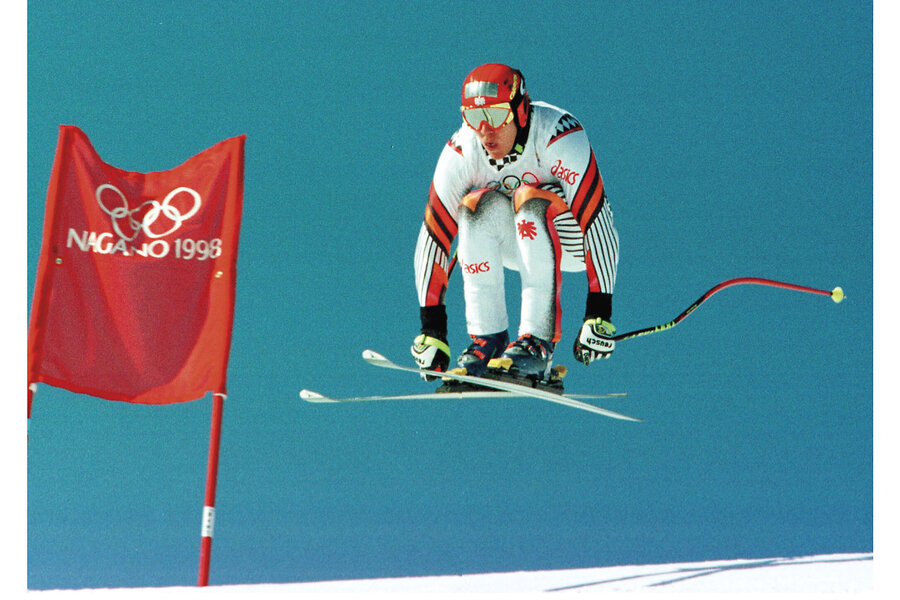
After Austrian ski legend Hermann Maier literally flipped upside down and landed on his head at 65 miles per hour during the 1998 Nagano downhill, he won gold in his next race three days later.
We know Olympians are a rare breed, committed to all sorts of monastic deprivations in pursuit of athletic excellence. But in covering four Winter Olympics from 2002 to 2014, I can testify that Winter Olympians are certifiably nuts.
I remember aerial skier Jeret Peterson inventing a quintuple twisting triple backflip he called the “hurricane” in 2006. (That’s five twists and three flips in three-and-a-half seconds of airtime.) Mogul skier Jonny Moseley in 2002 pioneered a sideways, corkscrewing midair confection called the “dinner roll” because the rules of the day sadly outlawed going inverted.
Vermont snowboarder Hannah Teter in 2006 kept trying to sell everyone her family’s maple syrup.
Combine elite performance with looming danger, and you get athletes with only a tenuous grasp of reality – or the laws of physics.
Yet when they blow through those barriers, the result is something without equal in the world of sport. To watch Usain Bolt smash the world record in the 100-meter dash is to witness the extraordinary. But start strapping skis and skates to athletes’ feet – or toss them into a hurtling ice missile of carbon and steel – and it is something else entirely.
I wish everyone who watched the Olympic bobsled event could hear the race firsthand. Bobsleds do not skate down the track in frictionless curves of balletic perfection. They argue with every inch of the track, a crunching crescendo of terrifying force, attacking the finish line with all the subtlety of a burning tank.
And yet within that clattering shell of pure speed, the pilot’s smallest steering adjustments – the tiniest twitch of a tug – can be the difference between gold and a potentially fatal mistake.
The Winter Olympics are humans amplified without need of steroid or supplement.
In the run up to the Milan Cortina Games, The Associated Press asked a question: “Has figure skating reached the limits of human performance?”
This is in reference to American figure skater Ilia Malinin, the anointed “Quad God.” He is the only human being on Earth able to complete four rotations of the sport’s hardest jump, the axel, in competition. Mr. Malinin’s ability to sprinkle multiple quad jumps through his program – and land them – makes him almost certain to win the gold in Milan Cortina.
But the story asks: “What comes next?” Is a “quint” even physically possible?

That, of course, has been one of the most alluring aspects of sport, from the once-mythical four-minute mile to the “2340” – a big air snowboard jump with six full rotations, landed for the first time in competition by Japanese athlete Ogiwara Hiroto in 2025.
Yes, world records fall at the Summer Olympics. But there, the enemy is the clock. At the Winter Games, the enemy is often the physical world itself, fighting to keep its laws in order.
The result is something more than awe. If we allow ourselves to slip into this strange world where 80 miles per hour is a normal state of being and there is nothing at all peculiar about people skiing with rifles, something in our experience and expectation dilates.
For many, the Winter Olympics are a two-week journey into the unfamiliar. When we stop fighting that unfamiliarity, the Winter Olympics become the vessel for a different kind of inspiration. One in which a ski jumper can flirt with the “agony of defeat” but instead, for a moment suspended in a tiny eternity, glide through the still air as though an ornament untethered from the world – floating, floating – until she lands snowflake-soft on the course.
True, most humans can’t really relate to what that must be like. But at least once every four years, they can imagine it. And that is the incomparable wonder of the Winter Olympics.