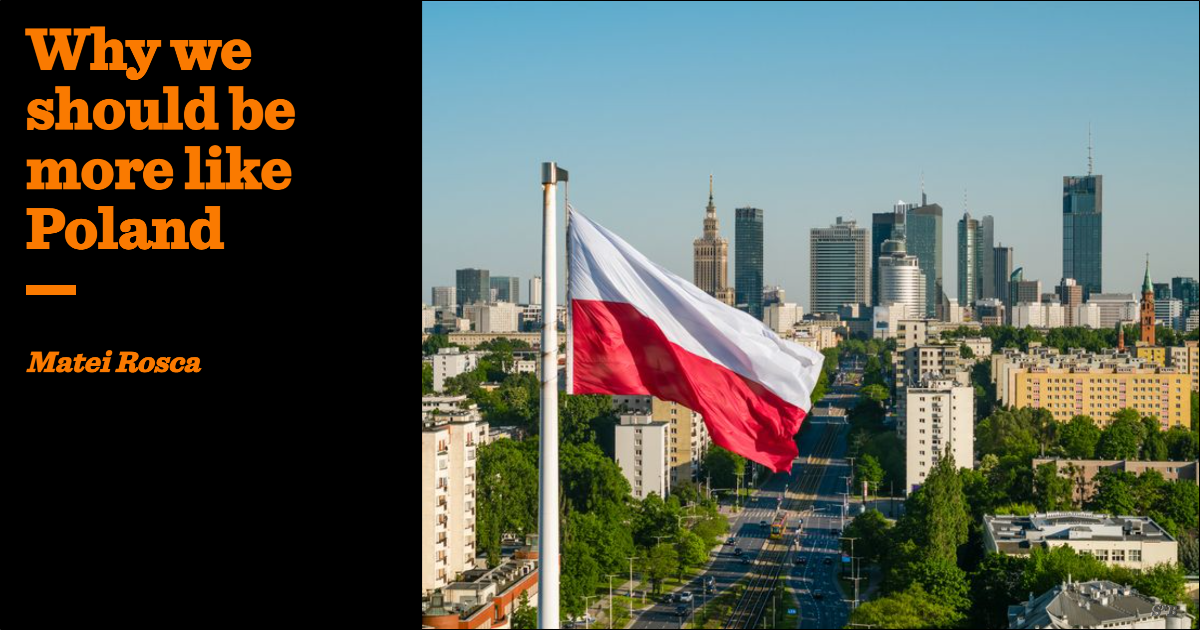
Poland, with its pragmatic patriotism, is being unfairly overlooked by Western policymakers looking for solutions to the polycrisis they are facing. The term Near West may need to be introduced into the geopolitical and international affairs vocabulary to conceptualise this booming region, which separates itself from the West in numerous positive ways while also being an increasingly vital part of it.
The original name was Intermarium, but this took on negative connotations due to its adoption by some anti-Western politicians who will soon be out of office, swept up in inexorable European historic events succeeding themselves in crescendo.
In any case, its capital is Warsaw.
It almost sticks in the throat if I try to say it out loud but, as a progressive internationalist mugged by reality, I have reluctantly come to the conclusion that the key ordering principle of the success of Poland, and the way forward for the whole of the West, is a healthy dose of inclusive, positive-sum, moderate, calm and confident nationalism. Modern, first world, constructive patriotism. Not so much blood and soil as free-thinking European civilisation and open society, but, importantly, strict on those who refuse to contribute to its maintenance. Some call it muscular liberalism.
Poland … is routinely excluded from strategic meetings deciding the future of the continent
I am at pains here to draw a sharp contrast between the Polish version of temperate (some call it conservative) nationalism, and Hungary’s pro-Russia and pro-China variant. I also hasten to confirm up high in the article that I am not a sycophant of Poland in any way, and I have not taken any payment or gift from Polish interests. On the contrary, the government officials and ex officials I approached for comment were slightly disturbed by my open admiration and suggestion that Poland should be a leader of Europe in a way that Great Britain and France once were. Indeed, they rushed to point out that Poland, despite doing everything right and getting the best results, is routinely excluded from strategic meetings deciding the future of the continent, usually held between the UK, Germany, France and Italy. They were, alas, too polite to speculate about the reasons for this exclusion.
I am not, in other words, in the pocket of Big Polski. But it is hard not to be smitten when you walk the streets of Warsaw in late October, as I did, concluding that this is today the number one city in Europe. The autumn colours, the architecture, the courtesy, friendliness, humility and good manners of the people, the clean streets and hearty food and drink, the high and middlebrow culture available at every turn, the unashamed, earnest religious faith of young people popping into Church for a quick Hail Mary before heading to a restaurant to meet their friends.
How safe and civilised the public areas and transport feel, even late at night and even around the big mainline hubs or peripheral open-air train stations and underpasses, where elsewhere in Western Europe you’d take your life in your hands going through after 9pm.
Indeed I would almost say there is no blemish on Warsaw at all, but I can’t do that because they put straws in pints of lager. Let me also mention that unlike my native Romania, Poland lacks a vigorous, mainstream folk music scene rooted in a centuries-old vernacular, highly functioning alcoholic peasantry. Nobody is perfect.
But Poland comes close, not least by having avoided all the pitfalls of what John Gray, the UK’s foremost centrist thinker, calls ultraliberalism. And the sources I spoke to for this article agreed.
It is going from strength to strength economically
Poles did it in an organic way by putting their principles first, and by not being guilt-tripped by coddled, overeducated ideologues with personality disorders into relinquishing their national identity, history and religion. They love Poland. When you love something truly you take pleasure in thinking about it as a distinct entity, with its own past and future. And you acquire an instinct for realising what may harm and what may benefit the thing you love. Contrary to the cheap stereotypes promoted by some critics, gay people and immigrants of all skin colours are welcome in Poland. Indeed Poland has had relatively high levels of immigration for some time, but immigrants are expected to learn to love and be part of Poland by speaking the language and making a positive contribution.
It is going from strength to strength economically, and with the ongoing drive towards rearmament and reshoring (moving critical manufacturing out of China and into the West) Poland has found a new well of big money. It is, after all, a reliable NATO ally in which it is possible to build infrastructure and work with local authorities to make investments that alter the Polish landscape in ways that Greta Thunberg might object to.
Not 40 years ago it was communist, destitute and defiled. As Poland recovered, millions migrated. Hundreds of thousands are returning today. The same phenomenon of reshoring and remigration is picking up pace in the Baltics and Romania, all of which are part of the Near West, all the way down to Greece. Poland leads the pack. The ex-migrants returning home bring with them bourgeois zeal, ambition, entrepreneurial know-how and personal savings they productively invest in small businesses.
The macroeconomics of Poland are looking healthy, its debt to gross domestic product ratio is at around 55 per cent, and it made headlines recently because World Bank data suggested it was on track to overtake Japan in terms of GDP per head in purchasing power parity (PPP) — a proxy for the standard of living.
Financiers, economists, and Robert Jenrick are calling it the Polish miracle. But as much as most Poles remain strong believers in a Christian God, they understand it was not divine intervention, but sound policy, hard work and consistent follow-through that made Poland come good, in spite of many hurdles over the years. The art lies in the careful balancing out of the inevitable special interest groups that emerge in any society, against an overarching and well-defined national interest. Indeed, speaking to Polish officials, you get the impression of a strong sense of duty to the nation, something that senior Western civil servants or progressive politicians would regard as quaint or even eccentric.
“The starting point we had was kind of unique,” said Adam Antoniak, a senior economist based in Warsaw with Dutch bank ING. “We had an abundance of skilled, educated and inexpensive labour. It made the country attractive for foreign investors.”
Poland also did “lots of catching up, absorbing Western management solutions [..] Demographic dividend, adoption of European law and standards, EU funds to boost infrastructure etc. On top of that entrepreneurial spirit of Poles and flexibility.”
Antoniak said that while it has developed very fast, Poland is entering a new phase which is “more challenging,” seeking to create globally recognised brands and “move up the value chains” of strategic global industries. “Poland’s GDP per capita is still around 80% of the EU average, but we certainly have ambitions to close the gap.”
There is no doubt that this ambition is widely shared.
Additionally to economics, the country is an exporter of security. It produces and procures vast amounts of arms and dual use goods which bolster NATO, and is on track to be able to field Europe’s largest ground force, thanks in part to a popular reserves training program.
Being neighbours with Belarus and Russia (Kaliningrad) has turned even Donald Tusk, the arch-Eurocrat and Remainer sweetheart into a laser-eyed hawk. Suspending the automatic right to asylum and flooding a border region to create a biodiversity-producing and tank-hobbling swamp are natural things for a not-so-wet Polish Europhile centrist to support.
“I have been in Poland for most of the last 20 years,” said Daniel Tilles, a London-born academic who is now running Notes From Poland, an English-language independent newsroom in Krakow. “I used to avoid Warsaw because it was grey and dull, now it’s a thriving, booming international city,” he added. “There is less of a difference [with the West] in quality of life. Take major cities in parts of Southern Europe, around the Mediterranean. Poland has overtaken them.”
“I was mugged 20 years ago” in Krakow, but today, “I feel safer in most parts of Polish cities compared to most parts of British cities,” said Tilles on November 11, Poland’s independence day. “Poland used to have problems with crime and doesn’t now, and that is a product of getting wealthier,” Tilles said, adding that despite the heavy international criticism against the previous PiS government, branded as national conservative (as opposed to far-right, which is reserved for another party to the right of PiS, Konfederacja), “the media did not focus on the reasons for their popularity,” one of these being a drive to increase welfare programs for the provincial poor, through pensions and child support, while also supporting growth.
Most restaurants and cafes have a children’s play area. Playgrounds are plentiful, clean and well maintained, and notably not occupied by young men in paramilitary-style sports gear who smoke weed and aspire to become psychotic gangsters when they grow up.
The major infrastructure projects started by PiS, such as a large transport hub in Warsaw, LNG terminals in Gdansk, and Poland’s first nuclear power station, are now supported by their main rivals, the Civic Coalition, who took over government in 2023, Tilles noted. “This has been very much the philosophy of Poland over the past 10 years,” he said, pointing to economic growth and more generous welfare for pensioners and parents.
I, for one, am still not fully at peace with the strange inversion of values and outcomes that Poland illustrates so well. I left Romania in 2008 for the West, and these days I am reminded of the awful Eastern Europe of the 90s in my daily life in London, with random violence, despair, broken institutions, widespread lawlessness, cynicism and corruption. Indeed the types of people I hoped to get away from by leaving Romania, I now frequently encounter in my corner of East London: professional criminals, violent mentally unstable thugs, human traffickers, con artists, corrupt politicians and fraudsters. When I was assaulted on public transport and threatened with death in a supermarket, the police did not do anything; nor when my wife was pickpocketed and my friend’s elderly mother was robbed; there are regular break-ins in my neighbourhood and the ambient violence after dark is putting an end to social life. Taxes and costs are increasing without meaningful reforms. There is a stampede out of Great Britain and France to the Emirates and the US.
In the meantime, when I find myself in Warsaw or Bucharest I can glimpse the ideals of Western liberalism still alive- individual merit and responsibility, contributivity, patriotism, freedom of expression, a love of commerce and improvisation, and above all, governance in the national interest. Perhaps the only thing worse than jingoism is the absence of grounding patriotic thought.
“In Poland even the liberal and progressive parties are, in a way, nationalistic,” said Pawel Wujec, an entrepreneur who sometimes operates abroad.
“We don’t take everything coming from the West as universal truth,” said Wujec, who emphasised that he did not support the PiS and he celebrates Polish independence in the liberal way by joining charity running competitions. He added that Poland’s attitude toward the West began to change around 2015 when Angela Merkel invited millions of non-EU migrants into Europe with no plan to integrate them. “We could see that was wrong,” he said. “The West was also very wrong on Russia,” Wujec added, referring to Germany and France’s attitude in the lead-up to the full-blown invasion of Ukraine in 2022. In that period most Western European countries were against giving aid to Ukraine, arguing, by turns, that the country was doomed anyway or that an invasion was not going to happen despite warning from the Poles, Brits and Americans.
Poland admitted a million or so Ukrainian refugees who are likely to lose access to the benefits system, but are invited to either stay and work, or return to Ukraine to join the army and kick out the Russians. Poland has one of the EU’s highest rates of Ukrainian workforce integration.
“Our relationship with the EU is very transactional,” even under Donald Tusk, the former EU Council leader, Wujec said. “We have no illusions. Many [Polish] liberals have been to Brussels and have seen how the institutions work. There are a lot of common interests but there are also our own interests,” he said.
Importantly, according to Wujec, Poland “did not catch the green virus” of environmentalist ideology. “There are no green parties in Poland,” he said. “We know using coal is bad, and we love using solar panels because they make sense, but it’s not our thinking to sacrifice our economy to save the planet, which would not work anyway,” he said.
Poland’s policy is to grab a bigger share of European container trade by exploiting climate change, with the first ship arriving from China to Gdansk a few weeks ago via a new Polar route.
Poland also avoided “the mass third world migration of the last few years” which Western countries like Britain and France are struggling with in social and economic terms. “We saw it brought a lot of problems and there was a high degree of scepticism,” Wujec said.
Donald Tusk secured EU exceptions from migrant quotas imposed in October. Representatives of the Civic Coalition, the governing political party headed by Tusk, did not respond to requests to comment.
Poland also benefits from not joining the euro, which allows the zloty to handle swings in global trade, said the businessman. But more broadly, Wujec says the current success of Poland is thanks to the people’s innate entrepreneurship and a period of consolidation in the wake of free-wheeling, often violent capitalism in the 90s. “We had open-air bazaars with electronics and tools in the centre of Warsaw for years, completely illegally,” he said. “We did not have a big political master plan except for NATO and the EU.”
In the final analysis, Wujec says, “we are totally patriotic — we hate politicians but we love our country.”
Turning on the well-produced English-language channel TVP World, “a central European perspective on European affairs,” you will enjoy such documentaries as “1000 years of Poland” hailing the visionary courage of various leaders who contributed to the country’s current state of preciously guarded sovereignty. Or a sleek historical docudrama about how Bolshevik Russia offered to keep safe some 90 tonnes of Romanian gold, after the first world war, never to return it. A nod to the growing partnership of Poland and Romania.
The Near West is coming out.
Janusz Kowalski, an MP from the right-wing party PiS, which was in power until 2023, said in an exchange of messages that, “the country’s economic growth is largely driven by the hard work and resourcefulness of its citizens.”
Kowalski’s view, similar to that of Wujec, the businessman, is:
… the country has also, to a significant extent, resisted the negative trends currently eroding many Western nations. Left-wing ideologies, the Green Deal, and mass migration are undermining the economies and social systems of Western Europe — challenges that Poland has so far largely managed to withstand.
The Green Deal is an EU mega-policy incorporating several elements of environmentalist degrowth ideology, which the EU itself is now scrambling to dilute, but not fast enough for Poland’s liking.
British public opinion, with the exception of the government, has more or less aligned to the view that climate change must be mitigated through innovation rather than culling the human species.
It is when asked directly what the West should do to improve that Kowalski’s thoughts coalesce around ideas that remain unfashionable among decision makers in Britain or France. “In my view, the political leaders of Western Europe should return to the roots of Europe — to the Greek and Roman traditions and the moral framework shaped by Christianity. Only a return to these foundations can save Europe today,” he warns.
Will Poland be accepted as Europe’s new moral centre? Probably not yet. But Poland’s basic conservative principles are gaining traction in election polls in the West, and it might serve mainstream parties to learn from their Polish friends rather than leave the field open to upstart forces with inscrutable agendas. It might also minimise the inevitable upheaval.
Surely, before our failed attempt to create a global utopia under universal human rights and international law further degenerates into something altogether odious, it is time to look to Poland and the wider Near West and ask ourselves if having a stable, prosperous and safe society within a politically legitimate democratic nation state is not an acceptable consolation prize.