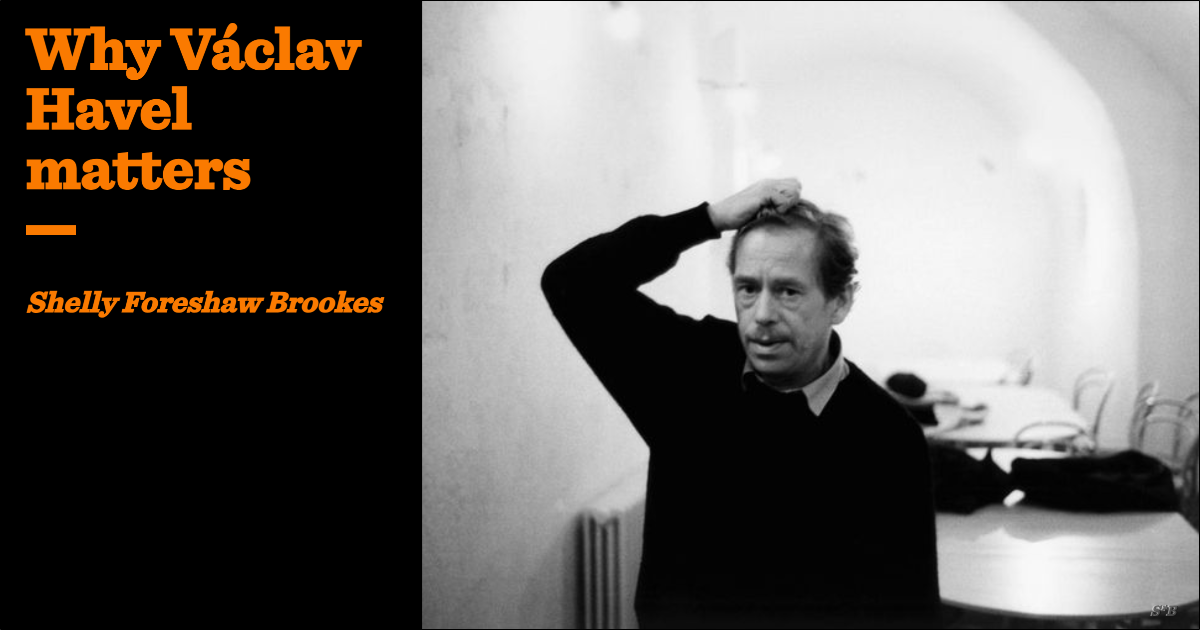
During a cultural moment in which artistic risk is often tempered by institutional caution, one person stands out as a reminder of the positive corrective power and influence that art can have on society. Václav Havel, the Czech playwright, dissident, and later president, remains one of the clearest counterexamples to the culture of evasiveness that dominates the arts today.
Today Havel is often remembered and invoked as a politician and human rights activist. Becoming the last president of Czechoslovakia (1989–1992), and the first president of the Czech Republic (1993–2003) he oversaw the peaceful Velvet Revolution and with it the transition out of communist rule as well as emphasized reconciliation and European integration.
His past in the arts as a playwright however is often treated as a curious biographical footnote, something he did before becoming head of state, as though his artistic past simply adds charm to a romantic and remarkable story. This trivializes what was, in fact, the foundation of his entire political vision. Havel wasn’t an artist who happened to go into politics. He was a man whose years immersed in theatre, philosophy, and literature gave him the moral clarity and intellectual precision to help lead his country out of dictatorship and into democracy. He didn’t treat the humanities as ornament or hobby but as the substance of human life. His leadership was not in spite of his past in the arts but was made possible by it.
This year marks fifty years since the secret performance of Václav Havel’s play “The Beggar’s Opera” in Horní Počernice, an event as bold in its defiance as it was modest in staging. This anniversary should not just be seen as a commemorative marker but a moment to revisit and rethink Václav Havel’s legacy. He didn’t emerge from nowhere. He didn’t inherit a platform or cultivate a public persona in the modern sense but was, in the most vital way, self-made in intellect and moral clarity.
The performance took place in an old village dance hall just outside Prague and roughly 300 people attended, each invited personally by members of the amateur cast, the director, or Havel himself. The evening marked the first time Havel had seen one of his plays staged in nearly a decade. The adaptation, banned by the regime, transformed John Gay’s satire into an allegory of political rot and moral compromise in normalization-era Czechoslovakia. But the celebration was short-lived as photographs of the cast and audience were leaked to the authorities and interrogations followed. Some of the attendees were fired outright, others were sidelined, had their passports or drivers licenses seized, or were forced out of work through subtler pressures. The persecution even went beyond those present; a Czech theatre actress lost her job without having attended simply because her father had been present in the audience at Horní Počernice. The director of the amateur theatre group who had staged the play was interrogated for eleven hours and lost his job due to sudden “staff restructuring” at the theatre.
A joyful, interdicted night of theatre turned into a slow grind of repression and for Havel, the beginning of an even sharper descent into surveillance, harassment, and eventual imprisonment.
Thrown out of formal education as a young teenager because of his bourgeois family background he had to find a way to self educate. With his grandfather having been one of the country’s most prominent interwar entrepreneurs and a pioneer of modern Czech capitalism, the Havel family became a clear and early target when the Nazis and later the communists invaded the country.
Because he was considered a “class enemy” and was refused higher education from the age of fifteen, Havel, with the encouragement of his intellectually and culturally curious mother began his own education in the cafés of Prague, where he founded a group with others who’d been similarly expelled. This group of teenagers, who called themselves the 36ers in reference to the year they had been born, read, debated, and thus taught themselves how to think. From those café tables, Havel worked his way slowly into the intellectual underground by sitting at the edges of groups of older, banned philosophers from the pre-war generation, absorbing their ideas, their questions and their concerns. As Havel later recalled in his informal autobiography Disturbing the Peace: A Conversation with Karel Huizdala, those meetings with older thinkers taught him the importance of individual responsibility and especially the duties of the artist and intellectual toward culture and, by extension, society. During these early years he was not only forming opinions; he was constructing an inner life that would later prove capable of resisting the machinery of ideological conformity.
Following his then-girlfriend and future wife Olga, the theatre was where Havel’s resistance began to take shape in his early twenties. Initially he worked behind the scenes: as a stagehand, a technician, anything to be near the conversation and eventually began writing. He did so with discipline and his plays were not simply off-the-cuff political jabs. They were slow, precise, philosophical dissections of power, language, and the human spirit, often done from first principles. Plays like The Garden Party and The Memorandum display the absurd logic of bureaucracies, not just as institutions but as ways of thinking, where language becomes a substitute for truth and compliance masquerades as morality. Instead of writing slogans he wrote systems, and then turned these systems inside out.
What makes Havel enduringly interesting is that his moral sense wasn’t just innate but rather it was built and acquired. He himself emphasized: “I can’t say I had the feeling that my acts were driven by any sense of historical destiny, or by any uniqueness on my part.”
He educated himself in literature and philosophy as well as in the practice of thought and didn’t merely agree or disagree with the ideologies around him. By writing his way through ideas he got to take them to their logical conclusions, test their boundaries and articulate their temptations. This gave him an unusual strength: he could anticipate the moral cost that came with compliance, and was able to foresee how acceptance, when rooted in unwitting conformity, corrodes both individual integrity and public life. Havel wasn’t obstinate with the things he stood for or against, neither as a playwright nor later as a president; he was precise.
This precision often turned out to be prophetic. More than once, Havel wrote a play that anticipated a political event that hadn’t yet occurred. In his play “Temptation”, Havel reimagines the Faustian legend within a paranoid government institute, where the authorities become obsessed with uncovering underground resistance that doesn’t exist. The regime’s fixation on surveillance and ideological purity leads it to manufacture enemies, and in doing so, it corrodes itself from within. The play satirizes a system so consumed by fear that it ultimately turns on itself which transpired to have been a prescient depiction of the late 1980s, when the communist regime in Czechoslovakia, increasingly fractured and paranoid, began to collapse under the weight of its own contradictions.
While banned and living in a cottage in the Czech countryside, Havel would use the time to write detailed commentaries on his plays, allowing him to explore their structures and consequences more deeply than he could through constructing the performances alone.
Havel paid close attention to the turning atmospheres of the communist regime his country lived through, the subtle changes in language or posture that signaled a coming shift.
Often it was he who initiated public petitions or wrote open letters to those in power, such as his appeal to President Dubček, or his 1975 letter to President Husák, in which he condemned the moral and spiritual degradation under communism. He co-authored Charter 77, a manifesto that called on the Czechoslovak government to honour the human rights provisions it had committed to under the 1975 Helsinki Accords. The following year he was arrested and sentenced to over four years in prison for his involvement with an organization supporting political prisoners in Czechoslovakia.
During his time in prison, the state showed their paranoia about Havel and his influence by tasking many of his fellow inmates to write daily reports about his habits and conversations. Ironically, his influence was cemented even more as some of the men came to Havel for help in writing said mandatory reports. Ultimately, he himself wrote most of them about his goings-on, putting in conflicting information about what he might have said as well as a lot of useless information. Several inmates were released early, having proven their allegiance to the regime through their purported involvement in monitoring Havel.
Today, much of what passes for resistance in the arts is highly mediated, institutional and safe. Artists are praised and subsidised for toeing the right cultural or political lines, not for challenging them. And when there is any challenge, it is often either offensively literal, veering toward poorly executed propaganda with little hints of irony, or aimed at targets that barely warrant confrontation anymore. This is the plight of a certain literal-mindedness that prevails today. Theatre, in particular, now behaves less like a space for challenge and more like an HR department, cycling through pre-approved issues that have already been processed and neutralised in the broader public arena.
Many artists today emerge from the university system, where certain frameworks are not just taught but assumed. Rather than questioning dominant ideas, many are trained implicitly as much as explicitly to reproduce them with stylistic polish. The result isn’t merely dull; it reflects a deeper narrowing of who gets to make art in the first place and class barriers remain stark. According to UK research done in late 2024, younger adults from working-class backgrounds are four times less likely to work in the creative industries than their middle-class peers. The upper tiers of the arts are even more skewed: top-selling musicians are six times more likely than the general public to have attended private school (43 per cent versus 7 per cent), and BAFTA-nominated actors are five times more likely (35 per cent versus 7 per cent). In such a landscape, the official culture not only reflects institutional caution but is produced by a shrinking demographic, unpractised in personal moral discernment and largely unfamiliar with the necessity and cost of dissent.
Havel knew he was not without flaws and what set him apart was his willingness to articulate and struggle with ideas. His plays were banned, his career derailed, his friends harassed, and the public gradually turned against him. After the secret performance of his play at Horní Počernice, workers across the theatre and arts industry were summoned to the National Theatre and asked, one by one, to publicly denounce Havel on stage. Most did, resentful of the tightening restrictions that followed his defiance and eager to protect their own increasingly precarious positions.
For Havel, the essential point of writing was not simply expression but understanding
The playwright, though, did not shrink from public life but, believing that his values did not matter unless put into practice, stepped into it. For Havel, the essential point of writing was not simply expression but understanding. He did not see ambiguity as an excuse for passivity, but as a condition to be navigated with courage.
If Václav Havel were an emerging writer today, one suspects he’d be a difficult figure to place in the artworld: too ironic for activism today and too genuine for the careerists. He would likely find himself once again on the margins, surrounded by a few young thinkers willing to meet in cafés, to argue, read and think. Perhaps this is where real resistance has a chance to grow. Not in viral declarations, but in the long, uncertain discipline of forming a mind that cannot be absorbed.
Havel’s legacy is not just artistic. It is political and ethical. He reminds us that the theatre and the arts are not a lifestyle accessory, but a space where truth can still be rehearsed, though sometimes dangerously and with consequences. And he shows us that moral clarity is not the product of slogans, but of solitude, reading, dialogue, and the slow acquisition of judgment.
He is one of the few intellectuals to have led a nation into democracy and to have done so with moral seriousness, not demagoguery.
We should not wait for another Václav Havel. But we should remember what it took to become one.