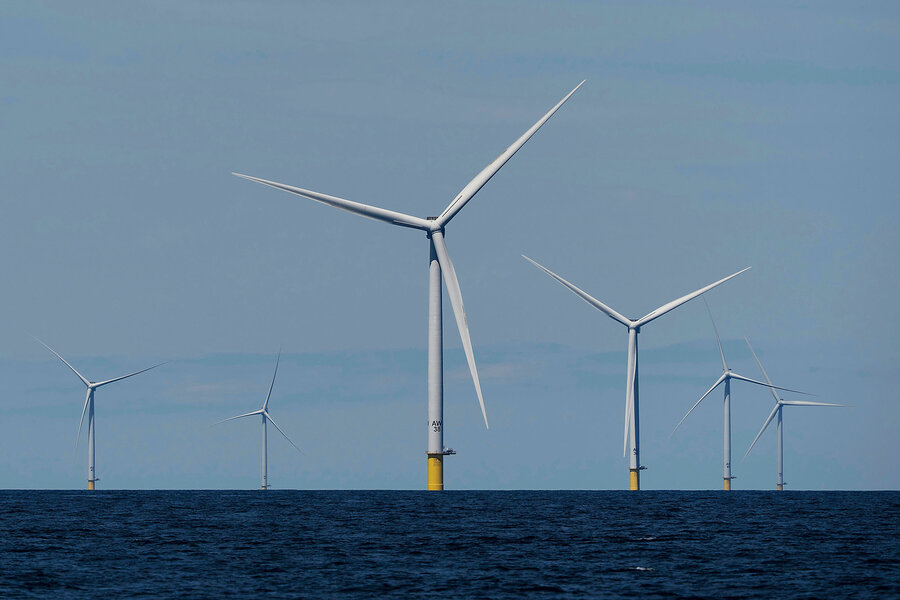
This week, the Trump administration announced it had struck an unusual deal. The U.S. government will pay TotalEnergies, a French power generation company, $928 million to scuttle its plans to build two wind farms off the coasts of New Jersey and North Carolina. Together, the projects could have powered some 1.7 million homes.
The deal represents a new wrinkle in President Donald Trump’s campaign to jettison America’s nascent offshore wind industry, which many environmentalists see as key to reducing the country’s carbon footprint. Mr. Trump has criticized wind power as ineffective and costly, and his administration has tried to curtail wind infrastructure development.
“Offshore wind is one of the most expensive, unreliable, environmentally disruptive, and subsidy-dependent schemes ever forced on American ratepayers and taxpayers,” said Interior Secretary Doug Burgum, in a news release announcing the deal on Monday.
Why We Wrote This
The Trump administration’s deal to pay TotalEnergies to shift from wind farms to U.S. fossil fuel investment appears to be a novel use of taxpayer funds. It also fits within a broader White House effort to restrict the offshore wind industry.
Environmentalists see the administration dismantling offshore wind as shortsighted and damaging to Americans’ pocketbooks. While offshore wind remains more expensive to install and run than other energy sources, costs have fallen significantly in recent years, driven by growing interest from nations and corporations, as well as improving technology. Offshore wind costs have decreased more than 50% globally since 2013, according to a 2024 report from the U.S. Department of Energy. They are expected to keep declining as the industry becomes more established.
“It’s also just a real hallmark of the administration’s hostility to clean energy at a time when clean energy projects are some of the biggest and cheapest and fastest coming online,” says Ted Kelly, director and lead counsel for the Environmental Defense Fund’s clean energy program. “Instead of encouraging that, we’re now not only discouraging it, but taxpayer money [is] being paid to stop it.”
The deal with TotalEnergies raises questions not only about the future of offshore wind in the United States but also about the extent of the president’s authority to influence private business transactions. Here’s a look at some of the issues at play:

Danielle Villasana/Reuters
How will the deal work?
The Trump administration will essentially refund the $928 million TotalEnergies paid for leases to build Attentive Energy, about 40 miles off New Jersey, and Carolina Long Bay, roughly 22 miles off North Carolina. Federal law mandates these leases, which are typically acquired through a bidding process, for anyone seeking to generate “electricity or other energy product derived from a renewable resource” in the waters off the country’s coasts.
In exchange, the French firm has agreed to redirect that money into oil and gas projects in the United States. Those investments include Rio Grande LNG – a liquefied natural gas plant in South Texas – and unspecified oil projects in the Gulf of Mexico. In the Interior Department news release, TotalEnergies’ CEO Patrick Pouyanné was quoted as saying the development of offshore wind “was not in the country’s interest” and that fossil fuel projects are a “more efficient use of capital in the United States.” The company also pledged not to build any offshore wind projects in the U.S., citing unspecified national security concerns.
Further details about the deal, which was first reported by The New York Times, have not been made public. Environmental advocates interviewed by the Monitor say it is highly unusual for a president to transfer taxpayer funds to a foreign company to prevent private investment. Most of the revenue from offshore leases goes to the Treasury Department’s general fund, which finances daily government operations, and the money TotalEnergies paid for the leases might have already been spent.
TotalEnergies, one of the largest liquefied natural gas companies in the world, already has investments in the Rio Grande plant dating back to at least 2023. The company also appears to hold dozens of leases for oil and gas production in the Gulf of Mexico.
It’s unclear how much money the company might now funnel into the Texas plant. It’s also unclear from what source the Trump administration would draw the funds. Some reports have suggested the money will likely come from the Justice Department’s Judgment Fund, which the government uses to pay court judgments and settlements. Neither TotalEnergies nor the Interior Department responded to requests for comment for this story.
The Bureau of Ocean Energy Management, an arm of the Interior Department, awarded TotalEnergies leases for both Carolina Long Bay and Attentive Energy in 2022. According to the leases, which are publicly available, TotalEnergies paid $133 million for the land encompassing Carolina Long Bay and $795 million for the territory slated to become Attentive Energy.
The company was also liable for at least $417,807 in yearly rental payments under the two leases. That breaks down to $164,811 for Carolina Long Bay and $252,996 for Attentive Energy. The leases require annual payments until the sites begin generating electricity for sale.
Because neither wind farm ever generated power, TotalEnergies would have been obligated to pay the government more than $1.6 million in rent between 2022 and 2025. It’s unclear whether that money was paid, and, if it was, whether the Trump administration will refund it as part of the deal.

What other actions has the Trump administration taken on offshore wind?
In December, the Interior Department issued a work stoppage halting construction on five wind farms off the East Coast. The administration cited a classified report from the Defense Department claiming offshore wind posed a national security threat. The administration also pointed to a finding in a public Energy Department report that said turbine blades and towers can create radar interference. Radar systems raise their threshold for detection to combat this, the report says, and might “miss actual targets” as a result.
Each of the farms sued over the work stoppage. Judges, after viewing the classified report, ruled against the government in all five of those cases. The classified report has not been made public, and litigation in the cases is ongoing.
On his first day in office, President Trump issued an executive order temporarily suspending offshore wind leasing pending an assessment by the Interior Department. He cited “the need to foster an energy economy” that meets rising demand, as well as unspecified impacts on marine life, ocean currents and wind patterns, and energy costs. A federal judge in Massachusetts ruled the order unlawful in December. The Trump administration filed a notice of appeal in February.
Mr. Trump, for his part, has publicly disparaged offshore wind since at least 2012, when the Scottish government sought to build wind turbines offshore from one of his golf courses. In testimony before the Scottish Parliament, he said wind turbines were “ugly” and “noisy” and would cause “almost total destruction” of the country’s tourism industry. Scotland proceeded with construction after defeating Mr. Trump in court.
What do environmentalists say about the deal?
Climate advocates and researchers argue that offshore wind is an effective and efficient method of generating clean energy. They’ve criticized the deal with TotalEnergies as an abdication of the country’s responsibility to lower greenhouse gas emissions.
“This is as much an attack on planet Earth relative to its ecological health as it is an attack on this particular technology,” says Stephen A. Smith, executive director of the Southern Alliance for Clean Energy.
Over its lifetime, the Energy Department says, a coal-fired power plant produces 90 times more greenhouse gas emissions than a wind farm.

Research suggests that offshore wind is more reliable than onshore wind, because the turbines tend to be larger, and the wind is stronger, faster, and more consistent over open ocean. South Fork Wind off the coast of New York – one of the country’s few completed offshore wind projects – produced electricity more than 92% of the time during its first year of operation, according to the farm.
Offshore wind has gained traction particularly in New England, which boasts some of the highest energy costs in the nation. Regional advocates see the technology as an answer to those prices because the farms can be deployed close to major coastal population centers, which reduces transportation costs. Offshore wind also tends to produce the most energy during winter, when energy needs spike for heating.
As the war in Iran has sent oil prices soaring, Brad Campbell, president of the Conservation Law Foundation in Boston, says renewable energies like offshore wind could help insulate consumers.
“Offshore wind is a homegrown energy supply. We’re not dependent or vulnerable to price spikes from disruption of international markets,” Mr. Campbell says. “It provides stability, particularly to the electric grid, when there are disruptions to oil and gas supply.”
What kind of impact will the deal have on offshore wind development in the U.S.?
With the Trump administration’s offshore wind losses in court, the president might be seeking new ways to move against the industry, says Mr. Kelly, from the Environmental Defense Fund.
“They might turn their attention to trying to prevent any more projects from getting started,” he says.
Mr. Campbell, who is also a lawyer, questions whether the president has the authority to conduct this kind of deal. In general, Mr. Campbell says, the president cannot spend money that has not been appropriated by Congress.
“It’s not merely unorthodox, but it’s unlawful,” he says. “There is no known authority for the president to spend a billion dollars of taxpayer dollars to stop a private investment.”