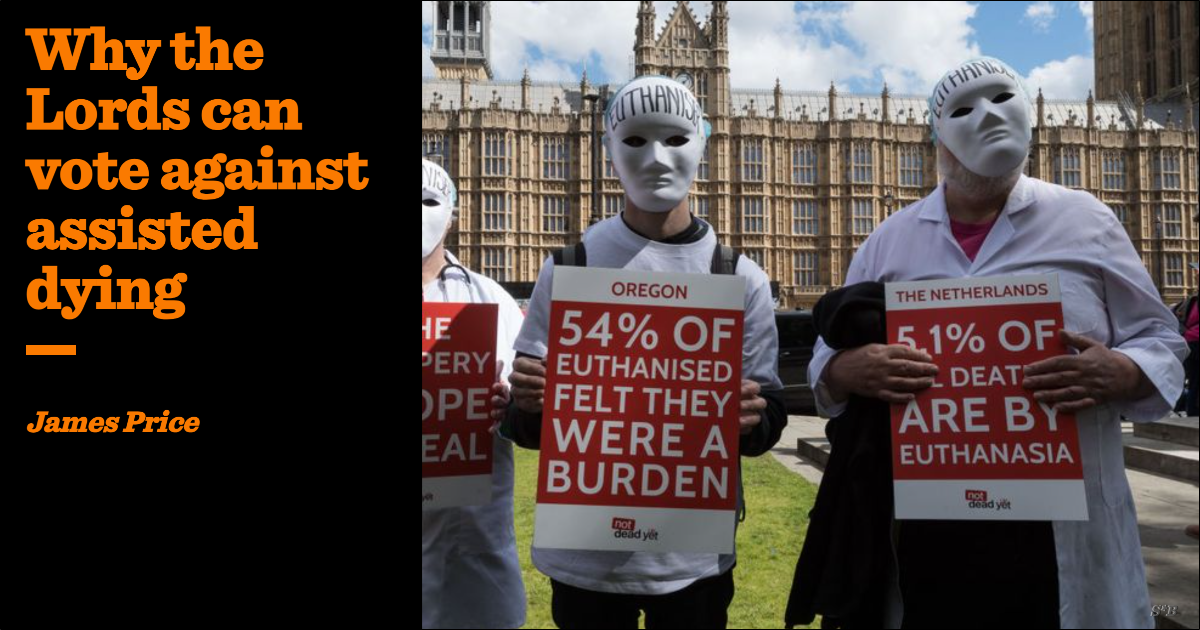
Time is now running out for the controversial assisted suicide bill, and we should all be grateful. The Bill will be back in the Lords today, for the 6th of 10 scheduled extra days of debate on over 1,000 amendments. These extra days were voted for to try to get through the mountain of amendments, but progress has been painfully slow, not least because the Bill is so flawed.
As things stand, the whole bill may fail if it is not passed through both the Lords and the ensuing Commons “ping-pong” by the end of the Parliamentary session in May. This is being painted by supporters of the Bill as an attempt to “filibuster” to ensure it fails. This is denied by their Lordships, who highlight the very real life-or-death stakes of such monumental legislation being rushed through without any considerations.
It is true that two-thirds of Peers who spoke at Second Reading in September opposed the Bill, which suggests that the Upper House may genuinely reject it, much to the dismay of its supporters. But it seems increasingly likely that their Lordships will reject the Bill on its merits, rather than preconceived ideas about the principle.
As the wonderful Lord Shinkwin — a man who, full disclosure, I was proud to get to know when I was the Special Adviser to the Leader of the Lords — said to the BBC: “We can only ever work with what we have been given, the volume of amendments, and the time taken to consider them, therefore, reflect the quality or lack thereof of the bill that was sent to us … If any bill is so poorly drafted and so unsafe, surely the question is not so much whether the bill deserves more time as whether yet more time could transform it.”
And whilst the increasingly ghoulish Lord Falconer, the Bill’s sponsor in the House of Lords, has said that failure to pass it would damage the reputation of the House, a poll recently published in The Independent suggests otherwise. There would be significant public support for peers’ right to vote it down.
Lord Falconer stated that it would be inappropriate for Peers to reject the Bill since it had been passed by the House of Commons. Falconer declared that “[i]t is for the elected representatives of this country to decide whether or not it’s right that we now move to an assisted dying bill”, not the unelected House of Lords. Lord Falconer seems to exhibit selective constitutional memory, having previously voted against several pieces of legislation passed by the House of Commons, including as recently as 2023.
The Bill’s sponsor in the House of Commons, Kim Leadbeater, has often made similar claims. She told Healthcare Today in late September that it is not the Lords’ role to block legislation, stating that she felt “disturbed” by the idea that Peers could prevent her Bill from passing.
Lord Falconer and Kim Leadbeater are mistaken in thinking the House of Lords ought not to reject this legislation. The Bill was brought to the House of Commons as a Private Members’ Bill by Leadbeater, not by the Government. Secondly, the Bill was not part of a manifesto commitment from her party. The Hansard Society notes that the House of Lords can reject legislation it finds unfit, as the Salisbury Convention does not apply. The House of Lords Constitution Committee ruled similarly.
This is why the poll reported by The Independent is so valuable. The poll of 2,071 UK adults by Whitestone Insight found that 70 per cent of those who took an opinion believe that peers have every right to vote against non-government legislation if they consider that it poses a significant risk to vulnerable lives. This indicates that the public sees through Falconer and Leadbeater’s convenient assertions and holds that the House of Lords should be able to reject the dangerous assisted suicide bill.
Lord Harper, former Minister of State for Disabled People, noted that the results were “striking”. He added that if the Bill “cannot be improved sufficiently, it is our responsibility to ensure it does not become law. This is not a manifesto Government Bill, and we should not treat it as such.”
Baroness Grey-Thompson also drew attention to the polling, saying, “Despite attempts to suggest otherwise, it seems the public are aware and support the ability of the Lords to reject this Bill should we think it necessary.”
Lord Falconer claimed that the duty of the House of Lords is to uphold legislation passed by the House of Commons. The House of Lords is responsible for intensive scrutiny of legislation and has a duty to reject such legislation if it is found to be fatally flawed. Since many Peers in the Upper House noted that the Bill lacked sufficient scrutiny in the Commons and deemed it unfit for purpose, it is not only their right but their duty, therefore, to protect the most vulnerable people in our society by rejecting it.
Their Lordships are well within their rights to reject it completely
This may also be an early skirmish in a broader constitutional conflict between the two Houses. If Reform do indeed win the general election, they will find themselves with an immediate challenge of almost no support in the Upper House. Not for nothing did Nigel Farage tell Bloomberg last year that he was reading Mr Balfour’s Poodle — Roy Jenkins’ account of the almighty fight between the Houses and the introduction of the Parliament Act by H.H. Asquith and the Liberals, which curbed the power of the Lords.
The key difference between now and then is that in the early 20th century, the Lords were thwarting the elected Government. Keir Starmer, by contrast, has been cowardly and sanctioned assisted suicide by allowing it go progress as a private members’ bill. This means that their Lordships are well within their rights to reject it completely. And what’s more, the recent poll shows that the public may agree they would be right to.