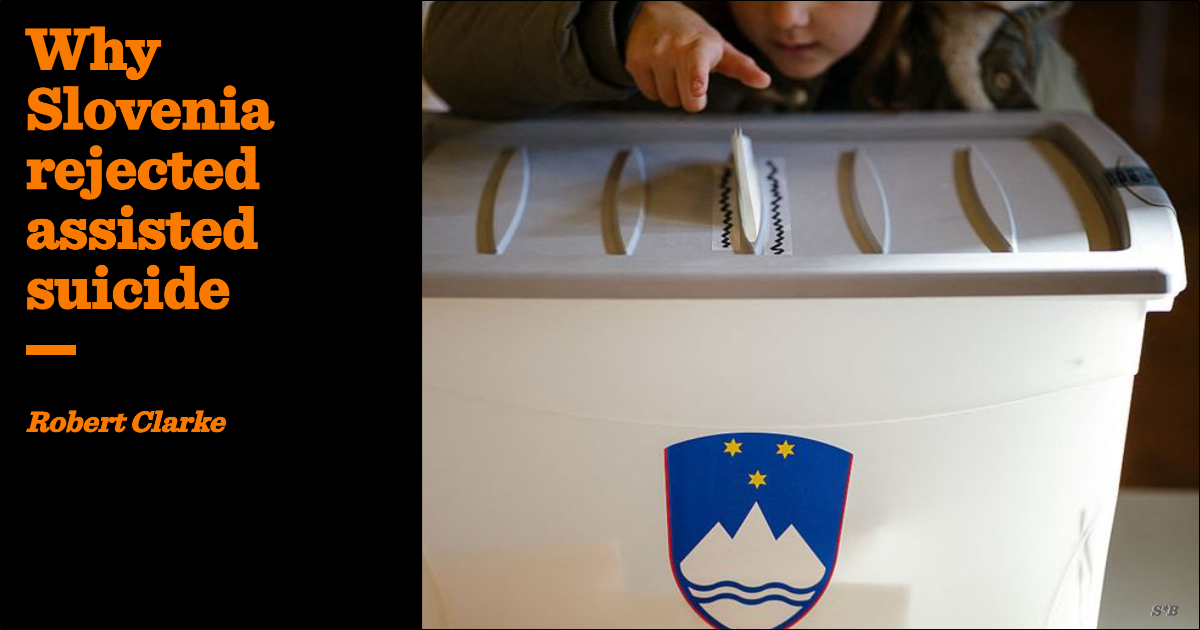
When a country of just two million people votes on a question the UK has wrestled with for decades, some too quickly shrug and move on. But Britain should pay close attention to what happened last week in Slovenia. On 23 November 2025, Slovenians went to the polls to decide whether to uphold or reject a new law permitting assisted suicide. Against the expectations of many pollsters — and those campaigning for the bill — they rejected it.
Just last summer, in a prior consultative referendum, 55 per cent of voters had indicated their support for the general idea of legalising assisted suicide. But in this week’s national vote, the position had flipped with 53.4 per cent opposing the bill.
What is clear is that support for the move dropped as the precise details of the bill became clearer. That should come as no surprise to any Brit as we have seen the same pattern emerge in Westminster. As the beleaguered Leadbeater Bill has limped through Parliament, we have seen support falling and opposition rising. Between the second reading and third reading in the Commons, its majority shrank from 55 MPs to just 23. In the Lords, it is facing greater opposition yet.
So, how did the Slovenian proposal go from commanding a majority to being rejected by a majority?
The answer may lie not in ideology, but in experience.
For years, Slovenia’s medical community has been warning of challenges in its healthcare system, particularly in palliative care. According to international assessments, Slovenia’s palliative provision remains “in developmental stages”. When real palliative options are missing, the suggestion of a lethal prescription stops looking like the advertised “autonomy” and starts looking like resignation.
This concern is directly transferable from Ljubljana to London. In the UK, despite world-leading hospices, access to high-quality palliative care remains patchy. A postcode lottery still determines the standard of care available. The British Medical Journal recently warned that “while palliative care in the UK can be excellent, its provision and funding are often inconsistent, inadequate”. Yet instead of addressing these shortcomings, Parliament is considering a bill that would introduce assisted suicide to Britain for the first time.
The second lesson from Slovenia is equally important: as Slovenians wrestled with the reality of what was being offered, many saw the truth that the promised legal “safeguards” do not work in practice
The Slovenian law was full of these so-called “safeguards” — multiple doctors, psychiatric assessments, commission oversight. Yet a closer look reveals troubling features that echo the experience of other European jurisdictions.
The definition of “unbearable suffering” was open-ended, including intense psychological distress if accompanied by some physical condition. The law allowed a central commission to approve deaths even when medical opinions conflicted. It required death certificates to hide the fact that a life had been deliberately ended, but simply record the underlying illness as the cause of death, creating a legal fiction to conceal what had occurred. And it compelled doctors to refer patients directly to someone willing to end their lives, while simultaneously excluding those same conscientious doctors from serving on the oversight commission. The referee’s bench, in other words, was reserved only for those already comfortable with the outcome.
These are not small details. They reflect the same patterns seen in Belgium, the Netherlands, Spain, and Canada — jurisdictions where eligibility criteria have expanded dramatically over time, and where once-exceptional cases have become routine. Belgium now records more than nine euthanasia deaths per day; the Netherlands is debating death for “completed life”; 5 per cent of all deaths in Canada are through “medical assistance in dying” despite it being legal for less than a decade.
Proponents in the UK insist that their bill is “narrow” and “tightly drawn”. But like the Slovenians, Brits are becoming more sceptical. And rightly so. Parliament cannot legislate in the naïve belief that cultural pressures, institutional incentives, or shifting interpretations will not lead the UK down the same path as every other country that has made the first step. In those countries, the slope did not merely prove slippery but almost vertical.
They refused the false choice between suffering and state-sanctioned death
That is what makes this week’s Slovenian result so significant. Here is a nation presented with a detailed law, with the chance for debate, here is a legislature that insisted it had built in “safeguards”, and here are voters — many of whom had previously expressed support for some form of assisted dying — taking a closer look and concluding that something was wrong.
They refused the false choice between suffering and state-sanctioned death. In doing so, they reminded the rest of Europe of a truth we are in danger of forgetting: that the compassionate response to suffering is not to eliminate the sufferer, but to address the suffering.
If Westminster is willing to listen, the people of Slovenia have delivered a message worth hearing.