“This Stalinist approach doesn’t seem like the way to build a happy team, but then it’s not my problem anymore”
“Just for a handful of silver he left us,
Just for a riband to stick in his coat …”
So begins “The Lost Leader”, Browning’s denunciation of Wordsworth’s slide rightward into conservatism. Yet the charge of betrayal is, as with Robert Jenrick’s passage from the Conservatives to Reform, less clear-cut than its loudest accusers suggest. Wordsworth’s revolutionary ardour was dampened by events — England’s war with France, the poor returns of the Revolution, the Terror, the guillotine. Disillusioned, he retreated into a period of quiet acquiescence to positions within the establishment rather than perform a clean ideological volte-face.
Jenrick’s journey was the result of a similar accumulation of doubt; a “long process” of realisation that the Conservative Party “hasn’t learnt, won’t change and is not the right vehicle” for the radical agenda he believes the country needs.
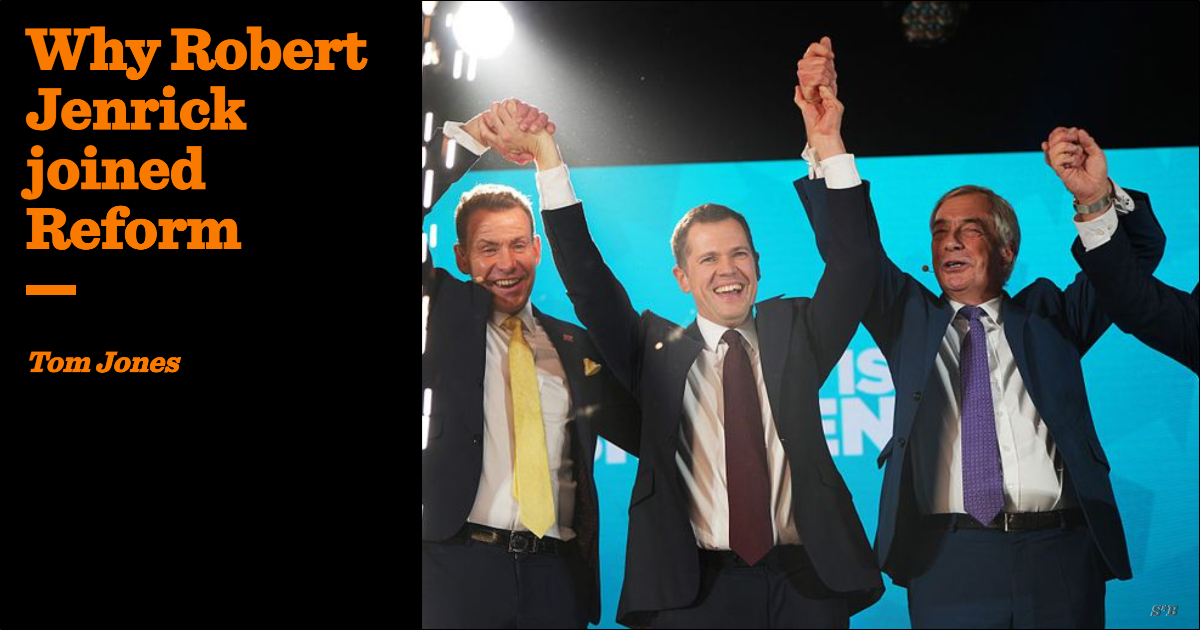
Unceremoniously booted from the party by Kemi Badenoch for planning to defect to Reform — an act reportedly uncovered by a Kemi ally, who found a draft defection speech in his office — Jenrick seems to be almost relieved that the burden of decision has been lifted. “Kemi might have thought she bounced me into this — she was wrong”, he tells the crowd at the rally Reform have organised in his seat of Newark to mark his arrival; “I have never felt more certain or stronger about anything I have done.” It is an unsurprising reaction; Newark was the only seat in either Nottinghamshire or Derbyshire to return a Tory MP at the last General Election, and Reform were able to gather 1,400 people to attend the event within just 48 hours notice.
More than a political event, Reform’s rally was a night of entertainment. Much has been written of Reform’s “daytime tv aesthetic”, and this is undoubtedly true; there are sparklers and chants, call-and-response, walk-on music timed to crescendos, speakers introduced like prizefighters, milked applause and held pauses.
But it owes more to televangelism than daytime tv, or indeed conventional British politics. By deliberately eschewing the staid seriousness of conventional political gatherings, Reform have successfully inverted the dynamic between political audience and performer. Conservative events are organised on the assumption that the importance of the event derives from those speaking; Reform behaves as if it flows from those who attend. It gives a sense of being in on something urgent, of a shared revelation.
Speaking after the event, Jenrick told me “no other party who could have arranged this; the Tories wouldn’t even try.” It’s a claim that’s hard to refute; perhaps only the BJP could draw so many people in at such short notice. Whatever else it was, the rally testified to the fact that Jenrick’s leap, however untidy, landed on solid ground.
When we meet at Reform Headquarters later that week, he tells me the decision had already been made — though not lightly. He describes it as “difficult” and “agonising,” the product of an internal conflict between loyalty to the party and what he believed the country required.
Defections — particularly ones as big as this — affect the party being left just as much as the one being joined, forcing the spurned party to reassess their direction. I put it to Jenrick that this problem is made sharper in his case because he had already set out a fully formed pitch for the party’s future — which he clearly decided could not be carried out by the Conservatives — and ask him what the consequences will be for his former party.
“There are a large group of MPs & members that share a common vision — they felt disappointed and angry, not just at the failure of last government, but that it caused immense lasting damage. That group hoped the party would admit its mistakes, learn and bring forward a new generation who were of this mind, and adopt a set of policies that would provide a radical agenda. I’ve come to the conclusion that is not going to happen – the party hasn’t learn, isn’t going to change and is not the right vehicle for a radical agenda.”
The parliamentary party, he explains, is why. “Over a third of members could be Lib Dems, a third just want an easy life, and then there is a minority group who share my values and the imperative to act to fix the country. I had hoped to shape the party so the minority became a majority position, but I think that was naive; within the party is a powerful establishment who are tied to the legacy of recent Conservative governments and unwilling to accept the scale of the failure. But if you can’t admit that the last government made the mistakes it did, there’s no hope it can change and be trusted to run the country.”
Since the defection, the battle between these factions has begun to rage again. Kemi Badenoch wrote to Conservative MPs saying these defections are “not about policy differences or ideology; they are about character”, insisting the Conservatives remain “the party of the right”. Matthew Parris has argued the opposite — that the Conservatives should now extend an olive branch back to figures like Kenneth Clarke, Michael Heseltine, David Gauke and Dominic Grieve. Gauke himself says that with Jenrick’s populist voice gone, Badenoch should “enthusiastically take the party in a different direction”. Andy Street and Ruth Davison have launched “Prosper”, a grassroots initiative aimed at the seven million centre and centre-right voters they argue are unrepresented by existing parties, advocating a pro-business agenda of growth, jobs, housing and opportunity while warning against populism and a “lurch to the right”.
His defection is being taken as an opportunity for the Conservative Centrist faction to re-assert itself because he performed a role in pushing the party to the right “initially decried, then adopted by the party.” He worries that without a drag anchor, the party will detach itself from where the true centre of gravity in British politics, and the electoral maths will dictate their future; “You end up appealing to pockets of great affluence in the South East, and nowhere else,” he says. “Nothing in the Midlands, the North, the East of England, Scotland. At that point, you’re not a national party anymore. That’s a recipe for irrelevance.”
Pursued to its logical conclusion, he argues, the realignment would harden along class lines: Reform as a workers’ party, the Conservatives as a party of the highly insulated and affluent. “The Conservatives might prosper in Kensington; Reform will win Derby, Nottingham, Lincolnshire. But the electoral system doesn’t allow for that. In most of the country, the choice will simply be between Reform and Labour.” The danger, he suggests, is that the Conservatives end up resembling France’s Republicans: confined to wealthy suburbs, a centre-right equivalent of the Liberal Democrats, a regional party detached from the electorate.
Questioned on Kemi herself, Jenrick remains scrupulously polite, and unwilling to offer any criticism. Yet she has begun to purge the party in his wake, with those suspected of “close affiliation and support of the Reform Party” finding themselves suspended, pending investigation. “This Stalinist approach doesn’t seem like the way to build a happy team” is all I can draw him into; “but then it’s not my problem anymore.”
Although it is early days, Jenrick seems to be relishing Reform. “I’m excited for the first time in a long time to be part of an energetic team of people”, he says. “I guess it’s now a scale up political party to fix the country, and it’s been an incredible boost to morale or energy to sense here that we are all working in same direction.”
As nice as this is for him, there is a rather more important question; Reform are the presumptive next government, but look perilously underprepared. He is familiar with Tory failure; what will it take for Reform to avoid their fate in government?
“Reform has to do what it says it’s going to do. The Conservative Party has failed to do a proper post-mortem; I tried to instigate that, but one of the flaws of the leadership election was that everyone else sought to avoid the debate. Kemi stood on a platform of fairly nebulous platform of conservative values, with policies coming later on.”
“The central reason for the Conservatives’ loss was it didn’t deliver on the things it promised — especially on immigration and the cost of living. In fact, it did precisely the opposite. Reform has to avoid that, and that means we need strong teams with serious plans, and above all strength of conviction to do the things and never back down.” It is perhaps this last line that Jenrick feels most strongly about; in his Newark speech, his most emphatic line to the crowd is that “in joining Reform I have resolved to never defend the indefensible again”.
Byron came to regret writing “The Lost Leader”, feeling it unfair to Wordsworth, who died five year after it was written. Political journeys are rarely as simple — or as venal — as they first appear. Jenrick’s move will be judged not by the drama of his exit, nor by the fervour of his welcome, but by what follows. If Reform becomes merely another vehicle for defending the indefensible, Byron’s couplet will apply after all. If it does not, the charge of apostasy may yet come to look hasty. History, as Byron learned too late, has a way of softening its first verdicts.