I am of the nuclear age. I was born and have lived my entire life under the threat of universal extermination that followed that day in the summer of 1945 when, on a testing ground in the New Mexico desert, the first nuclear bomb was exploded.
It caused Robert Oppenheimer, the brilliant scientist heading the US’s Manhattan Project, to proclaim – melodramatically but entirely accurately – an ancient Hindu prophecy: ‘I am become Death, the destroyer of worlds.’ Just three weeks later, in early August, the bomb was used for real for the first time against an enemy, in a blinding flash and a shockwave that destroyed the Japanese city of Hiroshima.
Pavements melted, skin was peeled off faces, 60,000 died immediately, another 60,000 in the following five months from injuries and radiation.
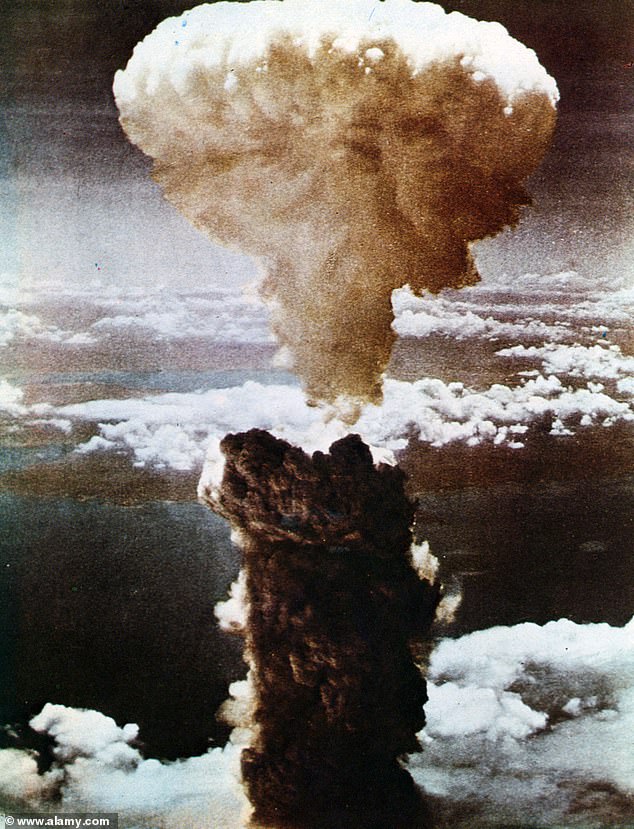
Three days later Nagasaki was given the same treatment. The original target had been a different city but heavy cloud cover saved it, diverting the American B29 bomber 125 miles south. Two square miles of the city centre were pulverised. More than 70,000 people died a horrible death.
And amazingly, those were the last fatalities of nuclear explosions. Eighty years on the world has somehow managed to avoid that apocalyptic, suicidal tripwire of its own making.
So far.
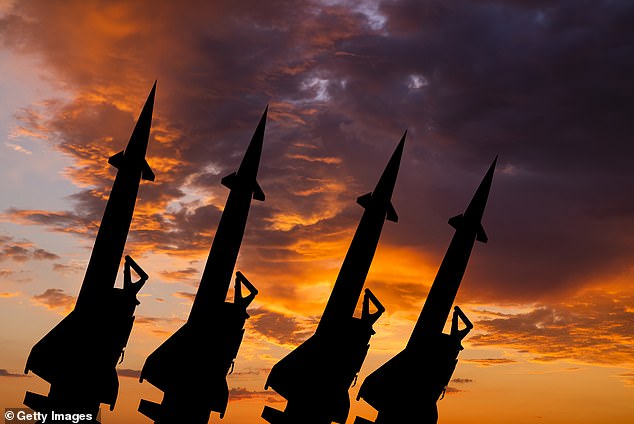
When the first nuclear bomb exploded on a testing ground in the New Mexico desert, Robert Oppenheimer proclaimed an ancient Hindu prophecy: ‘I am become Death, the destroyer of worlds’
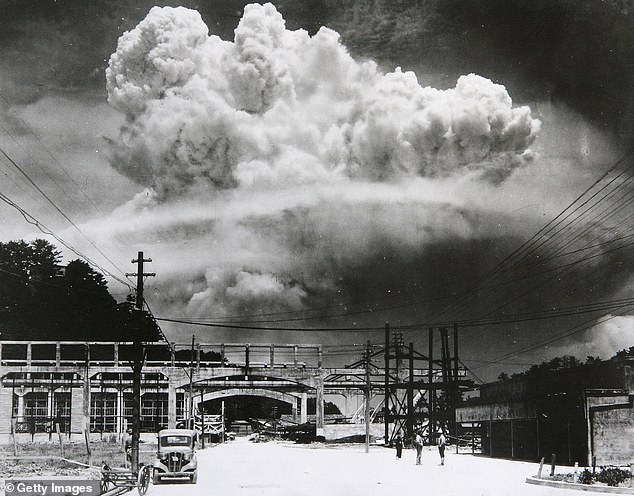
The radioactive plume from the atomic bomb dropped on Nagasaki as seen from Koyagi-jima, 9.6km away, in 1945
Those capital letters are necessary and should be imprinted on all our brains. It’s a miracle we are still here. Because, in an unstable world (and increasingly so) we are all one reckless move, one miscalculation, one technical glitch, one individual’s moment of madness, away from Doomsday.
How the lid has been kept on Armageddon is plotted by acclaimed American historian Serhii Plokhy in this chilling, bewildering book.
Bewildering because all we have ever done is make the threat greater, while posturing about the importance of containing it, claiming, nonsensically when you stop to think about it in the long term, that massive overkill is making the world a safer place.
I was a schoolboy back in 1962 when Soviet Union ships carrying nuclear weapons headed for a clash with an American blockade of Fidel Castro’s Cuba in the Cuban Missile Crisis. This was it. US President John F. Kennedy and Soviet leader Nikita Khrushchev toe to toe.
If no one blinked, inevitably those red buttons would end up being pushed, missiles would fly, the world was a goner. We teenagers counted off the miles to confrontation, laughed and sang: ‘We’ll all go together when we go.’
I remember a white-faced, scared history teacher coming into our classroom and bawling us out for being so flippant over the end of history itself.
He was right to bring us to our senses. Then again, how else do you deal with the apocalypse being hours, minutes, seconds away? Because the very idea is impossible to grasp. What do you do? Hide under a desk as a civilisation built up over millennia is blown apart and a world of abundance reduced to ashes?
With Cuba, the moment passed. The world survived. Plokhy argues that neither Kennedy nor Khrushchev was ready to push the button. They both pulled back. Phew.
And next time? Can we rely on the same calculated response from today’s leaders, from the likes of Putin, Trump, Kim Jong-un, Xi?
Because that’s the threat we live under, and yet we not only get on with our lives and look the other way but up the arsenal, increasing the destructive power to the point of absurdity.
Only recently, Putin boasted of a new Russian super-submarine with ‘unstoppable’ weaponry that can fire nuclear drones at Western coastlines from thousands of miles away. In response Trump ordered the US to restart nuclear testing.
How the lid has been kept on Armageddon is plotted by acclaimed American historian Serhii Plokhy in this chilling, bewildering book
Escalation like this is the underlying narrative of the nuclear age, of the powerful few thinking they can keep the weapon to themselves but finding all they have done is provide an incentive to other nations to follow suit as fast as possible for fear of being left behind. The US threw its scientists into nuclear research for fear of Hitler getting there first and the Nazis snatching a late victory in the Second World War.
Then Stalin had to have his, Britain, too, then France, China, Israel, India. The club just got bigger. Containment became harder. World leaders talked non-proliferation but that’s easier said than done once the genie is out of the bottle.
That genie is now everywhere. Officially there are nine fully fledged nuclear-armed states in the world. But the most worrying assertion of all in this deeply disturbing book is that close to 40 more states have access to the requisite technology and raw material or have the capability to produce nuclear weaponry, in some cases at very short notice.
That’s the size and extent of the timebomb each and every one of us is sitting on.
Those scientists – the Einsteins, Bohrs and so on – who first developed the principle and then the practicality of releasing unimaginable amounts of energy through nuclear fission and fusion, begged their leaders to concentrate on the massive peaceful benefits of their discoveries.
Of course, said presidents and generals, but first there is this enemy to defeat, this opponent to match, this military threat to see off.
Eight decades on, that’s where we still are.
It’s hard to find much to be optimistic about in Plokhy’s account of the nuclear age.
He concludes that fundamentally it is the fear of annihilation that has kept us from the brink – the general agreement that it is in no one’s interest to die in a global nuclear apocalypse. That held true in the Cuba crisis. He writes: ‘We must enhance the instinct of self-preservation shared by friends and foes alike to save the world once again.’
And keep our collective fingers crossed.