“Every state is now a border state.”
President Donald Trump and Republican allies have offered that metaphor for how unauthorized immigrants span communities across the United States. Increasingly, immigration enforcement is expanding, too. Personnel from a range of law enforcement agencies, most noticeably the Border Patrol, are moving deeper inside the U.S., where they’re contributing to controversial tactics.
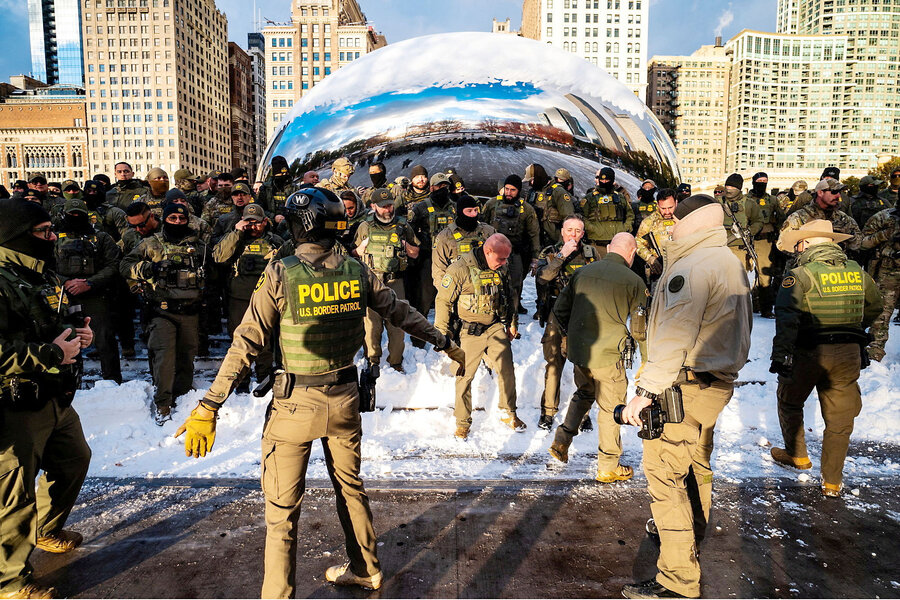
The Department of Homeland Security has launched a series of immigration enforcement campaigns this year, including “Operation Patriot” in Massachusetts, “Operation Midway Blitz” in Chicago, and “Operation Charlotte’s Web” in Charlotte, North Carolina, which began this past weekend. These efforts surge federal officials from multiple offices – including Immigration and Customs Enforcement, the Border Patrol, as well as drug and firearms agencies – to increase detentions and deportations of people living in the U.S. without authorization.
Why We Wrote This
The U.S. Border Patrol is playing a leading role in immigration enforcement activities far from U.S. borders. Critics say the agents’ borderland ethos results in overly aggressive tactics in urban centers – while the agency proclaims it is protecting Americans.
Actions by federal agents during these campaigns have shocked critics. They accuse officials of deploying overly aggressive and possibly illegal methods around street arrests, and unnecessary force, such as prolific use of tear gas on protesters. The administration cites broad enforcement powers under the law, and says its officers and agents are under attack.
As green-uniformed Border Patrol agents arrive in urban centers, agents are bringing their rugged borderland ethos with them, analysts say. To turbocharge arrests and deportations, Border Patrol officials are expected to take over top jobs at several ICE field offices, according to multiple news reports and an association of ICE officers. Gregory Bovino, a senior Border Patrol leader, left his post in California earlier this year to lead operations in Chicago, and now is in Charlotte. These shifts could portend more aggressive, public campaigns to come, analysts say.

Whether the Border Patrol and ICE are breaking the law, stretching norms, or simply doing their job can be difficult to detangle, in part due to conflicting social media videos that complicate fact-finding. Historians who study immigration enforcement agencies say there’s limited precedent.
Immigration experts say Border Patrol taking over ICE leadership would be a first. But use of border agents further into the interior has some historical context, such as during and after World War II.
The broad leveraging of the Border Patrol “certainly at this scale, and this scope, is unprecedented,” says Jennifer Chacón, a law professor at Stanford Law School.
“We are probably on the cusp of seeing a lot of unprecedented enforcement interventions,” particularly with the massive funding boost to immigration agencies, says Professor Chacón. ICE and the Border Patrol “will simply be present in more places, and have more people who can be deployed for more purposes, within the interior.”
As operations expand, what constitutes protection is under debate. Assistant Homeland Security Secretary Tricia McLaughlin says the law-enforcement surge to Charlotte is meant to “ensure Americans are safe and public safety threats are removed.” The administration claims 81 arrests were made on the first day. Local officials counter that the expected operations are “causing unnecessary fear and uncertainty in our community.”
What Border Patrol does
Both ICE and the Border Patrol sit within the Department of Homeland Security. It’s not unusual for the century-old Border Patrol to work with ICE, which Congress created after 9/11. ICE detention centers often receive detainees first apprehended by the Border Patrol in the borderlands.
“From its origins, the understanding was that the Border Patrol would be in charge of controlling the nation’s international boundaries, particularly for those persons who cross the boundaries without inspection,” says S. Deborah Kang, history professor at the University of Virginia.
Throughout its history, she says, the Border Patrol “resorts to these highly aggressive, militaristic tactics to establish itself as a bona fide police force.”
During World War II, certain detention camps for people of Japanese descent were guarded by Border Patrol agents, rather than military police, according to the National Park Service.

In the 1950s, a deportation campaign targeted unauthorized Mexicans as the Border Patrol pushed north of the southwest border. Besides checkpoints in California and Arizona, Border Patrol task forces came through Texas, Illinois, and the Mississippi Delta, “unleashing fast raids on farms, restaurants and Mexican majority communities,” according to historian Kelly Lytle Hernández. The press covered the roundups extensively, similar to now.
Publicity was part of the plan. The government’s early notice of the operation was “intended primarily to warn employers in time to replace their illegal workers with legals, especially in areas where perishable fruit is being harvested,” The Christian Science Monitor reported in 1954.
Publicity appears to remain a goal today. Mr. Bovino posts glossy social media videos of agents and arrests that resemble action-movie trailers.
What is “reasonable” location and enforcement?
All immigration officers draw their law enforcement powers from Title 8 of the U.S. Code. The law allows them, without a warrant, to interrogate and arrest anyone suspected of violating immigration laws in the U.S. Officials are also allowed to make arrests for “any offense against the United States,” if committed in their presence. A warrant signed by a judge is generally needed to enter private spaces like homes.
The geography of immigration enforcement matters. Following World War II, the government defined “reasonable distance” from the border as within 100 air miles. Within that 100-mile enforcement zone, there are exceptions to Fourth Amendment “unreasonable searches and seizures” protections, and the agency may temporarily detain drivers at checkpoints to check immigration status.
A narrower 25-mile zone from the border helps the Border Patrol traverse borderlands that are privately owned, which is common in Texas. Agents can operate anywhere in the country, but without the expanded enforcement powers afforded closer to the border.

Defining what is “reasonable” has played a controversial role in not just where but how agents can act. In September, the Supreme Court in an unsigned opinion from its emergency docket upheld agents’ rights to stop people based on assumptions of identity markers like race, as long as there are other factors involved. The standard that applies is called “reasonable suspicion.” (Other legal rulings can curb agents’ powers in certain jurisdictions. A 2022 court order by a federal judge in Illinois had further limited warrantless arrests in that region.)
Critics of the Supreme Court decision, which is in place temporarily while litigation proceeds, say it sanctions racial profiling. Assistant Secretary McLaughlin called the ruling a “win” for “the rule of law.”
“Everyone’s saying that we’re detaining citizens. Well, that happens on the border as well,” says Ammon Blair, a former Border Patrol agent and now senior fellow at the Texas Public Policy Foundation. He contends those temporary detainments can be necessary to discern U.S. citizenship or lack of status. At times, however, U.S. citizens have been detained by immigration officials for longer than two days under this administration, ProPublica reports.
Immigrant advocates counter that just because identity-based arrest tactics are legal doesn’t mean they are effective.
“Is it smart law enforcement? Does it actually help communities feel safer or be safer? And I think the answer to that is ‘no,’” says Aaron Reichlin-Melnick, senior fellow at the American Immigration Council.
“I think it is actively making communities feel less safe, and is raising the temperature and endangering their own officers, rather than actually working together with the community to focus on security,” he adds. Trump officials counter that the lack of cooperation with Democratic “sanctuary” politicians forces federal agents to arrest people on the streets, as opposed to taking custody of people in local jails.
Out of some 600 people detained in recent months, the federal government deemed 16 as a “high public safety risk,” notes a CBS News report based on court documents. Ac
Meanwhile, the expected replacement of ICE field office directors with Border Patrol brass appears to be deepening a rift between the agencies, despite the administration’s public projection of a unified team.
“I’m hearing from rank-and-file, specifically from California, that they’re not happy at all,” says a representative of the National ICE Officers Association, who asked not to be named while the union seeks to formalize. “There are competent people within ICE who could step up to that job.”
The two agencies are expanding their cooperation, Border Patrol Chief Mike Banks told the Washington Examiner. There are “twenty-seven plus cities across this country where we are working on the interior,” he said. “We have a long list of volunteers volunteering to go on those assignments.”
Expanding roles
Immigration-law enforcers have assumed other duties in the interior – and seen their ranks swell.
The pool of law enforcement officials with immigration powers has grown significantly since Mr. Trump’s return through the revival of an ICE initiative. The 287(g) Program deputizes local and state law enforcement with certain authorities, such as immigration arrests and interrogations during routine policing. The program now operates in 39 states, up from 21 states represented last December. The sheriff of North Carolina’s Mecklenburg County, which includes Charlotte, ended the county’s 287(g) agreement in 2018. He said the ICE partnership hurts community trust and ties up critical resources.
Federal agents, including from Customs and Border Protection, have also defended U.S. property and personnel in Portland in the wake of protests that have at times turned violent. Federal agents in Chicago have been accused of excessive use of force, involving tactics like tear gas and physical violence. Several protesters in Illinois have also been charged with assaulting and impeding law enforcement.
Border Patrol leader Mr. Bovino has called agents’ use of force “exemplary.” A federal judge in Illinois says the official admitted to lying about a rock-throwing incident to justify tear gas. The judge earlier this month restricted use of force during protests. The Monitor reached out to CBP and DHS for comment.
Over the weekend, Mr. Bovino posted a new slow-motion video announcing his arrival to Charlotte. Locals, meanwhile, began sharing their own videos of agents in pursuit of arrests.