When the Trump administration in September raised the fee for an H-1B visa to $100,000, it set off a global race for the highly educated foreign professionals now frozen out of the United States.
In the search for the best and brightest minds on the planet, H-1B visas have proven a magnet of unparalleled success. Holders of the H-1B have been an essential element in building today’s American tech behemoth. The CEOs of Google and Microsoft had H-1B visas, as did Elon Musk. The activities of current and former H-1B visa holders account for as much as one-seventh of the American economy, according to calculations by Michael Clemons of the Peterson Institute for International Economics.
More than three-quarters of H-1B workers are Indian, so shortly after the policy change, Germany’s ambassador to India made a video with a plea – and a dig at the U.S. “We do not change our rules fundamentally overnight,” said Ambassador Philipp Ackermann. “Highly skilled Indians are welcome in Germany.”
Why We Wrote This
When Donald Trump hiked the cost of H-1B visas, Indian professionals looked to be the hardest hit. But with the West shunning immigrants, India may also be the beneficiary of the new pool of job seekers.
Yet in conversations with experts worldwide and with the very Indian talent now set adrift by the H-1B changes, the biggest winner, it seems, might be India itself.
The reasons are many, starting with America’s unique and virtually irreplicable role in global innovation. But anti-immigration policies also play a part, meaning the workers who acted as rocket fuel for America’s current economic dominance no longer feel they have any place to go.
“I definitely want to move abroad, but … the laws have become very strict,” says Gunjan Malviya, who works for an IT company outside Delhi and was seeking an H-1B visa before the change. Australia is an option, she says, “but Europe doesn’t seem like a place that’s growing or accepting outsiders in a welcoming manner.”
“Everything now feels like it’s come to a halt,” she adds. “I don’t know what my next steps are.”

Less opportunity for Indians in the West …
In speaking with young Indian talent, one thing becomes abundantly clear. The American Dream is still a powerful force inside India.
Nowhere else in the world combines vast amounts of money ripe for investment, a willingness to embrace risk, and comparatively little bureaucracy. The result has been a U.S. tech sector that dwarfs its rivals. And H-1Bs made those startups and tech giants the proving ground for generations of India’s most ambitious entrepreneurs. It appears those already in the U.S. on H-1Bs should be able to stay, as the increase in visa cost only affects new applications. But the pipeline is now essentially closed.
Working in the U.S. had been Parmesha Reddy’s dream since she was 12. She came here to Bengaluru’s Indian Institute of Science (IISc) to achieve it. But as she walks beneath the campus’s canopy of gulmohar and mahogany trees, she rubs her hands, unable to mask her worries. “My father always wanted me and my sister to settle in the U.S.,” she says. “He saw colleagues’ children going there, getting jobs, and earning well.”
Even now, weeks after the Trump administration’s decision, she says, her family has still not come to terms with it.
“Now, everything we planned for is disrupted,” she says. “Our careers are at stake. My father has worked hard for this, and my sister and I have put everything into following this path.”
Neither the United Kingdom nor Germany can adequately fill that gap. First, the opportunities are fewer. While Britain has a strong startup culture, for instance, it lacks the venture capital to build the megacorporations that define and drive the industry. The U.S. has created a dozen tech companies worth at least $100 billion; Europe has none.
But this success has done more than provide opportunity, it has also forged a deep cultural connection. “The Indian diaspora has marinated in the H-1B experience, so the gravitational pull [to the U.S.] will be very high,” says Tom Hurd, founder of Zeki, a London-based firm that tracks top research and development talent worldwide.
That puts Europe at an inherent disadvantage. Anti-immigration politics have made it worse.
“You say you want to grow the economy, but at the same time, you’re making it less attractive for people to move to the U.K.,” says Nelli Shevchenko, a senior associate who works on immigration issues in London for employment law firm Sherrards.
Many Indians feel that. “Europe has always been very reluctant on that – immigrants as a way to grow,” says Madhavi Arora, chief economist for Emkay Global Financial Services in Mumbai.
That leaves India’s rising stars unsure where to turn. Prasant Thapa, a graduate student at IISc Bengaluru, had secured admission to New York University for a master’s in data science. But with no opportunity for an H-1B visa after graduation, he withdrew.
In the crowded cafeteria, he voices his frustration as he nurses a drink and overhead fans churn through the humid afternoon. “I look around the world, and there are not any good options, even close to what one could have expected from the USA,” he says.
“Europe seems like a very difficult place to move to because there are already strict regulations on visas, and finding a job is not easy.” So he, too, is considering Australia or Canada, “but nothing is certain yet.”

Francis Mascarenhas/Reuters/File
… But growing opportunity at home
Amid such uncertainty, the country most poised to take advantage could be India itself.
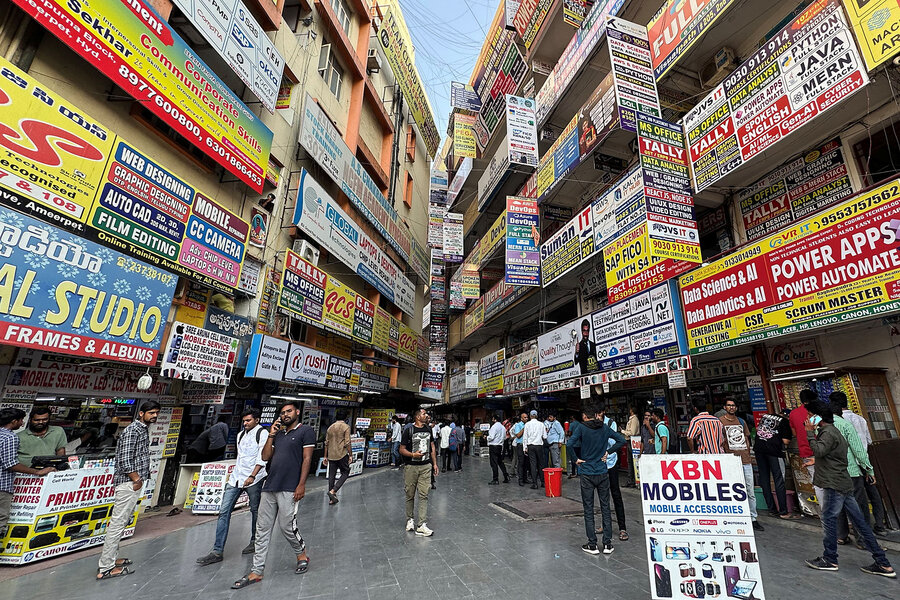
Its challenge is a lack of jobs with the profile or promise of those abroad. But that is changing. India is no longer merely a land of call centers and cost-cutting offshore operations. And the decline of H-1Bs could be an accelerant.
During the pandemic, India became a hub for “global capability centers,” which act as remote headquarters in miniature. They “are primed to evolve into innovation hubs,” said Pravin Goel of global investment firm BlackRock during a McKinsey roundtable discussion. “This is such a promising ecosystem for domestic startups.”
Just last week, Google announced plans for a $15 billion artificial intelligence data center in India, which will be “the largest AI hub that we are investing in anywhere outside of the U.S.,” an executive said at a ceremony in New Delhi.
Mr. Hurd of the talent-tracking firm Zeki happened to be in India meeting with senior government officials and tech leaders when the H-1B announcement was made. “They were delighted,” he says.
The shift is already underway. His data suggest that 36% of the top AI talents globally are in the U.S., with about 6% in the U.K. and another 6% in Germany – numbers that have remained static during the past decade. India’s share, however, has jumped from 4% to 7%.
Deepanshu Kumar can understand that. The undergrad at the Indian Institute of Technology in Delhi was disappointed by the H-1B news, but not distraught. He’s still in his teens, and he sees new opportunities emerging.
“After all, it’s not only Indian professionals who were dependent on the U.S. job sector,” he says. “The reverse is also true. U.S. companies were equally dependent on us.”
He doesn’t see that changing. What might change are the forms the relationship takes.
“In the longer run, I believe India is going to see more investments and people are going to get jobs within the country,” he says. “This could actually be an opportunity for us, if we handle it right.”
“The question is how we position ourselves going forward,” he adds. “Do we keep waiting for America to change its mind, or do we start building alternatives here?”