- The Edges of the World by Charles Foster (Doubleday £22, 304pp) is available now from the Mail Bookshop
If you want an insight into the surreal paintings of Salvador Dali, consider how he used to prepare for work.
He would sit in a chair, holding a large key over a metal bowl, and allow himself to fall asleep.
The key would clatter noisily into the bowl, waking him up as soon as he’d nodded off. This enabled him to access the thoughts he’d just encountered in the ‘hypnagogic state’, that curious territory between waking and sleep.
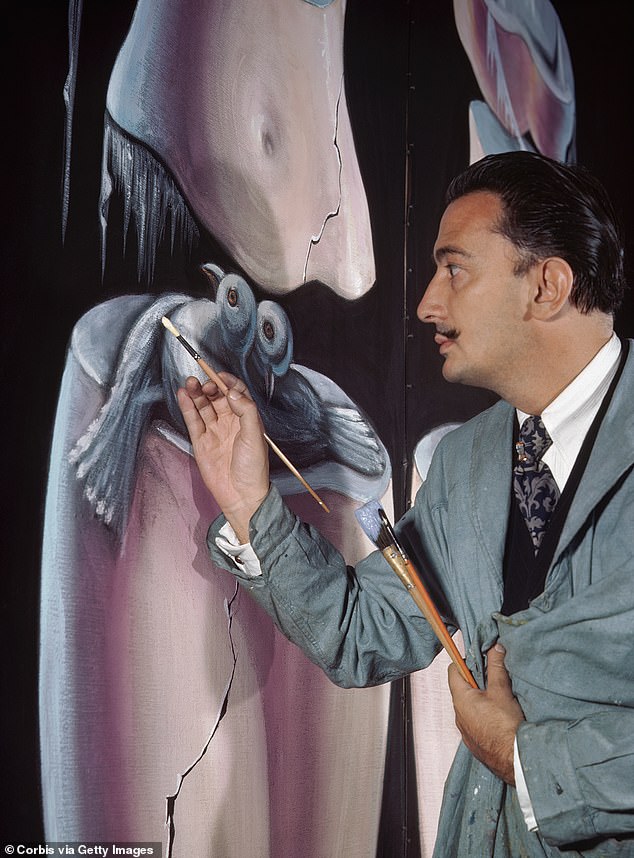
Pushing boundaries: Dali
The trick, writes Foster, allowed Dali to find ‘the images we all seem to recognise: images that are strange but strangely familiar’. It’s an example of Foster’s theory that all our best ideas come when we’re on the edge. The edge of consciousness, or a physical territory, or an evolutionary period, or a political movement. Foster loves edges. He dislikes centres.
Perhaps this is only to be expected from someone who grew up on the edge of Sheffield. ‘Our suburban road ran uphill from our house to the wilderness . . . the city twinkling on one side and the moors black on the other . . . I slept always with the windows open, because I wanted the wild in my bedroom.’
Even as he considers the cities at the centre of great empires, he dismisses their achievements: ‘Geographical centres are magnets . . . They are chatrooms where edges meet . . . They contribute little to the debate.’ Many great figures in ancient Rome, for example, came from the provinces.
Foster’s argument that cities such as London, New York and Paris are full of people from elsewhere is undeniable. But surely those people are only there because there’s something lacking in Elsewhere? People from small towns seeking excitement have always headed to London, changing both themselves and London in the process. Even if they don’t stay there for the rest of their lives, the great city has worked its magic on them.
As ever, the truth is somewhere in the middle. I loved living in London for my 20s and 30s, and now love living in rural Suffolk. But I visit the capital all the time – I still love it because I don’t live there any more. It’s my weekly treat. The centre and the edge need each other.
The very process of evolution itself depends on edges – creatures need to mate with others on the extreme of their group, who aren’t like them. This basic biological truth can be seen in the fact that ‘sexual disinhibition’ (sleeping around) is more common on holiday than at home. British sexual health clinics are busier after the holiday period. You’ll never see Skegness in the same light again.
This book isn’t the easiest read. Foster likes to use seven words where three will do, and they tend to be ones such as ‘liminal’ and ‘metastasis’.
But he makes plenty of interesting points, and we learn things along the way. Like, for instance, ‘ecstasy’ literally means ‘standing outside yourself’. And that Jeeves (as in ‘. . . and Wooster’) took his holidays in Herne Bay.