Christian leaders offered the comfort of a council-run DEI course on togetherness
“This desecration of our synagogue, on Yom Kippur of all days, is an episode that has changed us all forever.” The statement by the leadership of Heaton Park Synagogue is an incredibly sobering insight into the experience of British Jewish people, fellow subjects of the Crown, in the United Kingdom in 2025. A synagogue was desecrated. Jews were killed because they were Jews. With necessary moral clarity, the synagogue’s rabbi stated, “I saw evil”. Following the murderous attack, the Chief Rabbi echoed this moral clarity when he declared, “For so long we have witnessed an unrelenting wave of Jew hatred on our streets, on campuses, on social media and elsewhere — this is the tragic result”.
“Jew hatred.” There was a time in our history when these words conjured up for Britons distinctly foreign images of pogroms in Europe’s east. Even with the casual prejudice against Jewish people in parts of British society in the 19th and early 20th centuries, we British, it was thought, had nothing in common with distasteful loons on the European Right who ranted about Jewish conspiracies. And then there was Nazi barbarism and the darkness of the Holocaust, against which we stood as part of what Churchill termed “Christian civilisation” (a phrase that continued to be part of our national self-understanding until the 1960s).
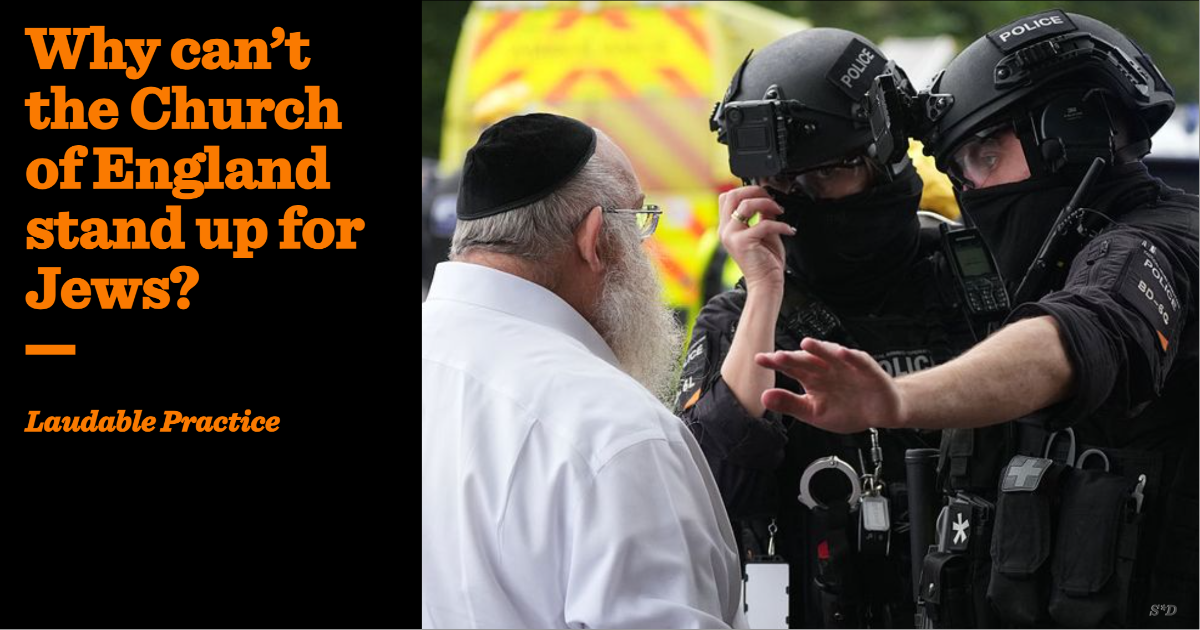
Now in 2025, British Jews need security guards at their synagogues and schools. On university campuses, Jewish students — in the face of activists campaigning for Judenfrei zones — feel safer when they remove their kippah or Star of David. And the Chief Rabbi is moved to warn the country that such “Jew hatred” resulted in a synagogue being attacked and Jews killed.
It is a time for national soul-searching; a time to ask how and why we have abandoned those moral foundations of national life which made virulent anti-Semitism entirely alien; a time to renew our covenant with British Jews, a covenant which has given them a peaceful, secure home in this country, as loyal subjects of the Crown, since the mid-17th century. It should, then, be a time for the established Church to speak with clarity, confronting the evil of anti-Semitism and encouraging a deeper recognition of what it is to be a culture rooted and founded in a vision of Christian civilisation, the basis of our covenant with British Jews.
It has spoken of a broader notion of “hatred”, obscuring the reality that it is very specifically hatred of Jews
Unfortunately, in place of this, the established Church has, at least partly, been as a trumpet giving an uncertain sound in the days since the murderous attack on Heaton Park Synagogue. Instead of recognising the evil of anti-Semitism, it has spoken of a broader notion of “hatred”, obscuring the reality that it is very specifically hatred of Jews that is at work. Instead of setting forth a Christian understanding of why British Jews are to be respected and protected, we have heard bishops utter progressive banalities.
The Bishop of Manchester is a case in point. Addressing the attack on the synagogue in his city, he declared Manchester to be “a city built on diversity, mutual respect, and unity”. This is the language of a local government civil servant who has attended all the necessary DEI seminars. A bishop of the established Church should be capable of articulating a rather more compelling vision of the moral roots of our common life than the ideology of early 21st century progressivism. He went on to call for “the courage to stand together against hatred in all its forms”. But it was not “hatred in all its forms” that was at work in the attack on Heaton Park synagogue. It was Jew hatred that led to Jewish blood being spilt in Manchester.
The Archbishop of York stated, “On this most holy day for the Jewish people, Yom Kippur, we pray all may live alongside each other in harmony and respect”. There is a jarring quality to these words — a specific recognition of Jewish people, followed by generalities. Such generalities are not innocuous. They can obscure the need both to challenge the particular evil of anti-Semitism; and they do not give an explicit call to all in our society to honour and respect Jewish communities. The Archbishop of Wales, who has previously served in the established Church, provided a particularly egregious example of this approach: “we are called to stand in solidarity with all who are victims of hatred and violence and work with all people of good will to counter anything in our society that threatens to divide us”. It was not merely “anything in our society that threatens to divide us’ which led to the attack on a synagogue and the killing of Jews — it was Jew hatred.
It is therefore welcome that the statement by Archbishop of Canterbury-designate Sarah Mullally struck a different note. She did specifically say, “We then, as a Church, have a responsibility to be a people who stand with the Jewish community against antisemitism in all its forms”. This, rather than the bland echo of DEI discourse in episcopal statements, should be what is heard from the established Church. Admittedly, Bishop Sarah went on to state, “Hatred and racism of any kind cannot be allowed to tear us apart” — as if naming the evil of anti-Semitism somehow needs to be “balanced” by wider concerns. That said, we should hope that her expression of a particular concern by the established Church for the place of British Jews in our society indicates a willingness by the next Primate of All England to say something deeper, more compelling on this issue than some of her episcopal colleagues.
The duty of the established Church towards our Jewish neighbours has much deeper roots than banal invocations of “diversity is our strength”. It flows from Christ’s words, “Salvation is from the Jews”. It reflects how many basic Christian practices — reading the Scriptures, heeding the Ten Commandments, praying the Psalms — are a gift from Judaism. And it is dependent on the truth that Our Lord Jesus Christ is the Son of a Jewish Maiden. Added to this, the cultural vision of Christianity, embodied as it has been in the life and order of this Realm, is profoundly shaped by our Jewish inheritance: “Zadok the priest and Nathan the prophet anointed Solomon king”. For these reasons, the established Church must heed Lord Glasman’s warning that anti-Semitism is a “significant rupture in our national story”, a national story defined over centuries by Christianity. Renewing that national story and its Christian roots requires a renewed commitment to cherish, respect, and protect British Jewry.