The Chief of the Imperial General Staff, in a report circulated to the Cabinet by the Secretary of State for War in October 1932 (uncirculated reports are scarcely of note), pressed for neutrality in Europe, “the consolidation of the Empire and the safety of Imperial communications”. In turn, the Committee of Imperial Defence responded to its critics in 1934 by arguing that “it would not be possible to organise a larger mechanised force than the one we recommend below without upsetting the whole system by which our forces overseas [in the Empire] are maintained by the Home Army”. The Committee proposed a tank brigade as part of an expeditionary Field Force designed to be sent to the Continent in the event of conflict, but also argued that imperial tasks cannot “be met by the creation of a highly specialised ‘robot’ army at home, even if that were the best system for a Continental war”. The Deputy Chief of the Imperial General Staff noted in May 1939:
under the plan approved in April 1938, the Field Force was to be organised primarily with a view to reinforcing the Middle East…. The crisis in September 1938 … focused sharply the fact that, even when the programme was complete, our forces would be inadequate for a major Continental war.
With the benefit of hindsight, it is possible to point to serious flaws in the decisions taken by British policymakers, but it is also worth underlining the difficulties of assessing links between challenges and commitments. In particular, the issues of prioritisation between commitments and the linkage of challenges both posed problems. The British concern with Empire reflected the experience of World War One when the Empire had provided crucial support, in men, money and supplies, in Europe. Thus, the Empire was both a source of weakness, through over-extension, and of strength. Economic diplomacy within the Commonwealth led to Imperial Preference, established in agreements reached at Ottawa in 1932. The diplomacy of the Dominions’ links was maintained by the Dominions Office in London, a body that managed relations with High Commissioners in Dominion capitals and with the Dominions’ High Commissioners in London. The Empire had in effect become a sphere for diplomacy.
Meanwhile, there was a hope that Hitler’s demands for a revision of the Versailles settlement could be achieved and Germany’s integration into the international order sustained, rather as Napoleon III’s pressure on behalf of France had been finessed in the mid-nineteenth century. In the winter of 1933-4, the Defence Requirements Sub-Committee decided that the German threat was in the future, while Japan was the immediate threat to British interests.
In hindsight, Western passivity in 1936 over the Rhineland marked a major step in Nazi expansionism, but, at the time, it was not seen in such a stark light. Furthermore, differences between Britain and France in their views of European development, the very limited nature of Anglo-French military co-operation over the previous decade, and their lack of preparedness, were understood by contemporaries as a poor basis for joint action. In 1933, the British were unwilling to make common cause with France towards Germany, and this remained their policy. More robust policies focused on alliance with France were rejected. Moreover, the Anglo-German naval agreement of 1935 was regarded by the French as a betrayal.
“Appeasement”, the Anglo-French failure to confront Germany, Japan and Italy, was a matter of goals and means. The British diplomatic world divided accordingly. Already, in response to the Japanese invasion of Manchuria in 1931, Sir Francis Lindley, the caustic Ambassador in Tokyo from 1931 to 1934, and his embassy staff, pressed against Britain backing League of Nations action over Manchuria, especially sanctions against Japan.
Meanwhile, the flow of information increased, which created serious pressures in staying abreast of developments, notably in London. For example, the Consul in Shanghai provided a series of quarterly political reports and six-monthly intelligence summaries from 1920 until the Japanese occupation of the city in 1937.
The attempt to contain the Axis powers short of war failed, but, however mishandled, the Realpolitik involved was not inherently dishonourable. Moreover, a wish to seek a negotiated alternative to war was widespread across the political spectrum. In Britain, far from being a characteristic of reprehensible Conservatives, not to say fellow-travelling neo-fascists, as it is frequently presented today, the desire to avoid war and the related opposition to rearmament were also notably strong among liberal opinion and on the Left, and particularly so prior to the Munich Crisis of 1938. On his visit to Germany in the autumn of 1936, David Lloyd George saw Hitler twice, the second urging him to visit Britain and providing the assurance that “he would be welcomed by the British people”. Hitler wanted to enlist Britain against Communism, but Lloyd George did not want to take relations that far nor to compromise the Anglo-French alliance. He criticised political and religious repression “a terrible thing to an old Liberal like myself,” while seeking good relations whatever the nature of the regime. In practice, as was to become apparent, Hitler’s determination on a fundamental recasting of Continental Europe made war likely.
Lloyd George assured Hitler “he would be welcomed by the British people”
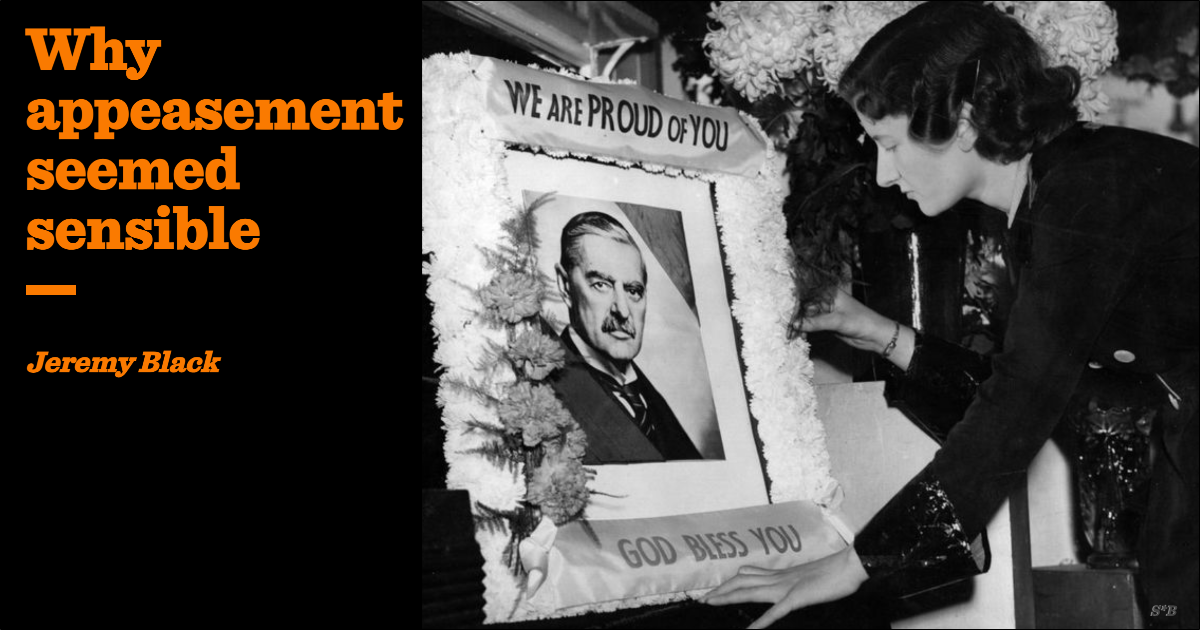
Meanwhile, on the part of Britain, a sense that compromise with Germany was possible, combined with a lack of interest in the areas threatened by German expansionism, encouraged a conciliatory search for a settlement, as did the extent that few were in other than denial about what Nazism was really like, both in domestic and international policy. Neville Chamberlain, Prime Minister from 1937 to 1940, feared that war would lead to the collapse of the British empire and would also wreck the domestic policies of the Conservative-dominated National Government for which he had previously served from 1931 as Chancellor of the Exchequer. He was correct on both counts. Chamberlain wanted a small defence budget to help in economic recovery. Ministers also assumed that, if conflict broke out with Germany, then Japan might be encouraged to attack Britain’s Asian empire, which was correctly seen as militarily and politically vulnerable.
“Appeasement” was designed to avoid unwelcome alliances as well as war. Unhappy with Britain’s allies and potential allies, and unwilling to explore the path of confronting Hitler by making him uncertain about the prospects of collective action against Germany, the British government preferred to negotiate directly with him. This political response was matched by Chamberlain’s focus on deterrence by a stronger navy and, in particular, air force, each of which was to be based in Britain, rather than through an army that was to be sent to the Continent.
The Versailles settlement had left to Czechoslovakia those parts of Bohemia and Moravia where there was an ethnic majority of Germans, the Sudeten Germans. This was unacceptable to Hitler, who sought the union of all Germans in one state and was determined to destroy Czechoslovakia, a democratic state that looked to the great powers for support.
Hitler wanted a short and successful war with Czechoslovakia. Prior to the Munich agreement, Britain and France had threatened action if Hitler tried to pre-empt a negotiated settlement of the Sudeten question. However, concern over the prospect of a more general war leading to conflict with Britain and France had led Mussolini to become more cautious, and, without the support of his ally, Hitler cancelled the mobilisation order and decided to rely on negotiations. Mussolini’s position had indeed been regarded as significant by the British Chiefs of Staff, notably because of the threat to Egypt. By the eventual agreement negotiated at Munich, the Czech frontier was to be revised to satisfy the Sudeten Germans.
Pacifism in British and French society and opinion affected their governments’ policies. So did anti-Communism, but suspicion of the Soviet Union as a potential ally against Germany also owed much to the purge of the military leadership. Soviet opportunism, which extended to considering closer relations with Germany, was also a serious handicap.
Britain was also affected by the reluctance of the Dominions, especially Canada and South Africa, to fight Germany. With President Franklin Delano Roosevelt of America guaranteeing Canada’s security in his Kingston, Ontario speech in September 1938, there appeared less reason for Canada to risk war. With isolationism strong, America played no real role in the Czech crisis, which itself ensured that it took an important part, not least as it was the leading industrial power. The lack of Anglo-American cooperation in the 1930s was a major feature in international relations, and one that affected British options.
Anglo-French fears in 1938 may have been excessive, given the weaknesses of the Nazi regime, not least a lack of enthusiasm among the German generals, as well as the deficiencies of the German military, the weaknesses of the German frontier defences, and the lack of German strength for any attritional conflict. British intelligence, and notably the Air Staff, exaggerated German military capabilities with regard to Britain and Czechoslovakia. In practice, the Luftwaffe lacked the training and range to launch a bomber offensive against Britain, while the number estimated for German reserve and armoured divisions was too high.
The Luftwaffe lacked the training and range to launch a bomber offensive against Britain
It is too easy in hindsight, however, to criticise the leaders of the period and to underrate their genuine and understandable fear of causing a second “Great War”. In many respects, the Munich agreement was part of the legacy of World War One. Germany may have been weaker than was thought, but was determined to gain its objectives. There were also serious weaknesses in the British and French militaries.
Separately, there was the retrospective defence offered in 1944 by Frederick, 1st Viscount Maugham, Lord Chancellor in 1938-9 in The Truth About The Munich Crisis, an appeal for a geopolitics of caution and realism:
It is always easy to write a vigorous article or to deliver an eloquent oration denouncing oppression and cruelty by any state however remote and urge on our Government – which will of course be described as pusillanimous — acts which must lead to war…
Nothing is so foolish as the idea that Great Britain can or should act as the schoolmaster of the world. There are remote countries where we could not launch and maintain a large expedition against a well-armed enemy with any real hope of success for the reason, amongst others, that supplies on the scale required by modern mechanised war would be impossible. The magnitude of the problem has greatly increased since the last war. The supplies of petrol, mines, shells, spare parts, food, and of all the multifarious planes, tanks, guns, carriers, and other mechanical vehicles, and repair outfits, call for an enormous quantity of shipping facilities, and a use of roads and railways which may be the objects of continuous attack by air.
It should be admitted that the interests of Great Britain may be indirectly involved if the enemy is engaged in acts of aggression against another country which seem to form part of a system which will sooner or later bring him into an attack on Britain of its interests. This is perhaps only expressing in a more modern form the proposition that we are interested in seeing that the Concert of Europe is not seriously disturbed.