This article is taken from the December-January 2026 issue of The Critic. To get the full magazine why not subscribe? Get five issues for just £25.
For anyone whose idea of what a history of religious art might look like is informed by Catholicism, the aesthetic consequences of the English Reformation might be hard to comprehend.
The cherubic opulence of European Baroque, for example, is impossible to square with the austerity of English Gothic. What’s more surprising, however, is that four hundred years after the Roundhead William Dowsing, also known as the “Iconoclast General”, oversaw the removal of religious pictures from some 250 places of worship, the Church of England still refuses to figure out what to do with art.
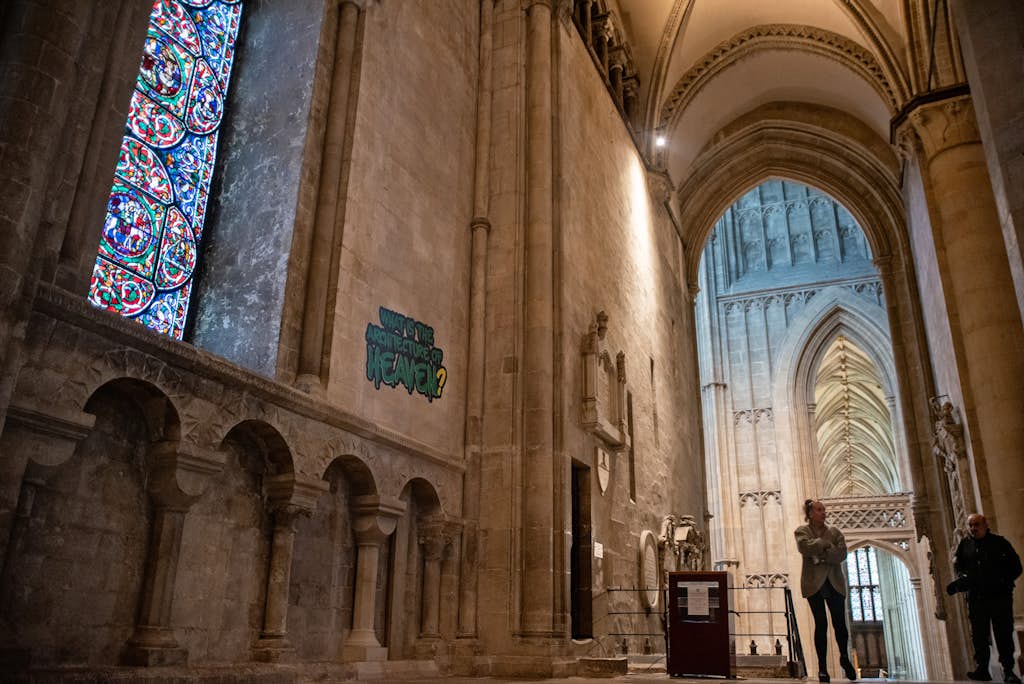
The installation Hear Us, which opened at Canterbury Cathedral in October, garnered irate responses from a raft of commentators, including the US Vice President and Catholic convert J.D. Vance. Critics were furious that the artefacts — graffiti-like designs with questions such as “is this all there is?” and “where is humanity heading?” — were damaging to the fabric, physical or moral, of the 11th century cathedral.
But they missed the much larger issue: these slogans’ anti-transcendental aesthetic is entirely in line with the uneasy historical designation of religious art in England as somehow ungodly. This project takes the iconoclastic impulse even further by making an art that is also unhuman.
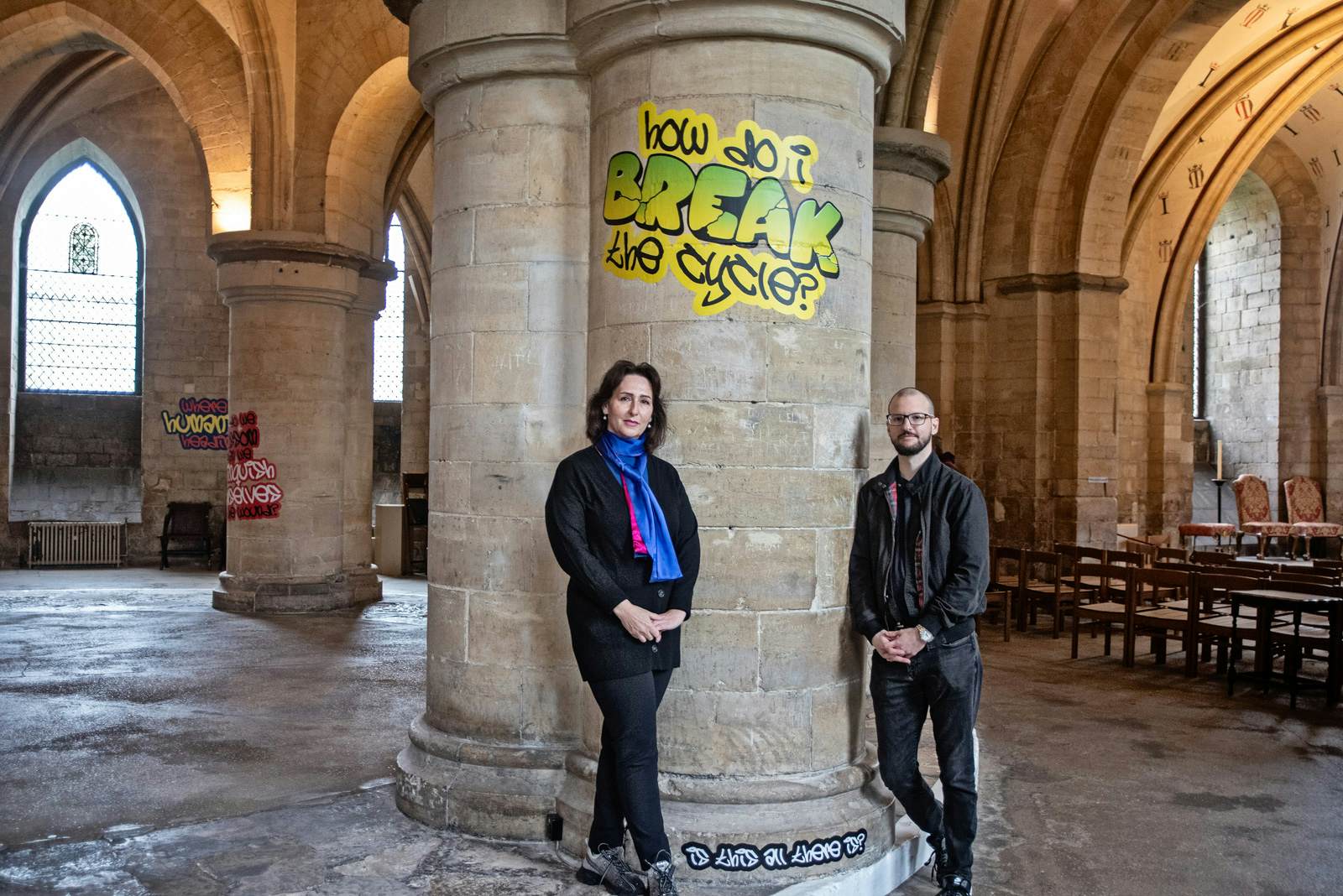
Hear Us is intentionally more of a community outreach project than an act of worship. The poet Alex Vellis worked with “marginalised” groups who, according to the curator, Jacqueline Creswell, did not feel welcome in the cathedral, despite holding religious beliefs. It is they who formulated the questions to God, coming up with the rather obvious “are you there?” and the more cryptic “what is the remit of my responsibility?” Creswell had these words turned into designs reminiscent of street art using AI graphics software, preferring the legibility of its output over the work of a human graffiti artist.
The result of this process is a series of trivial interventions which are no match for the imposing architecture of the church. In this, the colourful vinyls of Hear Us bear some relationship to the often anonymous, unauthorised markings left on church stones over centuries by Canterbury pilgrims. This comparison, however, breaks down when one understands that the new graffiti would be entirely out of place in the city’s streets.
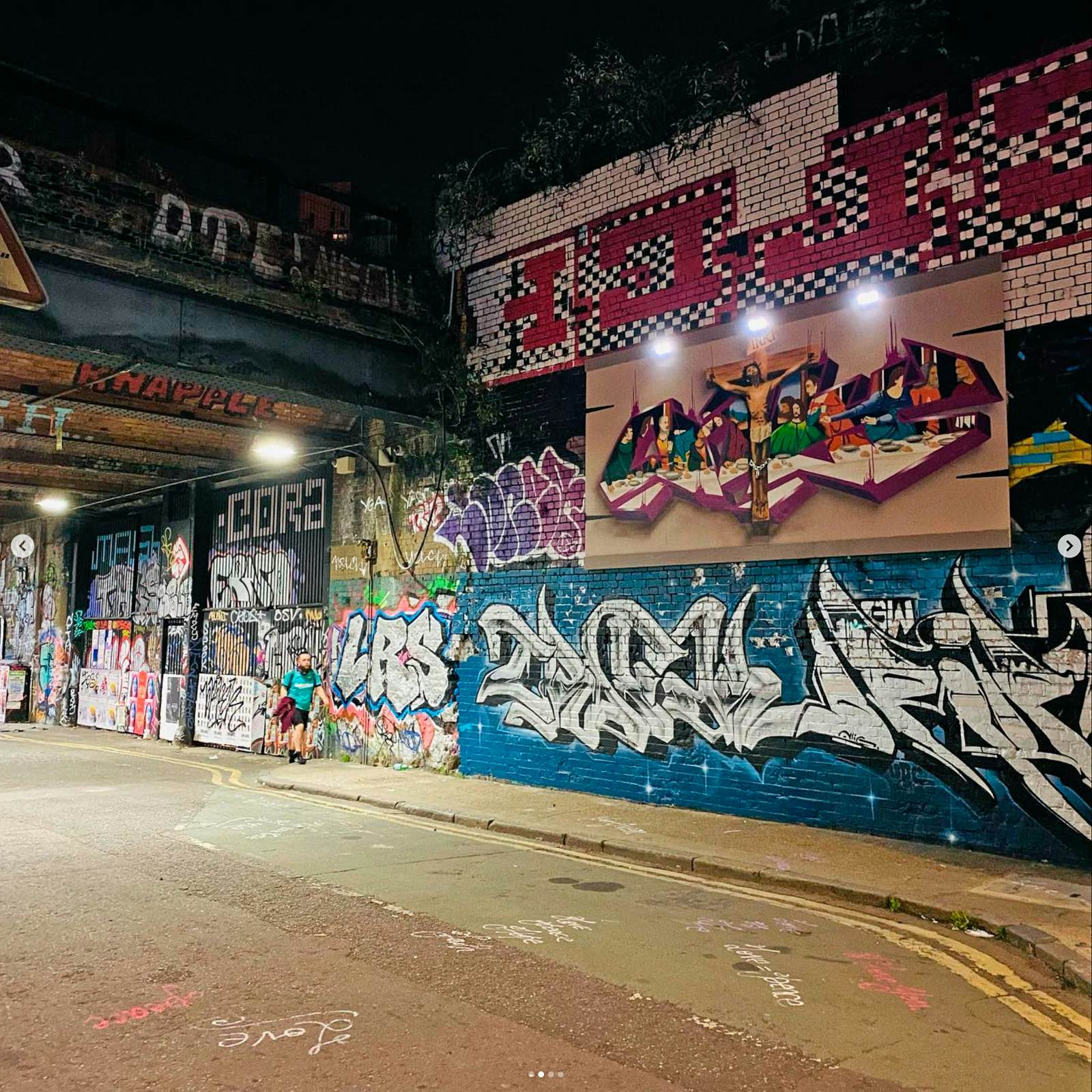
Connoisseurs of this form derided the stickers as more reminiscent of chewing gum packaging than the expression of a graff writer. The cathedral, meanwhile, seems unaware that some street artists are perfectly capable of addressing religious questions. The ornate 2021 tag by Only HMZ, found in East London’s Shoreditch, included a crucifix and a clear reprisal of Leonardo’s Last Supper. One might struggle, however, to make out the name “Only” in this billboard-sized piece. This is typical of the form, whose illicit claim on wall space is only ever temporary. Might it be that the intentional indecipherability of the human hand in graffiti, exemplified by this piece, leaves space for other, more abstract considerations?
If Hear Us is a confused mix of human angst, institutional need for public engagement and corporate aesthetics, it is indicative of the fraught relationship between contemporary art and Christianity. The artist Kate Pickering, whose practice is explicitly rooted in her faith, recalls a tutor on her Master of Fine Arts (MFA) course in the 2000s refusing to take a class with her. The teacher expected that a Christian would be unwilling to change her mind on anything and that, therefore, no critical discussion could take place.
Yet the presumption of secularism inherent to the practice of contemporary art is so deep that even the Church may not be the place to challenge it. Pickering’s performance event Ritual/Bodies, which she staged in St Pancras Church in Euston in 2024 to explore Christian visual culture and tradition together with seven other artists, had parts of its documentation censored by the parish.
One may recall, by contrast, Pope Paul VI’s 1964 meeting with artists in the Sistine Chapel, held amidst the Second Vatican Council, in which the Pontiff urged a rapprochement, admitting that the ministry needed artists’ collaboration. It could be said that this call was effective inasmuch as the Holy See, in time, relaxed some of its social teachings in parallel with those espoused by contemporary artists.
The long-term outcome is that when the Vatican staged an exhibition in a women’s prison in the 2024 Venice Biennale, the art world took the endeavour entirely seriously. Whether that is because, or despite, the project included a grand mural by Maurizio Cattelan, an artist known for his 1999 sculpture of a meteor hitting John Paul II, seems beside the point.
In England, the Protestant schism between images and belief proves difficult to bridge. It is as though Anglicanism lacks that iconic quality that is the currency in today’s visual culture. Many of Creswell’s projects, granted, have an awe-inspiring grandeur — Michael Pendry’s 2017 installation Les Colombes in Salisbury Cathedral, for example, consisted of thousands of paper birds floating high in the building’s rafters, each inscribed with a prayer sourced from the city’s inhabitants in the wake of the Novichok attack.
Yet even this work highlights the iconophobic discontinuity by which rituals such as prayer are distanced from the image of God. Creswell suggests that her practice of commissioning art installations for English cathedrals for nearly two decades has little link with the tradition of church art.
Her project is thus to introduce art into those heritage (rather than religious, in this understanding) settings as if for the first time. The cult of art history — and this sentiment is echoed by Pickering, whose practice specifically focuses on the ritual — would only get in the way.
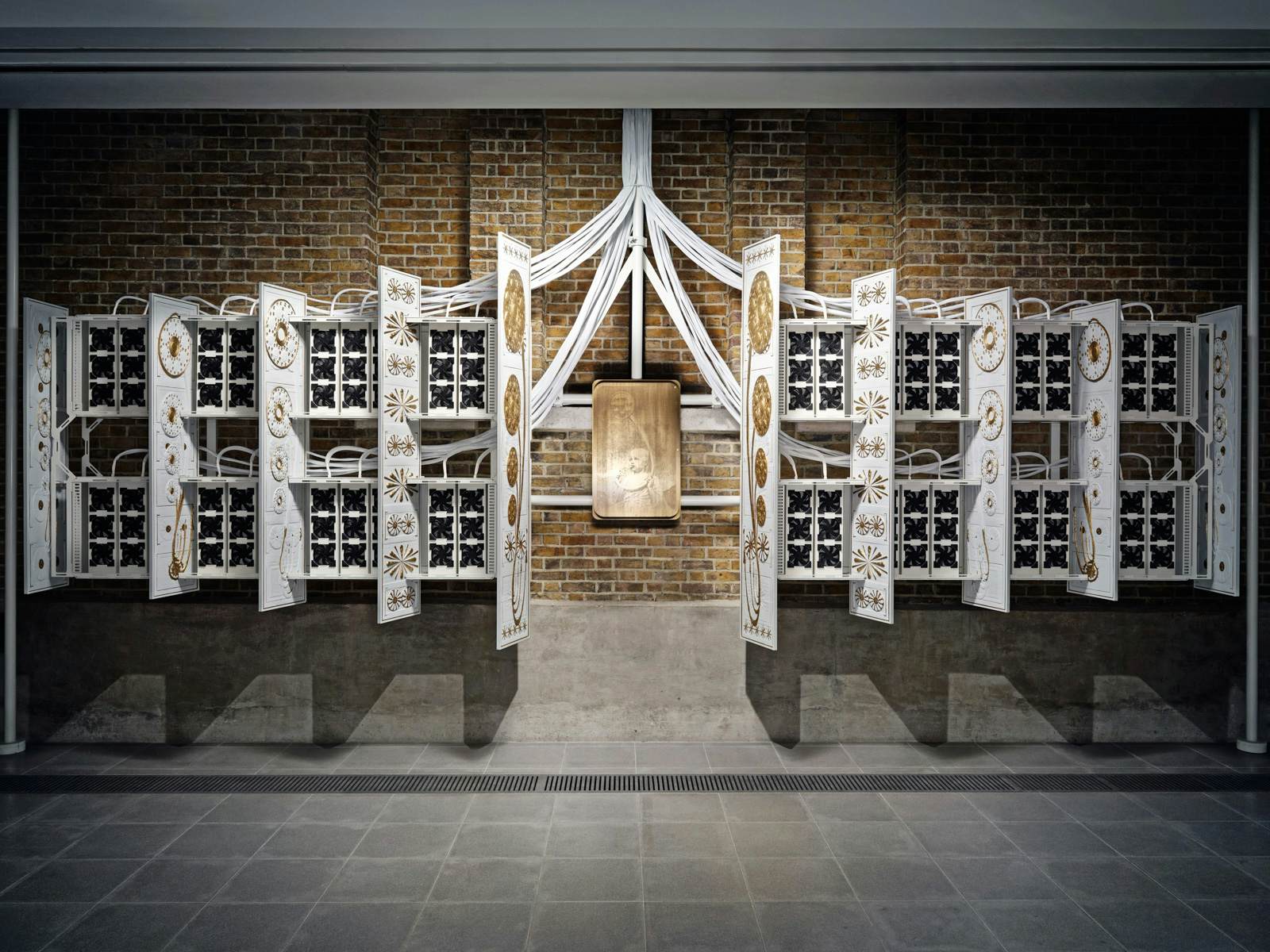
The 2024 installation The Call, by musicians Holly Herndon and Mat Dryhurst, is one of the more puzzling interventions into the living history of religious art. Herndon and Dryhurst spent months training a vocal AI engine to mimic the harmonies of a church choir. These sounds were reproduced in the gallery by a software organ adorned with an array of computer fans to emulate human breathing.
The Call also comprised two smaller spaces, styled in the manner of Modernist Protestant side-chapels, in which the punters could hear the AI voice in tune with their own. Each visitor could thus not only figuratively offer a prayer but also literally hear it answered.
One may argue that an AI God can only short-change the believer, and that a choir which relies on a robot for consonance has no faith. Yet this installation inspired in visitors to the Serpentine Galleries an outward expression of reverence that church institutions today would be envious of. Is this why many church art commissions double down on the iconoclastic fallacy? The misguided use of AI in Hear Us, for example, could be an undignified attempt to profit from the trend, but it lacked even the finesse with which Herndon and Dryhurst used — and abused — the history of their chosen art form.
The point is not merely that the reformed Church lost the competition with the contemporary icon — this may well be irreversible — but that the icons it makes today have no image. Despite this, artists like Pickering, or even Only HMZ, are capable of re-establishing the connection between their aesthetic and religious practices. It may be that this reconciliation takes place neither in the temple nor in the gallery.
Hear Us continues at Canterbury Cathedral until 18 January