This article is taken from the October 2025 issue of The Critic. To get the full magazine why not subscribe? Get five issues for just £25.
“All Cretans are liars,” said the prophet Epimenedes, himself a Cretan, more than 2,500 years ago. Ever since, philosophers have puzzled over his paradox. Now, however, the paradox has been solved: for in Georgios Varouxakis we have a Cretan who, beyond any shadow of doubt, tells us the truth. It is, moreover, a truth we need to know: the truth about the story we have told ourselves, the story of our civilisation, the story of the West.
Growing up in the 1970s on an offshore island close to three continents, Varouxakis learned early in life that Western civilisation was a problematic concept. In 1974 Turkey, a Nato member, invaded nearby Cyprus and his father was mobilised. Opinion was divided between those who insisted that Greece was a Western nation and those who blamed the West for betraying the Greek Cypriots.
Looming over such Levantine conflicts was the global confrontation of the Cold War. That had been preceded by the equally cosmic struggle between Nazi Germany and the Western Allies. The Battle of Crete in 1941 had been a disaster for the British, only slightly redeemed three years later by the daring abduction of General Kreipe, the German commander in Crete, by an SOE team led by the writer Patrick Leigh-Fermor and the Cretan resistance.
W. Stanley Moss’s account Ill Met by Moonlight (later a great Powell and Pressburger film) recalls how, as they waited to be evacuated, Leigh-Fermor recited a Horatian ode and the captive general continued it — a moment of calm when the classical culture of the West reasserted itself in the minds of the combatants.
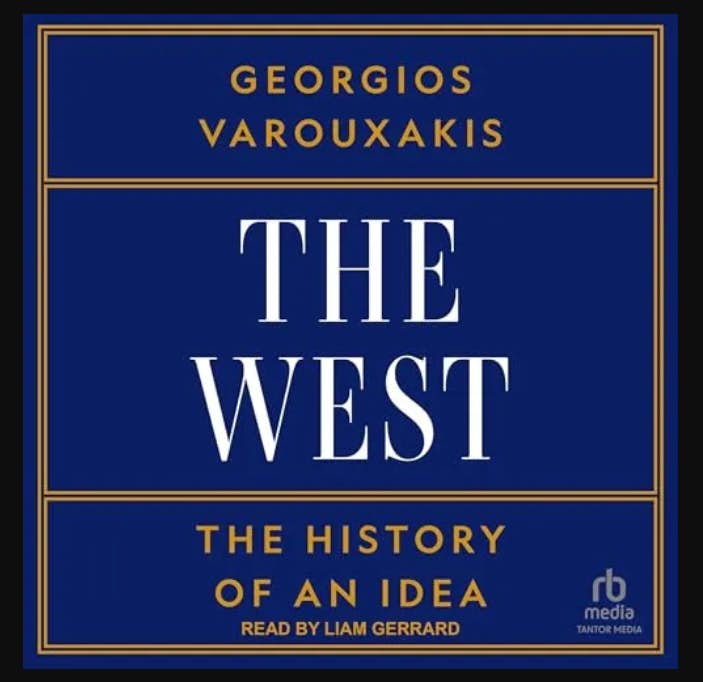
Much of the story Varouxakis tells will be new, even to other historians. His book The West: The History of an Idea (Princeton, 491 pp, £35) is not only deeply researched and clearly written, but also highly original. He shows, for instance, that “the West” in its modern sense emerged at least half a century earlier than the 1880s and 90s, as had been thought, and that it was not an expression of European imperialism — rather, of its opposite.
Auguste Comte is remembered, if at all, for coining two other key concepts of modernity: positivism and sociology. Varouxakis demonstrates that this deeply eccentric, and latterly possibly deranged founder of “the religion of humanity” also came up with the idea of the West. Comte usually called it “the Western republic”, meaning a Eurocentric family of five nations: “Anglo-Germano-Latino-Hispano-Gaul”. It would have a shared “Western navy”, flag and currency, all rooted in occidentalité, or “Westernness”. the progressive mentality formed between feudalism and the French Revolution.
It is revealing that Comte’s authorship of such a fundamental part of our mental furniture has been hidden in plain sight. For decades after his death in 1857, his influence was global: the Brazilian flag still bears his slogan “Order and Progress”. But he was eclipsed by his contemporary Marx, whose texts were scrutinised like Holy Writ. For a century, Comte was largely neglected.
Ideas surface for all kinds of reasons, but they catch on because they are needed. The West is no exception. After the defeat of Napoleon, the Russian Empire loomed large in Europe, as the military guarantor of autocracy. Comte invented his “Western republic” to exclude Russia, which “Europe” included. As Varouxakis shows, Comte had his reasons for defining the West not as a geographical but as a sociological phenomenon.
The atrocities perpetrated by Putin’s armies in Ukraine are a salutary reminder that there is much more to Western civilisation than merely political proximity. For if Russia, despite Tolstoy and Tchaikovsky, does not belong to what we have come to mean by the West, how did the United States and indeed the rest of the New World come to be at its heart?
The man who brought the new discourse about “Western” values to America had no less fecund a mind than Comte’s. Arriving in 1827, Francis Lieber was one of the first of many thousands of German liberals who emigrated to the US before and after 1848. He created political science as an academic discipline in America and his codification of the laws of war was the basis of the Hague Convention.
But Varouxakis has dug deeper and discovered the first use of “Western civilisation” in its modern sense in the encyclopaedia that Lieber edited soon after crossing the Atlantic. In the English language, Lieber pioneered “the West” (1829) and “the Western World — all Europe, with her many descendant nations” (1841).
His usages are cultural, not geographical, and his German hinterland is clearly not accidental. Adopting the language of the pseudoscience of race, he promoted the term “Cis-Caucasian” to denote the “commonwealth of nations” whose diaspora had spread from Europe across the globe. His phrase didn’t catch on. Yet whilst Lieber saw Western civilisation as the source of “human rights and civil liberty”, many Americans gravitated towards racially loaded definitions during the century that followed the Civil War.
Indeed, some of the most illuminating debates about the West that Varouxakis has unearthed took place amongst black Americans. In particular, the expatriate novelist Richard Wright emerges as the most articulate critic of the idea of the West precisely because he identified so strongly with it. Speaking at a congress of black writers in Paris in 1956, Wright explained his “double vision”: “I’m black. I’m a man of the West … I see and understand the West; but I also see and understand the non- or anti-Western point of view.”
Varouxakis is struck that in the midst of the Cold War, “Wright talked of East and West in almost completely civilisational terms, as much more important than the other, political-ideological confrontation”. Meanwhile a younger star of black America, James Baldwin, was reporting on this event for Encounter magazine. He argued black Americans could provide a “connecting link between Africa and the West”. But he did not believe they could be neutral in the battle of ideas between East and West: “In the case of America vs. Russia, America is the last stronghold of the Western idea of personal liberty. And I certainly think that this idea should dominate the world.”
In Europe, intellectual conversations about “the West” have failed to rise above cynicism and weltschmerz
Reading such sentiments three-quarters of a century later, one is filled with melancholy. It is as improbable that any American writer, let alone one of colour, would defend and identify with Western civilisation as it is that their compatriots would wish to extend Western ideas of personal liberty to the rest of humanity. It is not even clear that the American republic remains the champion of such liberties, much less its President. Left-wing Democrats avoid “the West” like the plague, seeing it as code for white supremacy, whilst in his second term Trump has dropped it as a rhetorical device in favour of authoritarian realpolitik. In short: “I run the country and the world.”
In war-torn Europe, intellectual conversations about “the West” have failed to rise above cynicism and Weltschmerz. Michel Houellebecq, peerless amongst living novelists on the Continent, has long since written off Western civilisation and admits, “I don’t give a damn”. For him, “there’s only one thing you can really do in the West, and that’s to make money”.
Varouxakis doesn’t buy this. Unlike Lieber’s clunky neologism “Cis-Caucasian”, Comte’s “Western republic” evoked a long and largely glorious history to which generations have responded ever since. There is no reason to believe that the West has run out of resonance, far less that Russia, China or any other rival can hope to match it.
The stories we tell about our past influence how our future will turn out. A parochial narrative that deprives us of the civilisational perspective within which our history unfolded would be as demoralising as institutionalising ahistorical self-hatred. We need to acknowledge our debt to the West if we are to be taken seriously by Africans, Latin Americans and Asians, who owe their own liberation to living under Western eyes.
Who better to represent us than a woman who knows what it is like to live in a post-colonial society but who has chosen to embrace our Western one? As we face a test of our mettle such as we have not seen for 80 years, as America retreats from the fray, abandoning its allies to their fate, as Europe wobbles, we need a leader who stands not only for our nation but also for our civilisation and for the principles that underlie it.
Not all readers will agree with these sentiments. For them I shall quote a speech by one of the greatest Conservatives of the last century, Iain Macleod. Stepping down as Colonial Secretary after the tumultuous years of decolonisation, he told the Conservative Conference in 1961 that he believed “quite simply in the brotherhood of man — men of all races, of all colours, of all creeds. I think it is this that must be at the centre of our thinking.” He then quoted Robert Burns:
It is coming yet for a’ that,
That man to man the whole world o’er,
Shall brothers be for a’ that.
Macleod added: “And this is coming. There are foolish men who will deny it, but they will be swept away … ”
The party rose as one to applaud him — the same party that will gather to hear Kemi Badenoch address it in Manchester this October for the first time as leader. This should be a moment of supremely gratifying fulfilment, both for her and for the members of the only party that has consistently championed the West and its humane values. I hope and expect that they will rise to the occasion.