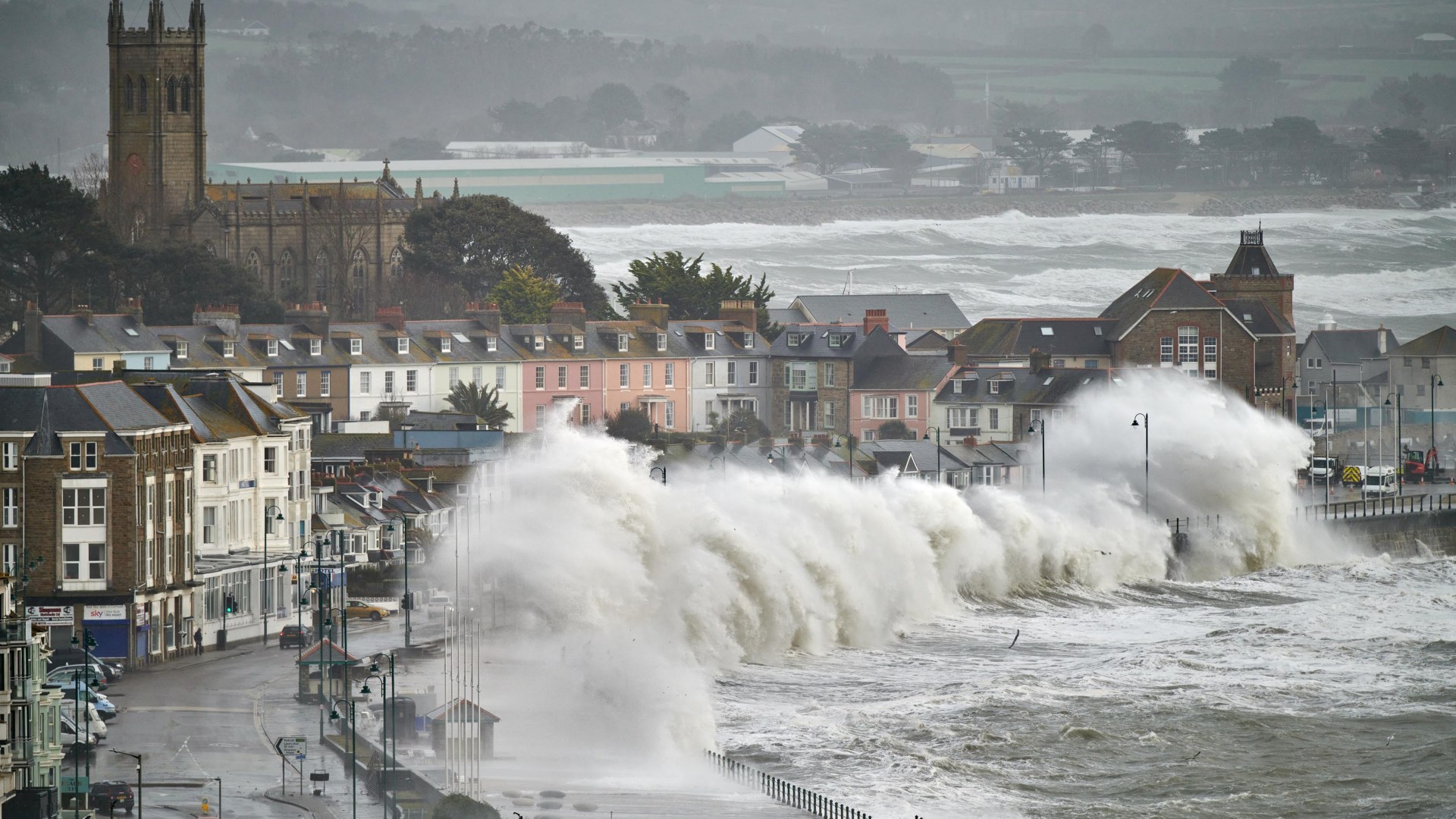
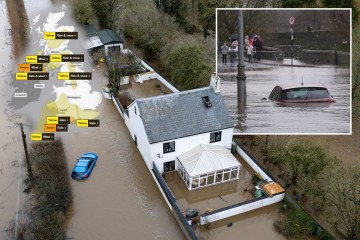
STORM Chandra has hit the UK with strong winds, heavy rain and spells of snow.
Britons are facing road closures and cancelled flights after the Met Office issued a “danger to life” alert and floodwaters sparked chaos across the country.
Paul Gundersen, Chief Forecaster at Met Office, said on Monday: “Initially strong winds will impact the Isles of Scilly, western Cornwall and southwest Wales, which are still vulnerable after Storm Goretti, gusts of 70 to 80mph are possible here.
“Heavy rain is an additional hazard as it falls on saturated ground in Dorset and southern parts of Devon, Somerset and Cornwall.
“As Chandra interacts with colder air further north snow becomes a hazard, with 10-20cm of snow possibly accumulating over higher ground in the Pennines, southern Scotland and the Highlands.”
Storm Chandra is the next storm on the western Europe storm naming group list shared between the UK, Ireland and Netherlands.

But how does the naming process work? Here’s everything you need to know.
Who names storms?
When the criteria for naming a storm is met, the local meteorological stations can name it.
In Europe, the UK (Met Office), Ireland (Met Éireann) and the Netherlands (KNMI) work together as the western storm naming group.
Spain, Portugal, France, Belgium and Luxembourg make up the south-western storm naming group.
Norway, Sweden and Denmark are the northern naming group.
Once a name has been chosen, the weather service will publish details via their website and social media channels.
If a tropical storm or hurricane moves across the Atlantic, the name given by the National Weather Service in the US is not changed, such as for Hurricane Ophelia.
Why do we name storms?
Naming storms helps to communicate the risks of severe weather.
In the UK, a storm will be named when it has the potential to cause disruption or damage — which could ultimately result in an amber or red weather warning.
Not all storms will be big enough to be named.
According to the Met Office, “the name of storms using a single authoritative system provides a consistent message and aids the communication of approaching severe weather through media partners and other government agencies.
”In this way the public will be better placed to keep themselves, their property and businesses safe.”
How does naming storms work in the UK?
Since 2015, the Met Office has asked the British public for name suggestions.
Thousands of ideas are sent in throughout the year before a list is complied.
The list runs from early September until late August and includes one name for every letter of the alphabet, except for Q, U, Y, X and Z.
The Met Office states that these letters are not included to ensure they are in line with the US National Hurricane Centre naming conventions.
So, if you are called Quentin, Ursula, Xavier, Yvonne or Zendaya, you will never see your name on the list.
Letters further down the alphabet are far less likely to be used because there is not always that many storms before the end of the full season.
In the UK, the storm season starts on September 1, which also marks the beginning of the meteorological autumn.
The storm season then runs until the end of August the following year.
What are the storm names for 2026?
The current storm season started in September 2025, but the first name was not given until October when Storm Amy hit the UK.
This was followed by Storm Benjamin, which only really impacted France, and hence the name was also chosen by Meteo France.
November 2025 then welcomed Storm Claudia, which was named by the Spanish climate agency AEMET.
Getting back to its original list, the Met Office named its next storm in December Bram.
The strongest winds associated with Storm Goretti were expected to hit the Channel Islands and northern France, so it was named by Météo-France.
The following names for this storm UK season are:
- Dave
- Eddie
- Fionnuala
- Gerard
- Hannah
- Isla
- Janna
- Kasia
- Lilith
- Marty
- Nico
- Oscar
- Patrick
- Ruby
- Stevie
- Tadhg
- Violet
- Wubbo
What factors are considered when choosing a storm name?
The Met Office considers a number of factors for a name to be on the list.
This includes how difficult it might be to pronounce, if it has different meanings across the different countries, if it is connected to a significant public figure and if it could be considered to be controversial in some way.
The climate agency would not name a storm after any private company or brand.
On the other hand, the popularity of a name in the UK or how many times it has been submitted for consideration does not impact the final decision.