The divisions ripping the Middle East apart today are not new. Indeed, they are almost as old as the beginnings of Islam, 1,400 years ago.
But now they are also fuelled by oil and gas wealth, nationalism, ethnic rivalries and tensions over relations with the West – and, above all, attitudes to Israel. The mosaic of allegiances is complex, dynamic and at first impenetrable, with both unlikely alliances and feuds of exceptional bitterness.
Yet there is a clear way to understand it all. At the heart of it, of course, is the vicious enmity between Islam’s two main sects, the Sunnis and the Shi’ites. These traditions have different legal systems and, crucially, disagree about how their religion should be ruled.
Shi’ites see their leaders, ayatollahs, as infallible and appointed by Allah, sometimes descended from the Prophet Muhammed himself. Sunnis don’t have a clerical hierarchy; they judge each preacher on his merits.
More than four-fifths of the Muslim world are Sunnis, making up the majority in most Arab countries, as well as Pakistan. (In Britain, 95 per cent of Muslims are Sunnis.)
However, in Iran, as well as neighbouring Iraq and Azerbaijan, the majority are Shi’ites. Large Shi’ite populations also live in Yemen, Lebanon, Saudi Arabia and Bahrain.
This alone sets the conditions for an internecine struggle. And it is vital to understand the conflict unfolding in this most volatile of regions.
The Iranian revolution of 1979 that deposed the Shah was no mere political shift: it was a religious takeover. Across the Middle East, most Shi’ites regarded Ayatollah Khomeini, who led the new government in Tehran, as their supreme religious leader.
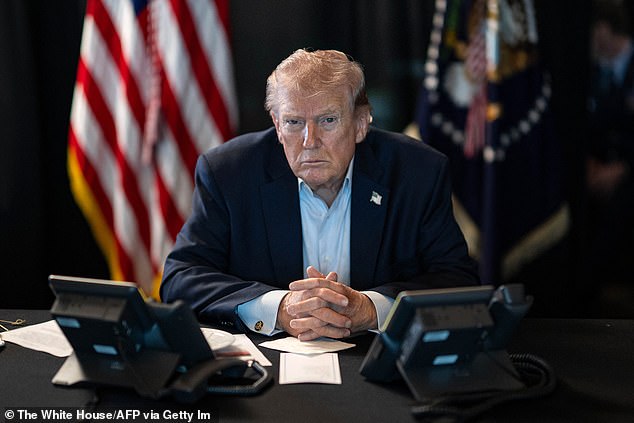
President Donald Trump overseeing Operation Epic Fury activity against Iran from Mar-a-Lago in Palm Beach, Florida
In Iraq, Saddam Hussein’s Sunni government feared the consequences of a Shi’ite uprising. In the ensuing war, waged throughout most of the 1980s, more than a million people were killed. Even that cataclysmic conflict could be dwarfed by the war that threatens to consume the entire region now.
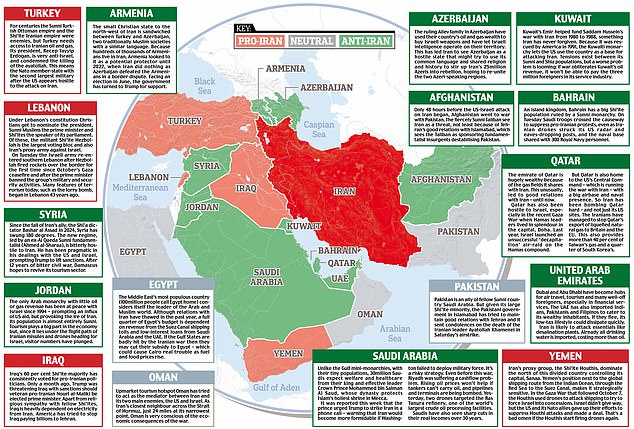
So let’s look at what is unfolding in the vast region – from Egypt to Pakistan – now a patchwork of states divided into three clear positions: the pro-Iranians, the anti-Iranians and those maintaining neutrality.
Iran’s regime, or what’s left of it, is fighting for survival. The secret police of the Islamic Revolutionary Guard Corps (IRGC), numbering about 125,000, have ruled by fear for decades, and can expect no mercy if the Islamic Republic is overthrown.
In the past few months, they are thought to have executed more than 30,000 dissenters.
Their high-risk strategy appears to be one of economic havoc. The Gulf states (Bahrain, Kuwait, Iraq, Oman, Qatar, Saudi Arabia, and the United Arab Emirates) are completely reliant on two sources of income: Exports of oil and gas, and Western tourism and expat businesspeople and financiers. War threatens to wreck both these business models.
If the Strait of Hormuz and parts of the Red Sea are closed to cargo, energy shipments will be constricted – which Tehran’s attacks on refineries will exacerbate. Europe and Britain in particular can expect steep increases in fuel prices.
At the same time, with Westerners flocking to Dubai and other Gulf destinations for holidays, several Arab nations had been trying to reinvent themselves as tourism hotspots.
Saudi Arabia, Oman and Jordan can all see the potential… but their ambitions are being blown apart by missiles and drones.
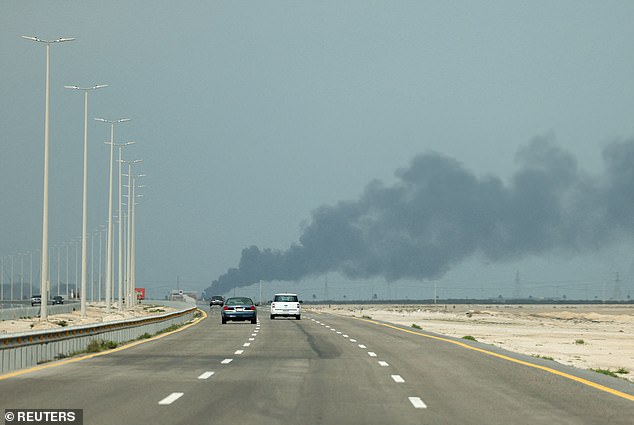
Smoke billows from Saudi Aramco’s Ras Tanura oil refinery after a reported Iranian drone strike in Saudi Arabia
If Iran can inflict enough pain on its neighbours, it hopes to turn them against America and Israel. But in doing so, it is provoking neutral states to side with the West.
Last night, sources close to the governments in the UAE, Qatar and Saudi Arabia said a combined retaliation was being planned – involving military co-operation that, until now, seemed hugely improbable.
Baffling as this all seems, we have to try to understand what motivates the current war, and understand the other rivalries across the Middle East to avoid clumsy mistakes making things much worse.
- Mark Almond is director of the Crisis Research Institute in Oxford
Who hates who in the Middle East?
Pro-Iran
Turkey
For centuries the Sunni Turkish Ottoman empire and the Shi’ite Iranian empire were enemies, but Turkey needs access to Iranian oil and gas. Its president, Recep Tayyip Erdogan, is very anti-Israel, and condemned the killing of the ayatollah. This means the Nato member-state with the second largest military after the US appears hostile to the attack on Iran.
Lebanon
Under Lebanon’s constitution Christians get to nominate the president, Sunni Muslims the prime minister and Shi’ites the speaker of its parliament. Of these, the militant Shi’ite Hezbollah is the largest voting bloc and also Iran’s proxy army against Israel.
On Tuesday the Israeli army re-entered southern Lebanon after Hezbollah fired rockets over the border for the first time since October’s Gaza ceasefire and after the prime minister banned the group’s military and security activities. Many features of terrorism today, such as the lorry bomb, began in Lebanon 43 years ago.
Iraq
Iraq’s 60 per cent Shi’ite majority has consistently voted for pro-Iranian politicians. Only a month ago, Trump was threatening Iraq with sanctions should veteran pro-Iranian Nouri al-Maliki be elected prime minister. Apart from religious sympathy with fellow Shi’ites, Iraq is heavily dependent on electricity from Iran. America has tried to stop Iraq paying billions to Tehran.
Yemen
Iran’s proxy group, the Shi’ite Houthis, dominate the north of this divided country controlling its capital, Sanaa. Yemen’s position next to the global shipping route from the Indian Ocean, through the Red Sea to the Suez Canal, makes it strategically sensitive. In the Gaza War that followed October 7, the Houthis used drones to attack shipping to try to force Israel into concessions. Israel didn’t give way, but the US and its Nato allies gave up their efforts to suppress Houthi attacks and made a deal. That’s a bad omen if the Houthis start firing drones again.
Neutral
Egypt
The Middle East’s most populous country (100million people call Egypt home) considers itself the leader of the Arab and Muslim world. Although relations with Iran have thawed in the past year, a full quarter of Egypt’s budget is dependent on revenue from the Suez Canal shipping tolls and low-interest loans from Saudi Arabia and the UAE. If the Gulf States are badly hit by the Iranian war then they may cut their subsidy to Egypt – which could cause Cairo real trouble as fuel and food prices rise.
Oman
Upmarket tourism hotspot Oman has tried to act as the mediator between Iran and its two main enemies, the US and Israel. As Iran’s closest neighbour across the Strait of Hormuz, just 24 miles at its narrowest point, Oman is very conscious of the economic consequences of the war.
Pakistan
Pakistan is an ally of fellow Sunni country Saudi Arabia. But given its large Shi’ite minority, the Pakistani government in Islamabad has tried to maintain good relations with Tehran and it sent condolences on the death of the Iranian leader Ayatollah Khamenei in Saturday’s airstrike.
Anti-Iran
Armenia
The small Christian state to the north-west of Iran is sandwiched between Turkey and Azerbaijan, two traditionally Muslim societies with a similar language. Because hundreds of thousands of Armenians live in Iran, Armenia looked to it as a potential protector until 2022, when Iran did nothing as Azerbaijan defeated the Armenians in a border dispute. Facing an election in June, the government has turned to Trump for support.
Syria
Since the fall of Iran’s ally, the Shi’a dictator Bashar al Assad in 2024, Syria has swung 180 degrees. The new regime, led by an ex-Al Qaeda Sunni fundamentalist (Ahmed al-Sharaa), is bitterly hostile to Iran. He has been pragmatic in his dealings with the US and Israel, prompting Trump to lift sanctions. After 12 years of bitter civil war, Damascus hopes to revive its tourism sector.
Jordan
The only Arab monarchy with little oil or gas revenue has been at peace with Israel since 1994 – prompting an influx of US aid, but provoking the ire of Iran. Its population is almost entirely Sunni. Tourism plays a big part in the economy but, since it lies under the flight path of Iranian missiles and drones heading for Israel, visitor numbers have plunged.
Azerbaijan
The ruling Aliev family in Azerbaijan have used their country’s oil and gas wealth to buy Israeli weapons and have let Israeli intelligence operate on their territory. This has led Iran to see Azerbaijan as a hostile state that might try to use its common language and shared religion and history to stir up Iran’s 25million Azeris into rebellion, hoping to re-unite the two Azeri-speaking regions.
Kuwait
Kuwait’s Emir helped fund Saddam Hussein’s war with Iran from 1980 to 1988, something Iran has never forgiven. Because it was rescued by America in 1991, the Kuwaiti monarchy lets the US use the country as a base for attacking Iran. Tensions exist between its Sunni and Shia populations, but a worse problem is looming: if war obliterates Kuwait’s oil revenue, it won’t be able to pay the three million foreigners in its service industry.
Afghanistan
Only 48 hours before the US-Israeli attack on Iran began, Afghanistan went to war with Pakistan. The fiercely Sunni Taliban see Iran as a threat, not least because of Tehran’s good relations with Islamabad, which sees the Taliban as sponsoring fundamentalist insurgents destabilising Pakistan.
Bahrain
An island kingdom, Bahrain has a big Shi’ite population ruled by a Sunni monarchy. On Tuesday Saudi troops crossed the causeway to suppress pro-Iranian protests, even as Iranian drones struck its US radar and eaves-dropping posts, and the naval base shared with 300 Royal Navy personnel.
Qatar
The emirate of Qatar is hugely wealthy because of the gas fields it shares with Iran. This unusually, led to good relations with Iran – until now.
Qatar has also been hostile to Israel, especially in the recent Gaza War when Hamas leaders lived in splendour in the capital, Doha. Last year, Israel launched an unsuccessful ‘decapitation’ air-raid on the Hamas compound.
But Qatar is also home to the US’s Central Command – which is running the war with Iran – with a big airbase and naval presence. So Iran has been bombing Qatar hard – and not just its US sites. The Iranians have managed to stop Qatar’s export of liquefied natural gas to Britain and the EU. This also provides more than 40 per cent of Taiwan’s gas and a quarter of South Korea’s.
United Arab Emirates
Dubai and Abu Dhabi have become hubs for air travel, tourism and many well-off foreigners, especially in financial services. The UAE has also imported Indians, Pakistanis and Filipinos to cater to its wealthy inhabitants. If they flee, its low-tax lifestyle could dissipate quickly.
Iran is likely to attack essentials like desalination plants. Already all drinking water is imported, costing more than oil.
Saudi Arabia
Unlike the Gulf mini-monarchies, with their tiny populations, 30million Saudis expect welfare and healthcare from their king and effective leader Crown Prince Mohammed bin Salman Al Saud, whose dynasty protects Islam’s holiest shrine in Mecca.
It was reported this week that the prince urged Trump to strike Iran in a phone call – warning that Iran would become more formidable if Washington failed to deploy military force. It’s a risky strategy. Even before this war, Riyadh was suffering a cashflow problem. Rising oil prices won’t help if tankers can’t carry oil, and pipelines and terminals are being bombed. Yesterday, two drones targeted the Ras Tanura refinery, one of the world’s largest crude oil processing facilities.
Saudis have also seen sharp cuts in their real incomes over 30 years.