Invitations should not be rescinded — but no one has the right to an invitation
A university debating society has turned down a request by Reform UK to speak to students, in an incident that could scarcely have been scripted more perfectly to demonstrate that, while you can legislate for “free speech” and “academic freedom”, you can’t codify the habits of thought, expression and tolerance for those we heartily dislike that ultimately bring those abstract juridical categories to life.
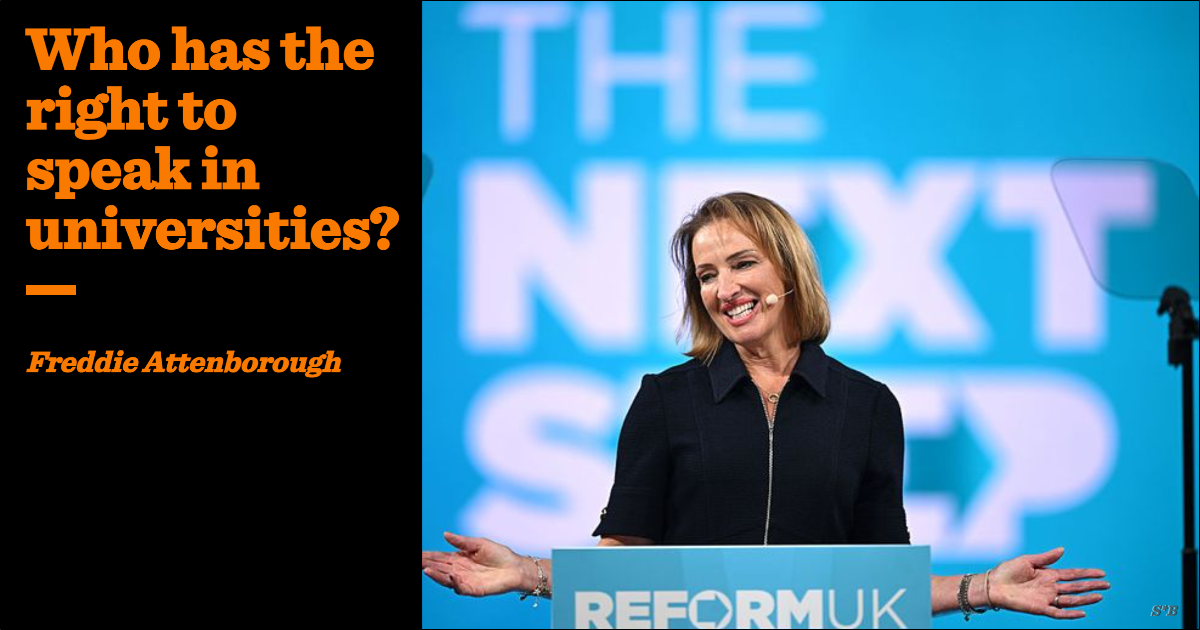
The row began after Sarah Pochin, MP for Runcorn and Helsby, and Jack Anderton, a party adviser touring universities to speak to undergraduates, wrote to the student-led Bangor University Debating and Political Society offering to “give a Q&A to students”. But in a public statement posted to social media, the student society declined to host them, “in line with our values”.
The statement continued:
We have zero tolerance for any form of racism, transphobia or homophobia displayed by the members of Reform UK. Their approach to the lives of others is antithetical to the values of welcoming and fair debate that our society has upheld for 177 years.
We are proud to be the first of the debating unions to take a stand against Reform UK. We strongly implore our fellow societies to join us in keeping hate out of our universities.
Unsurprisingly, Reform UK weren’t happy, with one senior adviser describing it as “the worst breach of the Higher Education (Freedom of Speech) Act 2023 I have ever come across”.
It’s an interesting assertion, not least because the Act’s student-union provisions — including new section A5 (inserted into the Higher Education and Research Act 2017 by section 3 of the 2023 Act) — do not apply in Wales. And even setting the question of jurisdiction to one side, the Act doesn’t create a free-standing right to be given a platform. Its core duty is to take reasonably practicable steps to “secure freedom of speech within the law” for defined categories of persons, including students, staff and “visiting speakers”. Ms Pochin and Mr Anderton weren’t “visiting speakers” in any meaningful sense: they had requested an invitation, and the society declined.
That’s the key difference between Bangor and another case cited this week as if it were part of the same pattern. In 2023, James Sunderland, then Conservative MP for Bracknell, had an invitation to speak at Reading University withdrawn after his views on immigration were said to be in “conflict with the ethos” of the students’ society. The key word there is invitation: one had been issued… and then rescinded. Disinviting a speaker isn’t the same thing as declining to issue an invitation in the first place.
In Wales, Bangor is governed (so far as statutory free-speech duties go) by section 43 of the Education (No. 2) Act 1986 — the requirement to take “reasonably practicable” steps to secure freedom of speech within the law, including for “visiting speakers”, backed by a code of practice governing meetings and other activities on university premises. This is in fact the legislation Reform UK’s Head of Policy, Zia Yusuf, invoked in a follow-up letter to the Vice-Chancellor while alleging a “serious breach”.
But it’s hard to see what that phrase means on these facts. True, section 43(2) goes beyond the “visiting speakers” formulation in s.43(1), and specifically requires that “the use of any premises of the establishment is not denied to any individual or body of persons on any ground connected with” the “beliefs or views” of an individual or the “policy or objectives” of “that body”. Given the society’s stated reasons — framed as objections to Reform’s alleged “racism, transphobia or homophobia” — the “grounds connected with views” limb is at least arguable. The stumbling block is whether the use of premises was “denied” on that basis. To characterise this as a breach you would, in effect, have to treat a student society’s refusal to organise an event as equivalent to the university (or those concerned in its governance) denying use of its premises for a proposed meeting. Bangor’s own response appears designed to head off precisely that inference: it stressed that the post “was issued by a student society and not by Bangor University”, and that “the views expressed by societies are their own and do not reflect University policy”, adding that Bangor “remains politically neutral and supports freedom of speech” and “welcomes debate from across the political spectrum”.
Not that any of this makes the episode at all reassuring.
A debating society that publicly congratulates itself for refusing to debate ideas it dislikes should worry anyone who cares about the future of academic freedom. “Keeping hate out” is a slogan that stretches so far beyond what the law actually prohibits that it risks becoming a censor’s charter.
Universities exist to test, challenge and scrutinise lawful views, not to pre-emptively moralise them out of discussion. It’s true that students are free to decide who they do or don’t invite — the law doesn’t create a right to be asked to speak. But as the Committee for Academic Freedom (CAF) knows from its casework, public virtue-signalling of this kind can have an insidious effect, narrowing the limits of the sayable, creating moral pressure to go along with orthodoxy and discouraging people from speaking out. The chilling effect is real, and it’s the last lesson students should be learning first-hand at university.
And speaking of chilling effects, following the furore Welsh Reform leader Dan Thomas indicated that he would introduce a law, within the first 100 days of being in power, allowing the government to fine or restrict access to state funding in cases where it felt “free speech” had not been supported. Speaking ahead of the Senedd elections in May, he said the party would “put an end to the militant cancel culture” in Welsh universities.
That’s right, Dan. It’s high time someone acted “in line with their values” and did something to keep all that “hate out of our universities”.