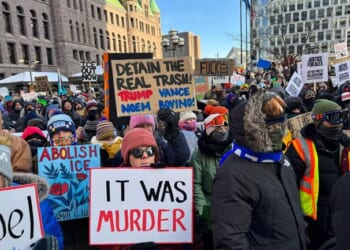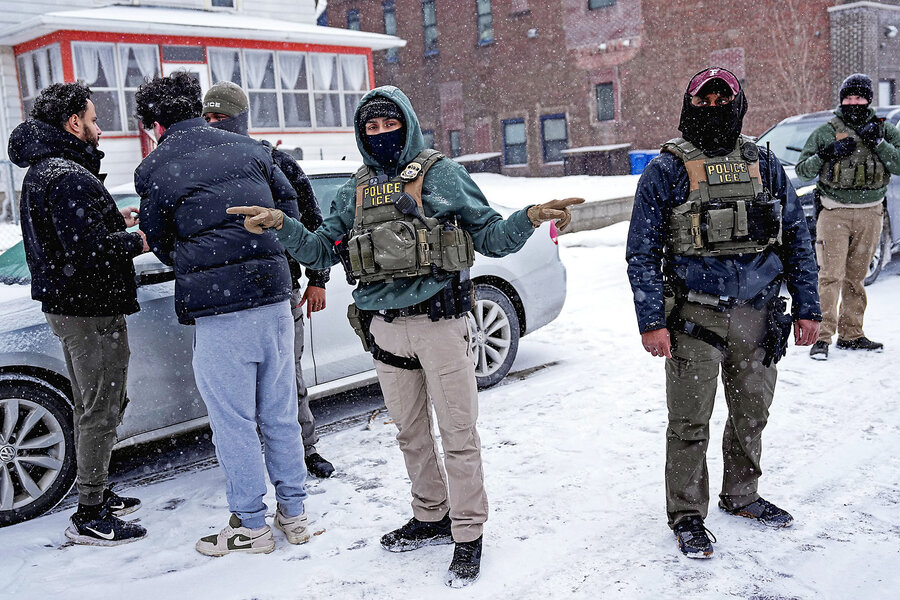
The killings of two U.S. citizens in Minneapolis by federal law enforcement have heightened concern over the street tactics of federal agents. Some opponents are also amplifying calls to “abolish ICE.”
But there are more agencies and personnel involved in the federal surge in Minnesota than Immigration and Customs Enforcement alone.
While the shooting of Renee Good on Jan. 7 involved ICE, the shooting of Alex Pretti on Jan. 24 involved the Border Patrol. Though both agencies fall within the Department of Homeland Security, they differ in history and approach.
Why We Wrote This
Immigration enforcement involves a slew of federal agencies. Amid some calls to “abolish ICE,” here’s more information about the roles various departments play.
There are other nuances. For instance, ICE has distinct parts. Some ICE officers seek unauthorized immigrants to detain and deport. Other ICE special agents in a separate division oversee a broader range of investigations into criminal cases, such as transnational crime and human trafficking, which aren’t always related to immigration. Those agents will support security at the upcoming Milan Cortina Winter Olympics unrelated to immigration enforcement, according to the Trump administration.
Discerning who’s who among federal forces can be hard, with many agents and officers wearing masks, plain clothes, or uniforms that look similar but are from different agencies. Distinguishing the key players is useful as these names are likely to stay in the news. Congress passed funding last year that will allow the ranks of ICE and the Border Patrol to swell. The Trump administration is also expected to continue a whole-of-government effort to meet the president’s campaign promise of the largest deportation campaign in U.S. history.
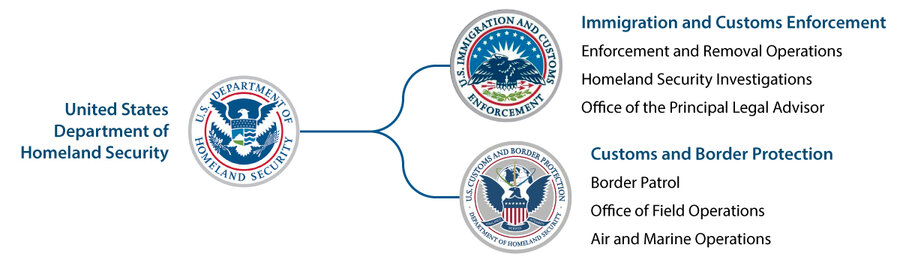
Department of Homeland Security (DHS)
Congress created the Department of Homeland Security in 2002 in order to better coordinate among federal agencies after the attacks on 9/11. All or part of 22 different agencies merged into DHS, whose secretary is a member of the president’s Cabinet.
Secretary Kristi Noem leads the sprawling department. Homeland Security screens travelers at airports, awards disaster-relief funding, and oversees the Secret Service. DHS also houses several agencies involved in immigration, including those below.
Immigration and Customs Enforcement (ICE)
ICE was established when the Department of Homeland Security formed. The new agency combined two previous departments: Immigration and Naturalization Service and U.S. Customs Service.
Led by Acting Director Todd Lyons, ICE enforces immigration laws and investigates a wide range of crimes throughout the country.
- ICE Enforcement and Removal Operations
This is the division that many Americans likely think of when they hear “ICE.”
ICE ERO officers find, detain, and remove immigrants who violate immigration law. The government can deport noncitizens for a variety of reasons, such as entering the U.S. illegally, overstaying a visa, or committing unrelated crimes. This branch of ICE oversees a vast network of detention centers.
Under the Trump administration, ICE has expanded collaborative agreements with state and local law enforcement countrywide, where those partners receive certain immigration enforcement powers.
- ICE Homeland Security Investigations
HSI special agents pursue many types of criminal investigations, including fraud, human trafficking, and cybercrime.
Unlike ERO, this branch of ICE has not typically focused on immigration enforcement, and investigates both U.S. citizens and noncitizens for crimes. Yet over the past year, reports suggest that HSI criminal investigators have at times been pulled off their typical cases to aid immigration arrests.
- Office of the Principal Legal Advisor
ICE also has lawyers who represent the government in immigration court. These OPLA attorneys argue why noncitizens should be deported in front of executive-branch immigration judges, and offer legal advice to other ICE departments.
Customs and Border Protection (CBP)
Led by Commissioner Rodney Scott, CBP has within it different agencies that cover different turf.
The Border Patrol secures U.S. borders, operating along stretches of borderland between ports of entry. The Border Patrol is more than a century old.

Border Patrol agents apprehend people suspected of illegal entry and other crimes in the borderlands. Under the Trump administration, however, these agents have increasingly engaged in controversial enforcement operations deeper in the interior, alongside ICE.
Border Patrol’s Gregory Bovino has led several of these interior surges as a commander. However, the country’s top Border Patrol official is Chief Michael Banks.
- Office of Field Operations
Unlike the Border Patrol, these CBP officials are stationed at ports of entry, screening people and vehicles.
Managing cross-border travel and commerce at ports involves searches for illegal cargo, such as illicit drugs. These CBP officials also verify travel documents at international airports.
- Air and Marine Operations
With its aircraft and boats, AMO interdicts people and cargo that do not have permission to enter the U.S.
The agency partners with the U.S. Coast Guard – a military service housed within the Department of Homeland Security.