This article is taken from the November 2025 issue of The Critic. To get the full magazine why not subscribe? Get five issues for just £25.
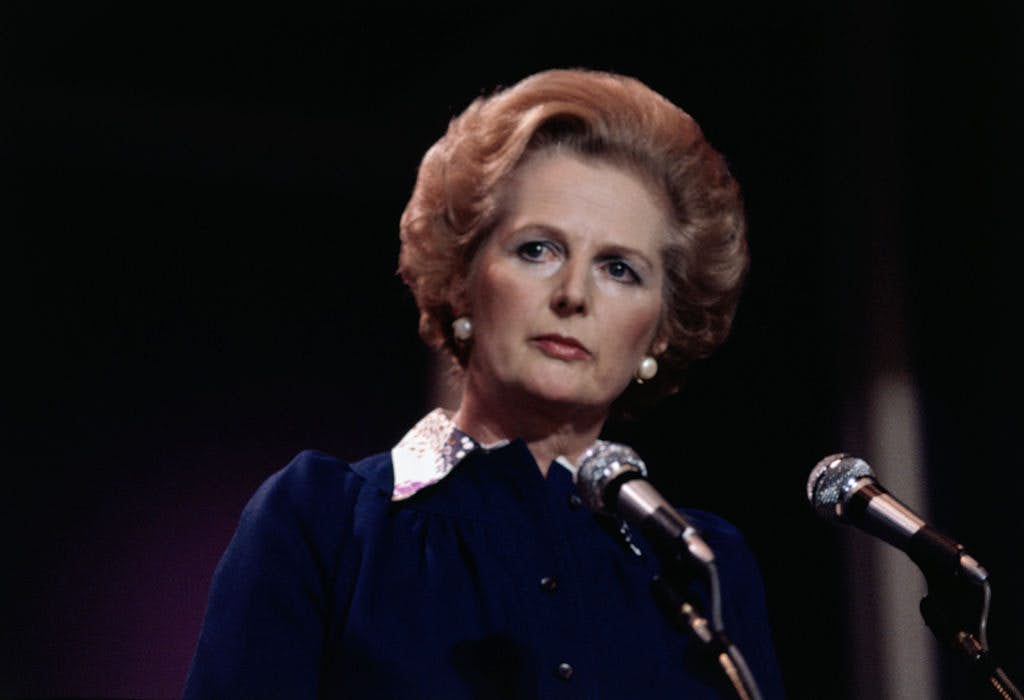
“I came to office with one deliberate intent,” Margaret Thatcher claimed in 1984. “To change Britain from a dependent to a self-reliant society: from a give-it-to-me, to a do-it-yourself nation.”
This October’s commemorations marking the centenary of Lady Thatcher’s birth might have reflected that if this was her primary ambition then it has not turned out well.
Even in her own time, it was only partially true. The 1980s did spark a new wave of entrepreneurship and the number of self-employed people almost doubled (in this, Britain was a European outlier). But unemployment rates averaged nearly 6 per cent in Thatcher’s final year in office. Economic empowerment had its limits.
And yet, achieving such outcomes today would be a triumph. The British economy increased by nearly 30 per cent during Thatcher’s 11 years in government. By contrast, in the 18 years since the onset of the 2007 recession, the country’s per capita GDP has moved glacially.
Hit by rising costs, real living standards have scarcely risen at all. The last two centuries of British economic history offer no comparable duration of sclerosis without remission.
Quantitative easing, huge borrowing, record net immigration, Brexit implemented by politicians with no strategy for what to do next, the remarkable Covid job retention scheme in which the state paid the bulk of employees’ wages for a year-and-a-half, £70 billion on energy price guarantees and schemes to compensate for the cost of an absurd energy strategy … there has been no want of policies. It is just that none of them have worked.
It is no longer fanciful to speak of a lost generation of growth and opportunity. At almost 5 per cent, the unemployment rate is creeping back to where it was when Thatcher was given her own P45. But unlike in 1990, the true rate of worklessness is far worse. One in five Britons between the ages of 16 and 64 are economically inactive.
Those on unemployment benefit may be rescued if economic growth eventually returns, but that will do little for the millions more who exist on universal credit, sickness and disability benefits funded by the heavily-taxed hard graft of the four-in-five.
Labour has observed what the Tories got wrong and engineered ways to make it worse
These four-in-fivers are also asked to shoulder the pension costs of an ageing population. It is impossible to invest heavily in the sort of initiatives that might boost economic growth when so much government spending is diverted to sustaining mass worklessness.
For much of the 20th century, millions toiled in jobs involving grim conditions and hard manual labour which left men and women physically broken by their fifties. Disabled veterans of the two world wars were a common sight, doing what they could in their place of work despite their mental and physical scars.
It is disturbing that far greater numbers now claim to be too incapacitated to work in an overwhelmingly service economy where huge efforts have been made to make workplaces so accessible and flexible that over 20 million employees (40 per cent of the workforce) are allowed to work either partly or entirely from home.
The largest share of those on out-of-work benefits profess mental illness or behavioural problems. The effects of the Covid lockdowns explain some of this collapse in mental wellbeing: there was a net increase of a million sickness benefits claimants between 2019 and 2024.
Additionally, for various societal and technological reasons, Britons live more atomised lives than did their parents. This is unlikely to be reversed. Almost 70 per cent of under-25-year-old claimants say they are too mentally unwell to do any kind of work. We have a problem here that culture and technology seem designed to accelerate rather than solve.
Clinical depression can be severe, long-lasting and potentially fatal. There should be proper appraisal and professional help. But it is right to ask whether government has been culpable in not devising a more discriminating system.
Claimants are assessed, marked according to set questions for which internet “crib sheets” coach the “right” money-winning answers, and the scrutineers are paid bonuses for getting more applicants quickly processed.
As in so many other areas, Labour observed what the Tories got wrong and engineered ways to make it worse. Under the last Conservative government an average of 2,000 applicants were approved for sickness benefit every working day.
Labour has upped that to 5,000. Whilst civil service productivity has scarcely risen this century, those charged with getting people out of work and onto benefits are truly the new Stakhanovites.
As Lenin once put it, “What is to be done?” Labour MPs won’t support serious welfare reform. When combined with ever higher taxes, this government offers no plausible route to get Britain out of its economic sickbed.
Nigel Farage’s inclinations for a smaller state are balanced by worldly temptations steering Reform away from upsetting potential voters who may think “benefits for me, but not for thee”.
The new think tank, the Centre for a Better Britain, visited for this issue by Tom Jones, and the arrival of Danny Kruger and the academic James Orr, give Reform minds that range beyond the next press release. Will they have impact?
If they do not, Reform is a misnomer.
This issue features Paul Goodman’s quest to identify when the Tories finally lost the voters’ trust. But bad policy as well as obvious incompetence also matters.
The Tory heirs to Margaret Thatcher incentivised the give-it-to-me Britain she scorned. There will be no recovery for this country if, given another chance, they fail to put right what they have so manifestly got wrong.