This article is taken from the February 2026 issue of The Critic. To get the full magazine why not subscribe? Get five issues for just £25.
A restorative break in the Austrian Tyrol surrounded by the German skiing classes afforded time to consider what we have in common with our Teutonic neighbours — as well as what continues to divide us.
We can all agree that a foaming ice-cold beer is the perfect way to toast the sun setting on the pistes. Our wives are united in the belief that — whatever their watching children may think — standing on a table and screaming out ABBA’s “Gimme! Gimme! Gimme! a man after midnight” is appropriate behaviour at the hotel’s New Year’s party.
But I will never ever understand the German male’s penchant for loud, spangly knitwear. And, try as I might, I just can’t get comfortable dropping my towel in the sauna and letting it all hang out.
When it comes to business, Brexit or no Brexit, our links with the Germans flow thicker than a mug of spiced Glühwein. A chairlift chat with a retired gent from Düsseldorf reminded me of the debts we owe.
The best time of my life, he wistfully recalled, was travelling to Liverpool in the 1980s. “Nothing to do with the football or the Beatles,” he said. “The unemployment rate was 15 per cent, and your government was paying me a fortune to set up a factory.”
Indeed, the only reason we have a functioning car industry is because the chief executives of Volkswagen and BMW in the 1990s had soft spots for British heritage marques — including Bentley and Mini — and invested in them when no one else could see any value.
Over the years, investment has flowed both ways. Newbury-based Vodafone memorably crashed onto the global stage in 2000 thanks to its bold — if ultimately value-destroying — merger with the German conglomerate Mannesmann in 2000.
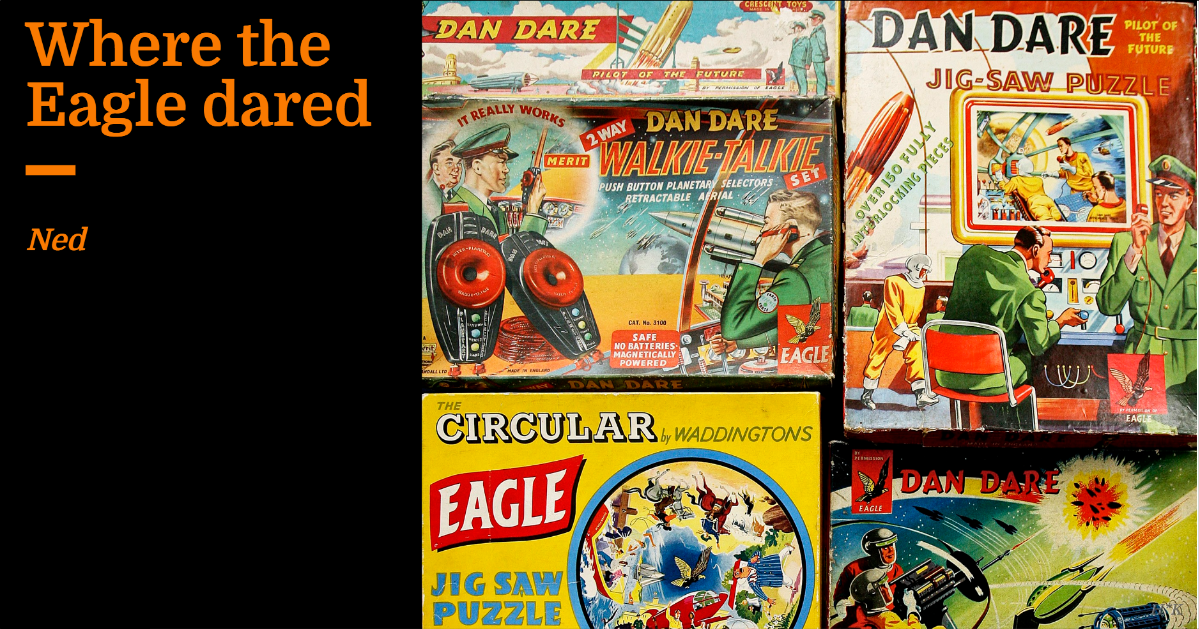
Yes, there have been profitable partnerships, but there have also been defining differences. The big one is this: we had Dan Dare (and the Germans did not). Trust me — the 70-year-old “Pilot of the Future” casts an extremely long shadow.
The brightest engineers of the post-war West German state focused on building the Wirtschaftswunder with silently purring dishwashers and internal combustion engines powering family saloons up icy alpine switchbacks (whilst our Coventry-built equivalents spluttered in the first autumn mist).
Over here, amidst the ration books and austerity, our boys were reaching for the stars and making things that went boom. Jonathan Glancey’s evocative book V-Force describes the enormous teams of engineers who designed each of the three 1950s V bombers and the nuclear weaponry they carried.
Britain’s exciting but impractical ambitions in the 1950s were perfectly captured by the comic
Glancey wryly notes that the Avro Vulcan, powered by four mighty Rolls-Royce Olympus turbojets to a ceiling of 55,000 feet, had a soup heater which took more than an hour to warm a pan. No Luftwaffe flyer would have tolerated tepid Kartoffelsuppe.
Our exciting but impractical ambitions in the 1950s were perfectly captured by the Eagle comic with its Dan Dare strip and its futuristic cutaway drawings. (Anyone remember the Nuclear-powered British Rail locomotive?) They went on to inspire the career choices of subsequent generations of British engineers.
The general consensus has been that these boys’ toys were a monumental misallocation of talent and scarce resources. Our focus on aerospace was a poor return on investment. Rolls-Royce went bankrupt in 1971 and had to be rescued by the state. Likewise, our expertise in splitting atoms never led to significant civilian dividends.
Whilst Bosch was turning out millions of labour-saving devices to liberate the Hausfrau, and Volkswagen democratised European motoring, we made just 20 supersonic Concorde jets to ferry rock stars and chat show hosts across the Atlantic.
Yet, could it be that Dan Dare, Digby and their chums are having the last laugh? German production lines are now struggling. Bosch last year announced 13,000 job losses and Volkswagen is cutting 35,000 roles. It seems that the world is no longer willing to pay such a premium for German engineering. It’s fast becoming a crisis of national identity.
Meanwhile, the successors to the companies which made the V-bombers are flying high. Shares in BAE Systems have almost quadrupled over the past five years, and Rolls-Royce is on course to become a £100 billion business.
It seems the future of European manufacturing may not be in mass production. Instead, it may lie in fiddly, low-volume, hard-to-replicate stuff exemplified by BAE’s military satellites and Royce’s giant turbo fans and miniature nuclear reactors.
Once again, we Britons can hold our heads high — even when getting a face full of snow from a passing Bavarian in Schöffel salopettes.