I forget why I bought, for a small sum, a copy of The Times dated November 30, 1914. I believe I had a vague sense that it might be useful one day. But so it has proved to be, despite its not immediately compelling appearance. It is an ungainly broadsheet (price 1d). The font is tiny: the front and back pages are taken up with small ads, and this alone, in our instant-access present, creates a presumption of trivial content within.
But the opposite is the case. Much information on undeniably important matters is packed into its 16 pages. Our Military Correspondent gives a detailed breakdown, over a column and a half, of German army strategy. Our Naval Correspondent analyses the submarine threat. The Trading with the Enemy Act (1914) receives detailed explanation. A column headed “Through German Eyes” offers a balanced account of German strategy and war finance, drawn from German newspapers. The following pages are filled with reports “From our own Correspondent” in Bombay, Copenhagen, Paris, Petrograd, Rome, and Washington; and, from “Our Special Correspondent|, in Amsterdam, Boulogne and Cairo.
There are additional un-attributed reports from Berlin, Bloemfontein, Johannesburg, Pretoria, and Santiago de Chile. A lengthy verbatim despatch from the British army commander, Sir John French, is illustrated with a map of the Western Front. “Financial and Commercial Intelligence” is detailed and international. There is even brief coverage of horse racing. But of British daily life there is almost nothing.
Even in the long shadow of 1914-18, my copy of The Times of September 4, 1939 looks little different (although now priced at 2½d.). Pages 3-4 contain careful reports of proceedings in both Houses of Parliament. Subsequent pages carry the texts of the last-minute communications with Germany, and cover domestic preparations for war. Letters to the Editor are far from jingoistic. The “Imperial and Foreign” page contains verbatim quotes from Hitler; the Editorial, in restrained language, argues that Britain and France had “no choice but to resist and overthrow him”. Foreign reporting sets out the reluctant arguments of President Roosevelt for American neutrality. The financial pages give detailed and dispassionate information. A column reports “Archbishop on Use of Defensive Force”, who is given the same space as the adjacent column on “Lesser Spotted Woodpeckers” (can this be a sub-editor’s satire?).
After 1918, shocked and disillusioned people sometimes blamed the newspapers for fictional atrocity stories and misleading propaganda that damned the enemy and encouraged and prolonged the slaughter, most notably in Arthur Ponsonby’s classic Falsehood in War-Time (1928); but however true of some papers, this description hardly fits these two issues of The Times. I turn from these careful compendia of important information to three of our own newspapers. They may remain nameless, though they are well known and highly regarded, not without cause. I blame none of their authors, or their editors. But my anthology of their headlines in recent issues includes the following guides to today’s culture:
“The best and worst supermarket hot cross buns”
“My £199 robot mower just spins around in circles and Lidl won’t fix it”
“We swapped Essex for rural Wales – and found Japanese knotweed”
“A 12m tall Wallace and Gromit in London? Cracking idea!”
“Why I swapped new year resolutions for a spring soft start – and how you can too”
“Stardew Valley at 10: the anticapitalist game that cures burnout and inspires queer art”
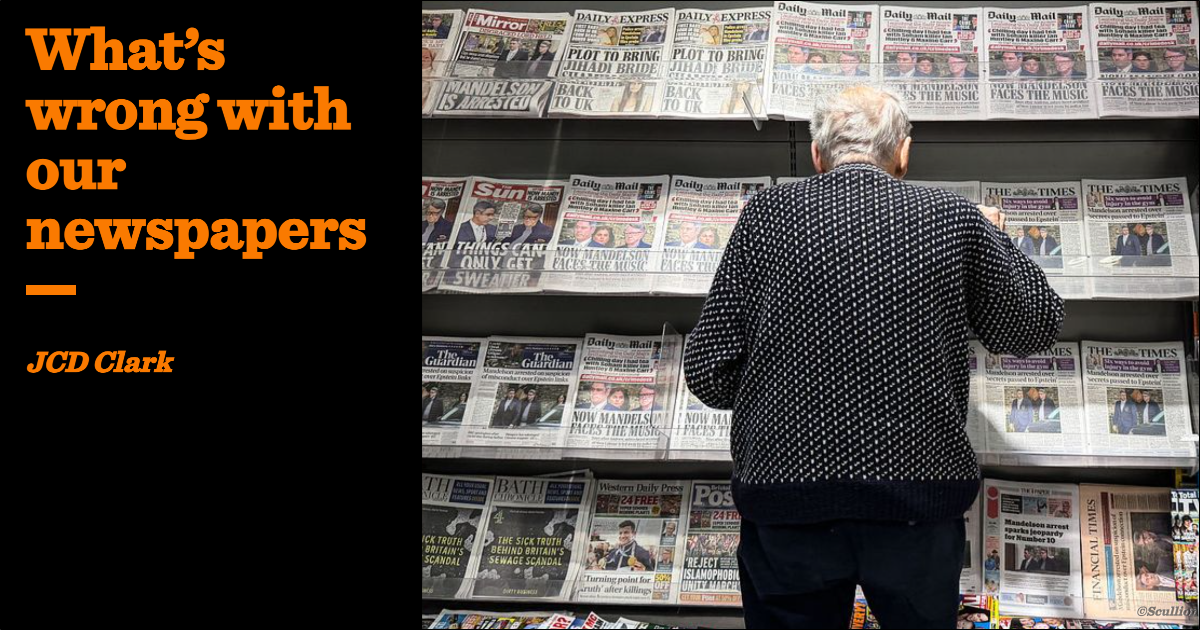
Might anyone think such writing just a touch embarrassing? Even a tad toe-curling? Might it sometimes fall just slightly short of intellectually serious? There is no point in a simple normative judgment; the point is to recognize what has happened, and to try to understand why. What distinguishes the papers of 1914 and 1939 from those of 2026? In a word, news; it is a far lesser component of what are still (perhaps only for the time being) called newspapers. But more than that: the intellectual horizons of these papers have contracted, and their content has moved steadily away from national and international events in the public realm towards subjective individual experience in the private. And this is true even in the Comment sections, where “columnists” (those post-1939 arrivals) offer ready-formed views on issues no longer reported in sufficient detail for readers to form their own.
That’s not to say that today’s papers do not contain stories that, in the right context, might sometimes be useful (they do: where indeed can I buy the best hot cross buns? But I shall pass on the other matters). Nor do these papers fail to cover violent international events (they do, and in colour; but if every picture tells a story, the pictures now increasingly replace the stories; visual images seem unarguably to identify the victims). The problem is that their large and proliferating named sections on beauty, cars, entertainment, environment, fashion, food, gardening, health, interior decorating, lifestyle, luxury, property, relationships, sport, and travel, almost wholly absent in 1914 and 1939, now crowd out so much of what is happening in the world. If you need to know (as with market information) you will now typically look to the internet. Politics? You will not read parliamentary debates.
It is more than a question of space, or speed of access. These topics from beauty to travel tend subtly to translate the papers’ coverage of difficult matters like politics, diplomacy, war and economics into their own idiom, often superficial, often uninformed about the origins and the complex detail of what is happening beyond the world’s momentary flashpoints. “Our own correspondent” now seems to sit behind a computer screen in a London high-rise office tower: the view, although striking, does not (metaphorically) reach beyond the M25. In a different age the height of Nelson’s Column was chosen so that the figure at its top could (literally) see the sea.
Even this might not matter so much, were we not on the edge of the Third World War … or have we just gone over it? Do our (news) papers give us the information on which we can judge?