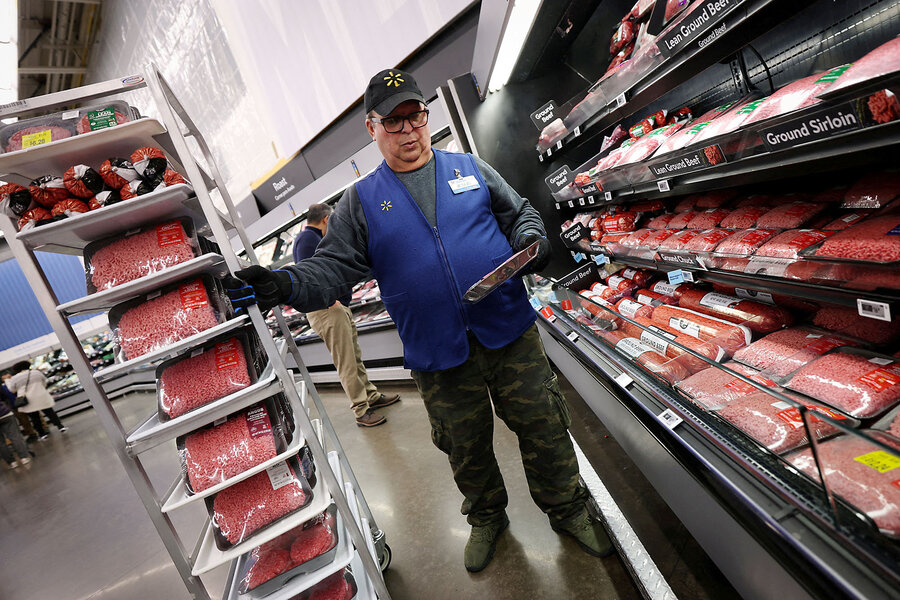
If you plan on serving roast beef at a gathering this holiday season, brace for sticker shock at the grocery store. The same goes for steaks and hamburgers as beef prices hit record highs in the United States, rattling President Donald Trump, who has vowed to bring prices down.
The average price for ground beef hit $6.30 a pound in September, up from $5.50 at the start of the year – an increase of almost 15%. As recently as May 2023, ground beef retailed for less than $5 per pound. Steak prices have risen even more sharply in recent months, hitting retailers and restaurants alike. Higher beef prices are squeezing margins at restaurant chains that have been reluctant to raise prices.
The price of beef has gotten the attention of the White House. Mr. Trump signed an executive order on Dec. 6 to examine anticompetitive behavior in food supply chains, including beef production. The Justice Department has also begun an antitrust investigation into meatpacking companies. Both measures are framed as a response to rising concerns over beef prices.
Why We Wrote This
Eye-popping prices for steaks and burgers are mostly a supply problem, exacerbated by lack of competition in the meatpacking industry. The upshot is that beef is likely to remain expensive for a while.
Polling shows that voters upset about the cost of beef and other everyday items have soured on Mr. Trump’s economic management, even as he claims that he has “crushed” inflation that spiked under his predecessor, President Joe Biden. “They caused the high prices, and we’re bringing them down,” he said in a speech in Pennsylvania on Dec. 9, referring to Democrats. The most recent monthly report from the Bureau of Labor Statistics showed inflation at 3%, above the Federal Reserve’s target rate of 2%.
Some ranchers are complaining about Mr. Trump’s trade policies, including his agreement to quadruple beef imports from Argentina and his on-off tariffs on Brazilian beef. The rollback of specific tariffs has been aimed at bringing down consumer prices. (The Brazilian tariff relief includes coffee, the price of which was up 41% in September compared with the previous year.) But most of the 28 billion pounds of beef consumed annually in the U.S., especially cuts of steak and roasts, is domestically produced.
Experts say the price of beef depends less on tweaks to the administration’s trade policy and more on the lack of competition in the meatpacking industry, which is a much knottier problem to fix and one that has eluded previous administrations. The upshot is that beef prices are likely to stay high for a while.
Why are beef prices so high?
Simply put, it’s about a lack of supply. The number of cattle being raised for slaughter in the U.S. has fallen to the lowest level since the 1950s. Ranchers cut their herds during and after the pandemic amid prolonged droughts in states such as Texas and higher feedstock costs. The total herd of beef cattle was 28.7 million in July, according to the U.S. Department of Agriculture.

Beef producers can’t respond to higher prices as quickly as consumers may wish since it takes around two years for a newborn calf to reach maturity. “I expect prices are going to remain high until we start producing more cows,” says James MacDonald, a research professor at the University of Maryland’s College of Agriculture and Natural Resources. “It takes a long time to rebuild herds.”
The suspension of Mexican cattle imports in May after an outbreak of screwworm has further restricted supply. Screwworm, a tropical parasite, was eradicated decades ago in the U.S. Reopening the border to Mexican cattle would boost supply, but would be risky unless the parasite is contained, says Professor MacDonald.
As U.S. beef production drops, the meatpacking industry has been trying to produce more beef from the cattle it slaughters. “By historic standards, we’re still producing a lot of beef. We’re just doing it with fewer cows,” Glynn Tonsor, a professor of agricultural economics at Kansas State University, told NPR.
So far, demand for beef has largely held up, despite the higher prices. Per capita consumption is forecast at 58.5 pounds this year, according to the USDA, down slightly from 2024.
What is the Trump administration doing about it?
Mr. Trump has asked his senior advisors to find more policy levers he can pull to bring down beef prices, the Wall Street Journal reported. He has consulted with trade organizations, governors of farm states, and the meat industry. His executive order directs the Justice Department and the Federal Trade Commission to examine competition in U.S. food supply chains.
Ranchers, consumer groups, and farm-state lawmakers have complained for years about anticompetitive practices in beef processing. Four major processors dominate the industry: Tyson Foods, Cargill, and two Brazil-based companies: JBS and Marfrig Global Foods. Together, they slaughter around 85% of grain-fattened cattle in the U.S.
Last month, Mr. Trump alleged on social media that foreign-owned meatpackers were colluding to manipulate U.S. beef prices, without providing details. During his first administration, the Justice Department opened an investigation into the beef industry that continued into the Biden administration. That probe recently ended, but a new one has begun into potential anticompetitive behavior, according to The Wall Street Journal.
Responding to Mr. Trump’s social media post, an industry group said in a statement that beef packers have been operating at a loss for the past year due to tight cattle supply. “U.S. beef processors welcome a fact-based discussion about beef affordability and how best to meet the needs of American consumers, who are the industry’s most important stakeholders,” Meat Institute President and CEO Julie Anna Potts said.
Do meatpackers have a monopoly?
Meatpackers say larger economies of scale allow them to produce more animal protein cheaply and that lower consumer prices stimulate demand. Critics say consolidation hurts ranchers by reducing the number of buyers for their cattle, resulting in lower prices.
Before the pandemic, meatpackers had begun to increase their profits based on what they paid for cattle and wholesale beef prices. This spread “doubled or tripled after 2016,” says Professor MacDonald, a former senior researcher at the USDA.
In December 2021, the Biden administration reported that the four largest meatpackers – of beef, chicken, and pork – had seen a 120% rise in gross profits since the pandemic began. (The companies disputed the finding.) President Biden then announced a $1 billion plan to increase competition in the sector by supporting independent meatpackers with grants and loans.
This program has led to a “significant expansion” in beef-processing capacity at a time when herds of cattle are smaller, says Professor MacDonald. “We’re back in a world of excess capacity and aggressive competition among packers to get cattle,” he says.
But the concentration of market power discourages cattle ranchers from investing because they worry about the price they’ll receive at the slaughterhouse, says Austin Frerick, an advocate for food-industry reform and author of “Barons: Money, Power, and the Corruption of America’s Food Industry.” Coupled with persistent drought that has degraded pastures and rising feed prices, it’s another reason for ranchers to hold back – and for consumer beef prices to remain high.
“We’re not seeing normal herd expansion because farmers don’t think [cattle] prices will be there, and that goes back to market dominance” among meatpackers, he says.
He’s skeptical that the Biden administration’s incentives for smaller meatpackers, which have continued under the Trump administration, will loosen the grip of the larger players, absent antitrust enforcement. “There’s never been an example in American history where you de-concentrate a market by throwing money at it,” he says.
What impact have tariffs had?
Relatively little. In July, Mr. Trump’s imposition of additional 40% tariffs on Brazilian imports led to a rally in U.S. cattle futures, since Brazil is a major beef exporter. His decision to reverse that policy last month has, in turn, sparked anger among farm groups. Similarly, his plan to raise the quota for Argentinian beef imports faced pushback from cattle ranchers worried about foreign competition.
But Argentina’s higher quota would amount to only 0.6% of U.S. beef consumption. Similarly, imports from Brazil represent only a fraction of what the U.S. imports from Canada and Mexico, which is why the screwworm outbreak in Mexico has been more consequential for U.S. beef prices.